St James's Street
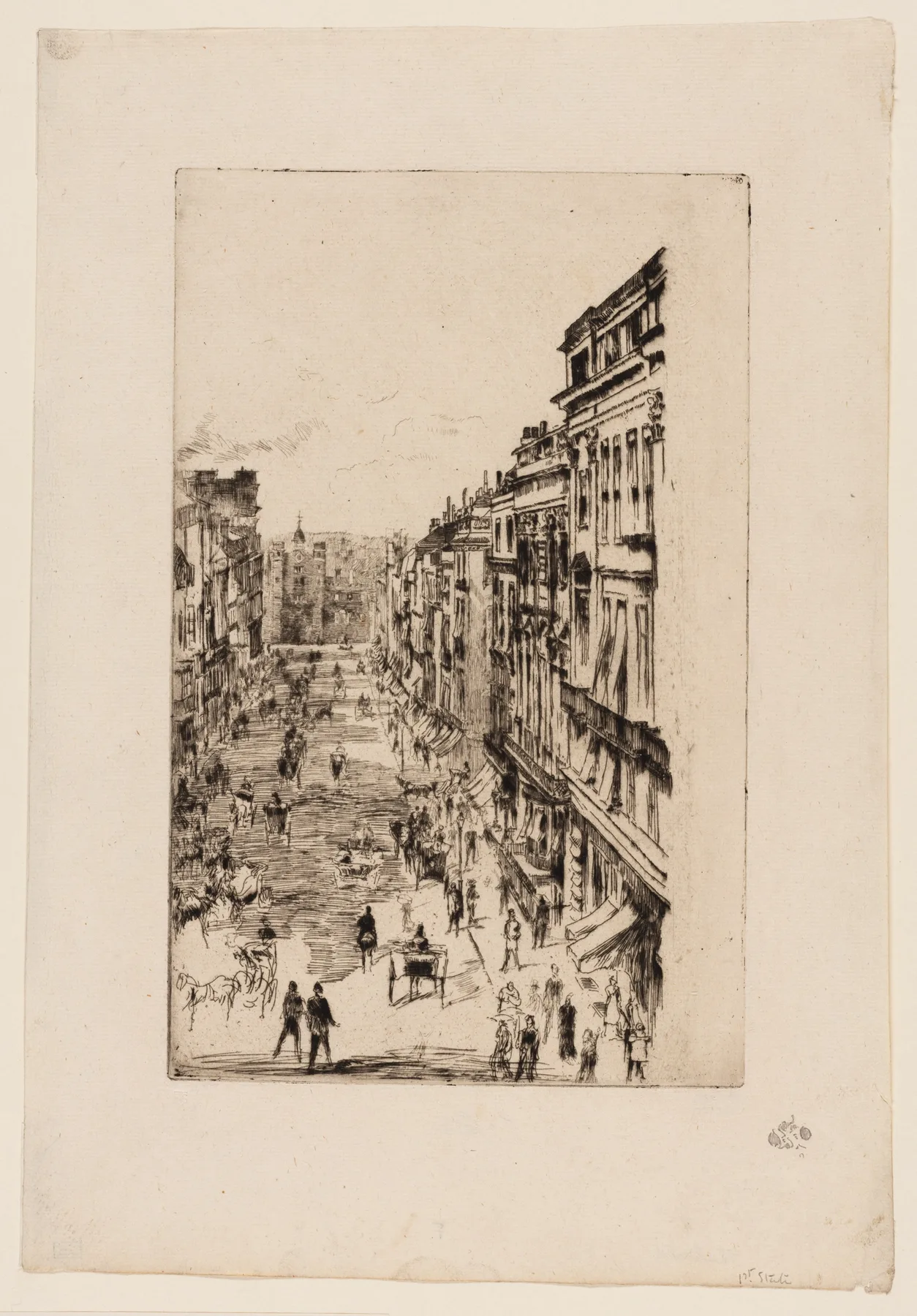
Whistler, St. James's Street, 1878. Etching in black ink on off-white laid paper.
Pins mark where to look before you draw.
The Art Institute of Chicago · Clarence Buckingham Collection
St James's Street
A street in one-point, finished where the eye goes and fading everywhere else
An 1878 etching looking down St James's Street toward the palace: tall facades converging, carriages and figures on the eye level, and a drawing that is dense near the middle and dissolves toward the edges until the margins are bare. The one-point street as Whistler draws it.
In pencilAn etched line is a drawn line. Copy it with hard grades and long points: tone from the spacing and direction of lines, cross-hatching only in the darkest third, no smudging anywhere.
- Master
- James McNeill Whistler
- Difficulty
- Time
- about 2.5 h
- You draw with
- H, HB and 2B graphite
Why this one
- One-point perspective with the vanishing point inside the sheet and visible.
- Finish concentrated around the vanishing point, falling off outward.
- Crowds as texture on the eye level.
From your kit
The whole kit →- 1Grafwood H, HB, 2B H, HB for layout and line; 2B for the darks. Long points from the Blackwing on everything up to B.
- 2Kneaded eraser and the Mono Zero press-and-lift corrections only; the Mono Zero for a single sharp light.
- 3Alpha sketchbook 9 x 6 draw at the book's size and keep the proportions; date the page.
In general, this study asks for
- Drawing pad or smooth cartridge
- 2H and H with long points
- HB for accents
- Kneaded eraser
- Sandpaper block
Watch first
All videos →A street in one point from a blank page. The Old College Wynd set-up.
YouTube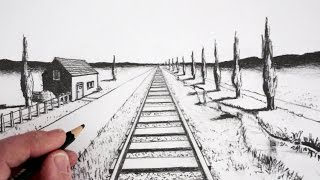
The plan
4 stages · ~105 min- 1
Eye level and vanishing point
15 minDraw the eye level through the heads. Mark the vanishing point on it where the street ends. Ghost the two kerb lines and the two cornice lines to it.
FigureEverything parallel to the street meets at one point. Checklist0 / 3 - 2
Facades by bays
40 minH: divide each facade into bays with the diagonal method, then window rows converging to the point. Draw the bays nearest the vanishing point most carefully and leave the nearest ones half-drawn, as the plate does.
FigureEqual bays in perspective by diagonals. Checklist0 / 3 - 3
The crowd and the darks
40 minHB and 2B: figures as vertical shorthand with heads on the eye level, carriages as dark boxes, the darkest accents in the middle distance. Fade everything toward the margins until the paper is bare.
FigureHeads on the line, feet tell the distance. Checklist0 / 3 - 4
Compare
10 minDoes your eye go to the vanishing point? Note, date, box.
Checklist0 / 2
What it should look like
- A street that pulls the eye into the distance.
- A drawing that is finished in the middle and bare at the edges.
- People as marks, not portraits.
Where it goes wrong
- Equal finish to the edges. The margins look empty. They are meant to. Stop drawing two inches from each edge.
Log this session
Start the clock when you pick up the pencil. Stop it when you put it down. Log it. Every session counts toward the box.
Status
How did it go?
Related studies
 Master study
Forrest · The Edinburgh closes
Old College Wynd, Edinburgh
A close in one-point perspective
3h Master study
Shotter Boys
Regent Street toward the Quadrant
A curved street, a straight facade, and the vanishing point that moves
2.5h Master study
Whistler
Old Battersea Bridge
A timber bridge drawn in full, a river drawn in fragments
2h