Sluice
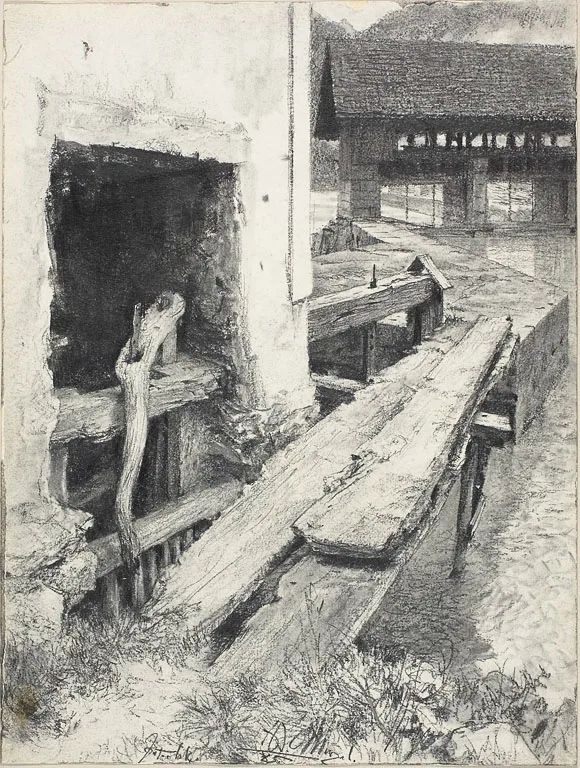
Menzel, Sluice, 1885. Graphite with stumping on ivory wove paper.
Pins mark where to look before you draw.
The Art Institute of Chicago · Mr. and Mrs. Henry C. Woods Fund
Sluice
Timber in perspective, drawn with pressure as a tool
An 1885 graphite drawing with stumping: a wooden sluice, its planks running away in perspective, a dark interior under a roof, every board's edge found. Menzel leans on the soft grades until the paper shines, then draws the edges with a hard point over them. This is the ceiling of what graphite can do.
- Master
- Adolph Menzel
- Difficulty
- Time
- about 3 h
- You draw with
- HB, 2B, 4B, 6B graphite
Why this one
- Pressure as a tool: burnished darks under hard-pencil edges.
- Planks in perspective, each a converging line, each found by looking.
- Draw what is there at the scale it is there: no approximation.
From your kit
The whole kit →- 1Grafwood HB, 2B, 4B, 6B HB for layout and line; 2B, 4B, 6B for the darks. Long points from the Blackwing on everything up to B.
- 2Kneaded eraser and the Mono Zero press-and-lift corrections only; the Mono Zero for a single sharp light.
- 3Alpha sketchbook 9 x 6 draw at the book's size and keep the proportions; date the page.
In general, this study asks for
- Drawing pad, medium tooth
- 2B, 4B, 6B with long points
- Kneaded eraser
- Precision eraser
- Slip sheet
Watch first
All videos →A street in one point from a blank page. The Old College Wynd set-up.
YouTube
The plan
4 stages · ~145 min- 1
Perspective of the planks
25 minHB: the eye level, the vanishing point, and every plank edge as a line converging to it. Count the planks on the plate and draw that many, with the gaps widening toward you.
FigureEvery plank edge meets at one point. Checklist0 / 3 - 2
Menzel's darks
50 min4B then 6B: the interior under the roof, pressed harder than you have ever pressed, then stumped, then pressed again, until it is black. Lighter pressure as you come out toward the light.
FigureFrom feather to full. Checklist0 / 2 - 3
Hard edges over soft tone
60 minHB, needle point: over the burnished tone, draw the edges of the planks, the roof, the posts, hard and exact. Where the plate's edge is lost, leave it lost. Mid-tones layered with the 2B.
FigureHard edges where it counts. Checklist0 / 3 - 4
Compare
10 minNote, date, box.
Checklist0 / 2
What it should look like
- A structure you could step onto.
- Darks that are nearly black and slightly shiny.
- Edges you can feel.
Where it goes wrong
- Fear of pressing. Every other study said layer, not press. Menzel is the exception. Press, in the darks only, and put a hard edge over it.
Log this session
Start the clock when you pick up the pencil. Stop it when you put it down. Log it. Every session counts toward the box.
Status
How did it go?