The choirstalls in Mainz Cathedral
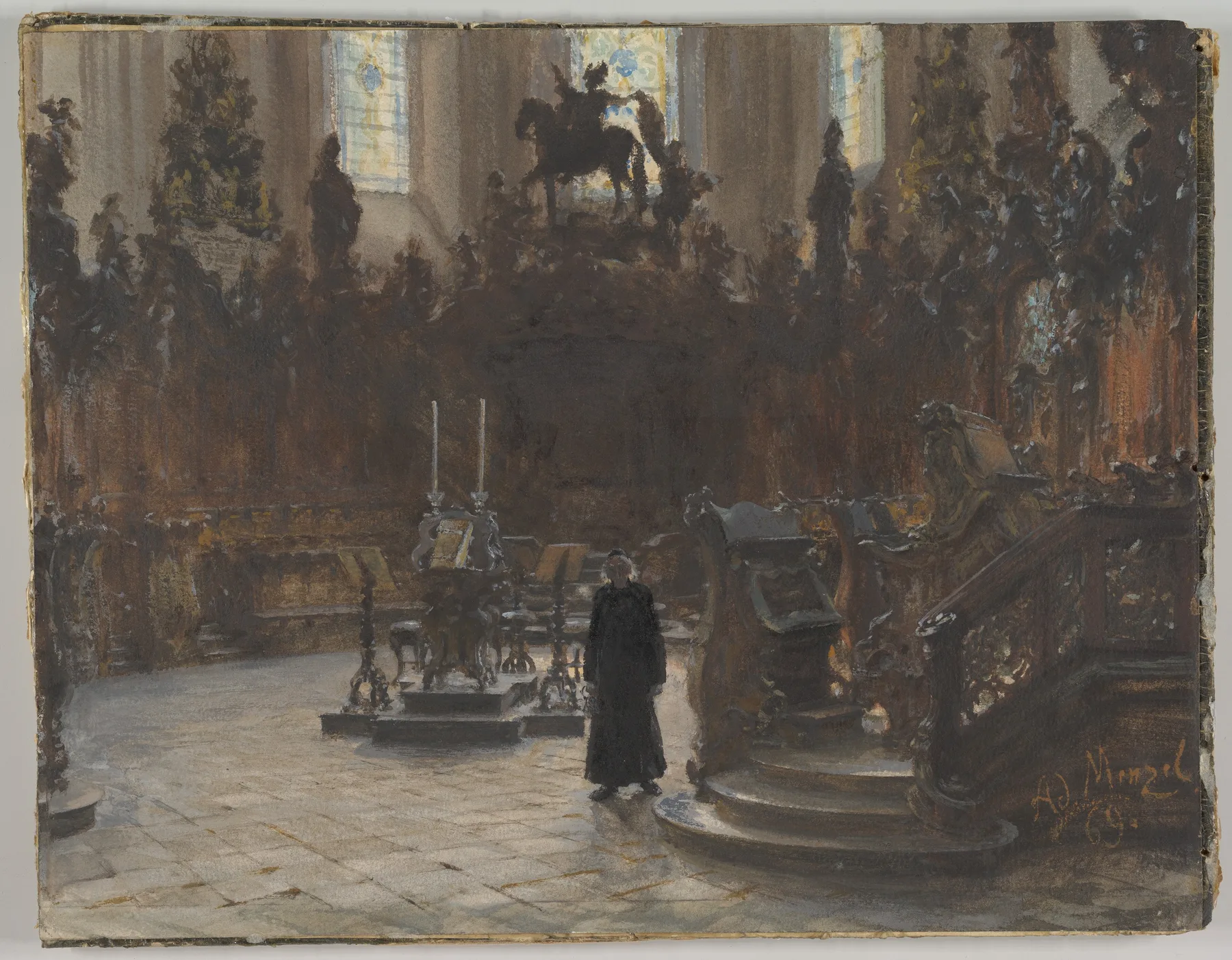
Menzel, The Choirstalls in the Mainz Cathedral, 1869. Watercolor and gouache (with gum arabic); framing lines in graphite.
Pins mark where to look before you draw.
The Metropolitan Museum of Art · Purchase, 2006 Benefit Fund, 2007
The choirstalls in Mainz Cathedral
A dark interior with one window of light, translated to graphite
An 1869 watercolour and gouache of the carved choirstalls, a cleric in black, windows above pouring light into a dark room. Menzel's interiors are the best place to learn the order of values indoors: window, then whatever the window hits, then everything else, then the figure.
In pencilColour becomes value: squint until the gilt and the wood become steps of grey. Lay the room as masses with the side of the lead, lift the window and the lit floor, and keep the carving as texture only in the light.
- Master
- Adolph Menzel
- Difficulty
- Time
- about 2.5 h
- You draw with
- 2B, 4B, 6B graphite on their sides, kneaded eraser
Why this one
- The value order of an interior: light source first.
- Carving as a texture inside a dark mass, caught only where the light falls.
- A single dark figure as the key the room is tuned to.
From your kit
The whole kit →- 1Grafwood 2B, 4B, 6B 2B, 4B, 6B for the darks, on their sides for mass. Long points from the Blackwing on everything up to B.
- 2Pitt Matt 8B to 12B for the big tone passages: matt, so the dark mass reads as tone, not shine.
- 3Kneaded eraser (warm it) and the clean Mono Zero lift the lights out of the mass; the Mono Zero for sky holes and lit edges.
- 4Alpha sketchbook 9 x 6 draw at the book's size and keep the proportions; date the page.
In general, this study asks for
- Drawing pad, medium tooth
- 2B, 4B, 6B with long points
- Kneaded eraser
- Precision eraser
- Slip sheet
Watch first
All videos →Squinting, value scales and why beginners under-read darks.
YouTube
The plan
4 stages · ~105 min- 1
Order the values
10 minWindow, lit floor, lit carving, walls, stalls, figure: say them in order from light to dark. Thumbnail in four steps.
FigureNine steps; you need four. Checklist0 / 2 - 2
The room as masses
35 min4B on its side: the whole room at a middle-dark, the stalls darker, the window left as paper, the lit floor lifted. No carving yet.
FigureGroup the room into four. Checklist0 / 3 - 3
Texture in the light, figure last
50 min2B point: the carving's texture only where the light rakes it. 6B: the figure, blackest, with a hard edge against the lit floor and a lost edge against the dark stalls.
FigureTexture where light meets form. Checklist0 / 3 - 4
Compare
10 minNote, date, box.
Checklist0 / 2
What it should look like
- A dark room with one source of light.
- Carving you see only where it is lit.
- A black figure that anchors everything.
Where it goes wrong
- Carving drawn everywhere. It is all there. In shadow it is a flat dark. Texture lives in the light.
Log this session
Start the clock when you pick up the pencil. Stop it when you put it down. Log it. Every session counts toward the box.
Status
How did it go?
Before this, ideally