A Byzantine column capital
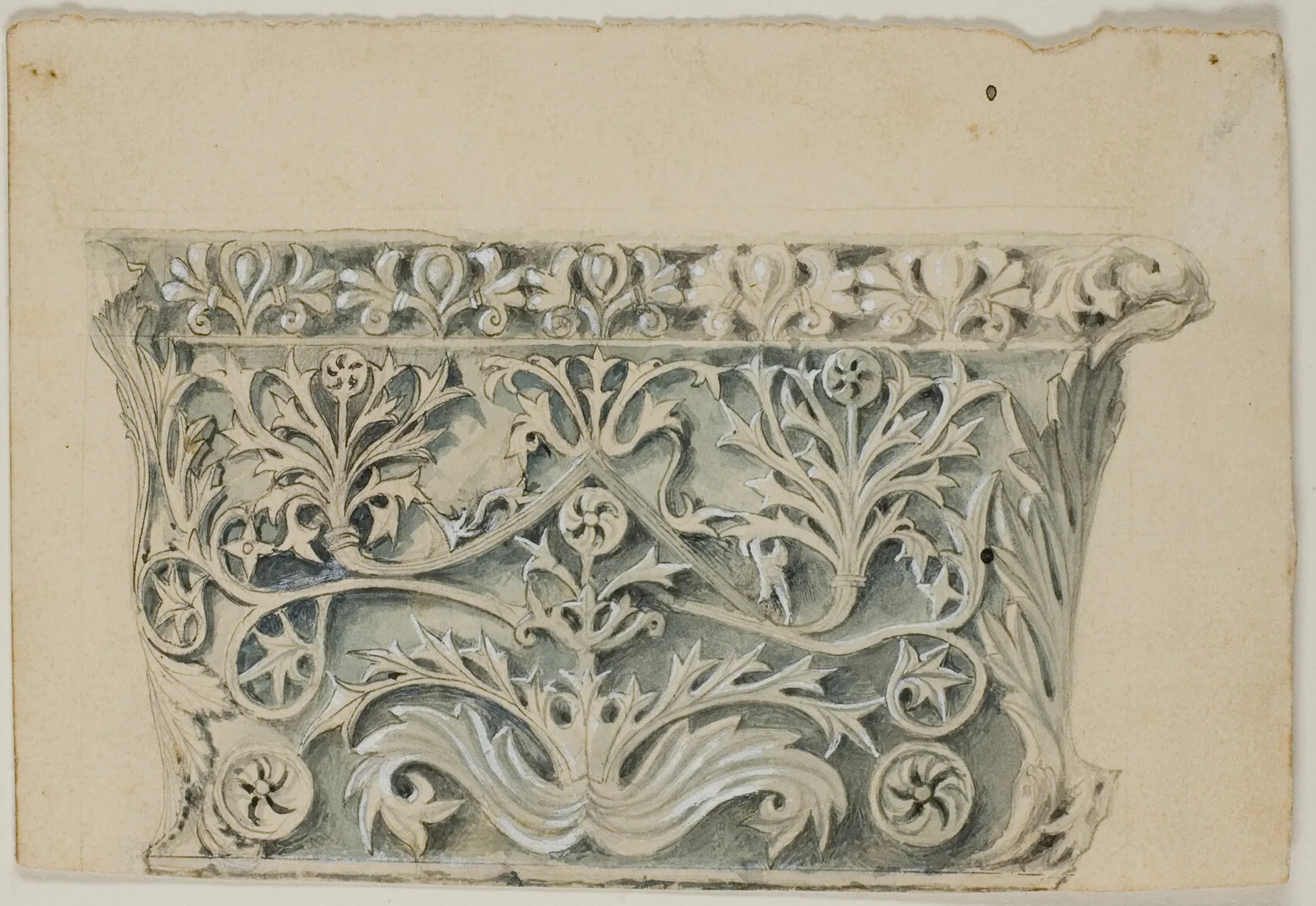
Ruskin, Byzantine Column Capital, n.d.. Pen and black ink, with brush and gray wash and white gouache, over traces of graphite, on cream wove paper.
Pins mark where to look before you draw.
The Art Institute of Chicago · Gift of Mrs. Chauncey McCormick
A Byzantine column capital
One fragment, drawn until it is understood
A single carved capital, leaves and volutes, drawn close and whole with the shadow under every undercut. Ruskin's method in one sheet: not the building, not the facade, one capital, all the way to understanding.
- Master
- John Ruskin
- Difficulty
- Time
- about 2 h
- You draw with
- H, HB, 2B graphite
Why this one
- The fragment method: draw one thing completely before you draw a facade.
- Carving as light and shadow on a curved surface.
- Even, slow shading laid with a point: Ruskin's 'skin of tone'.
From your kit
The whole kit →- 1Grafwood H, HB, 2B H, HB for layout and line; 2B for the darks. Long points from the Blackwing on everything up to B.
- 2Kneaded eraser and the Mono Zero press-and-lift corrections only; the Mono Zero for a single sharp light.
- 3Alpha sketchbook 9 x 6 draw at the book's size and keep the proportions; date the page.
In general, this study asks for
- Drawing pad or smooth cartridge
- 2H and H with long points
- HB for accents
- Kneaded eraser
- Sandpaper block
Watch first
All videos →Squinting, value scales and why beginners under-read darks.
YouTube
The plan
4 stages · ~110 min- 1
The block
15 minH: the capital as a block, its top ellipse, its bottom circle, the overhang. Measure height against width.
FigureA moulding is a profile in light. Checklist0 / 2 - 2
The carving as masses
35 minLeaves and volutes as simple masses on the block, each with a lit side and a shadow side. No veins, no edges yet.
FigureOne light. Checklist0 / 2 - 3
Ruskin's skin of tone
50 minHB, then 2B, with a point: lay the shadow sides as a slow, even skin of fine lines, layer on layer, never pressing. The undercuts last, with the 2B. The lit tops stay paper.
FigureLayers, not pressure. Checklist0 / 3 - 4
Compare
10 minNote, date, box.
Checklist0 / 2
What it should look like
- A carved object you could pick up.
- Tone with no visible pressure, only patience.
- The darkest line under the deepest cut.
Where it goes wrong
- Outlining every leaf. Carving looks like lines. Carving is light and shadow. Draw the shadow and the leaf appears.
Log this session
Start the clock when you pick up the pencil. Stop it when you put it down. Log it. Every session counts toward the box.
Status
How did it go?
Before this, ideally