Architecture
LineCast shadows on buildings
Shadows follow the profile of what casts them and step where the wall plane changes. One sun, one angle, everywhere. Two shadows that disagree collapse the building.
A buttress in sunlight casts a shadow on the wall beside it, and that shadow's edge follows the buttress's own profile: it steps where the buttress steps, slopes where the buttress slopes. Where the wall it falls on changes plane (a string course projects, a recess goes back) the shadow jogs. Cast shadows are the cheapest way to show that a wall has depth and the sun has a direction.
Keep one angle. Before you begin, draw the light arrow in the margin and give it a number, say 45 degrees from upper left. Every cast shadow on the building falls at that angle. The moment two shadows disagree, the eye knows something is wrong even if the viewer cannot say what.
Cast shadows are darkest and sharpest at the point of contact and soften slightly as they travel. On a sunny day they are usually a value darker than the shadow side of the form that casts them, because they receive no reflected light from the sky.
From your kit
The whole kit →- 1Grafwood 2B and 4B shadow shapes laid flat first, then their edges sharpened or lost.
- 2Mono Zero the lit sliver where a shadow stops short of an edge.
Visuals
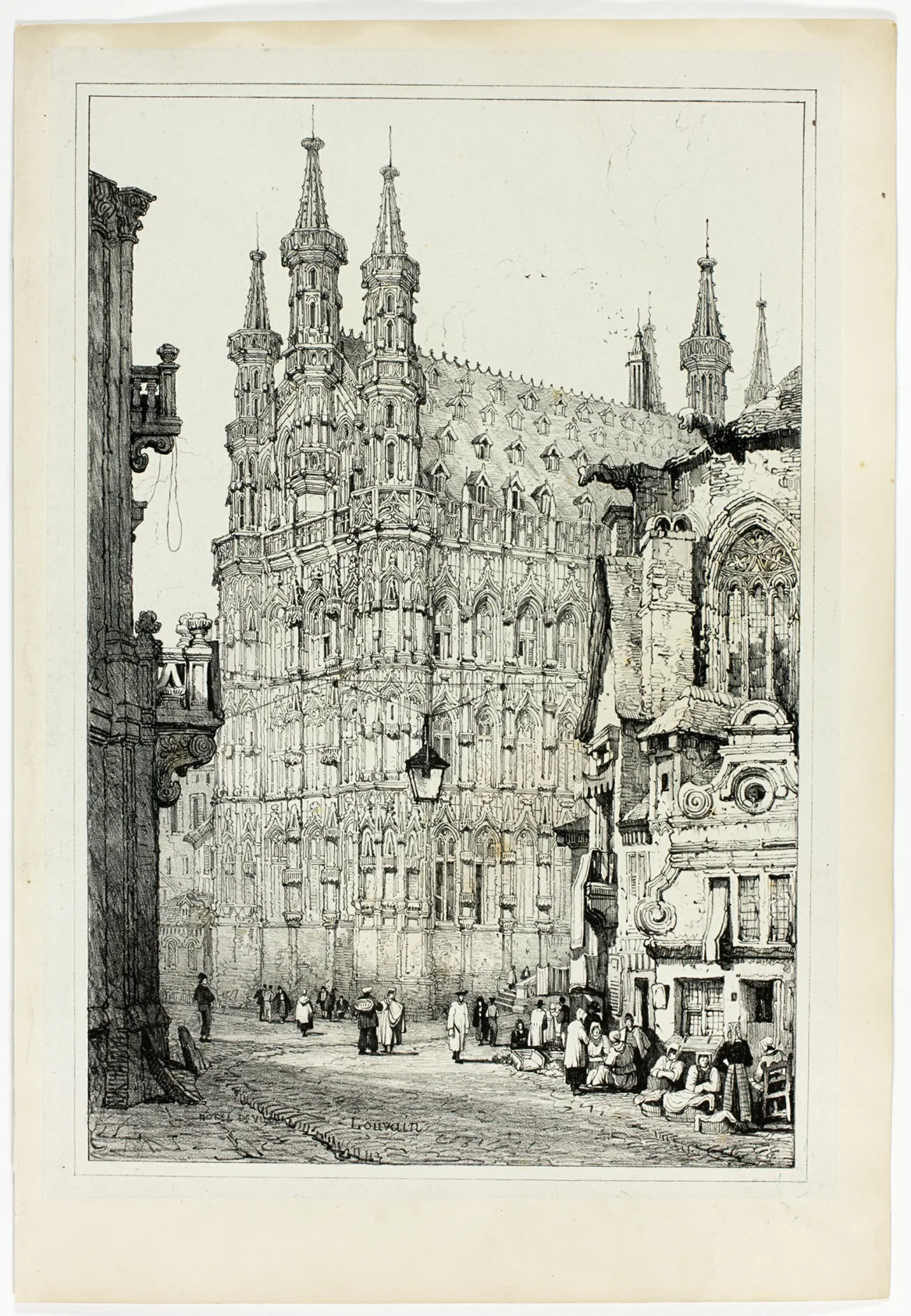
Prout, Hotel de Ville, Louvain, from Facsimiles of Sketches made in Flanders and Germany, 1833. Lithograph in black on grayish-ivory chine, laid down on ivory wove paper.
Prout, Hotel de Ville, Louvain. The deep shadows under every projecting canopy and cornice all fall the same way.
The Art Institute of Chicago · The Leonora Hall Gurley Memorial Collection
Pitfalls
What
Cast shadows the same value as the shadow side of the form.
Why
The two merge and the projection disappears.
Fix
Cast shadow one step darker, sharpest at the contact.