The ruin's silhouette
One big stable mass with its top bitten off. Some voids show sky, some show dark. Vegetation softens the base. The skyline does the storytelling.
A ruined abbey or castle is the perfect drawing problem because it is geometry, mass, texture and silhouette at once. Start with the silhouette, because that is what makes it a ruin: a large, stable, mostly rectangular mass whose top edge has been broken into an irregular skyline. Draw that skyline against the sky as a negative shape, carefully. It is the most important line in the drawing.
Then the voids. A ruin's windows and arches no longer have glass or rooms behind them, so some show sky through them (light) and some show the dark interior of a standing wall (dark). Never all the same. Then the coursing (suggested), the vegetation that softens the base and grows from the wall tops, and the fallen stone on the ground.
Cotman's Normandy castle, Prout's Norham, Forrest's Dryburgh and Melrose: in each, the broken skyline tells you everything before you have read a single stone.
From your kit
The whole kit →- 1Grafwood HB and 2B, broken line the silhouette is one stable mass with a broken top edge.
- 2Pitt Matt 8B the dark voids that show interior, against the paper voids that show sky.
Visuals
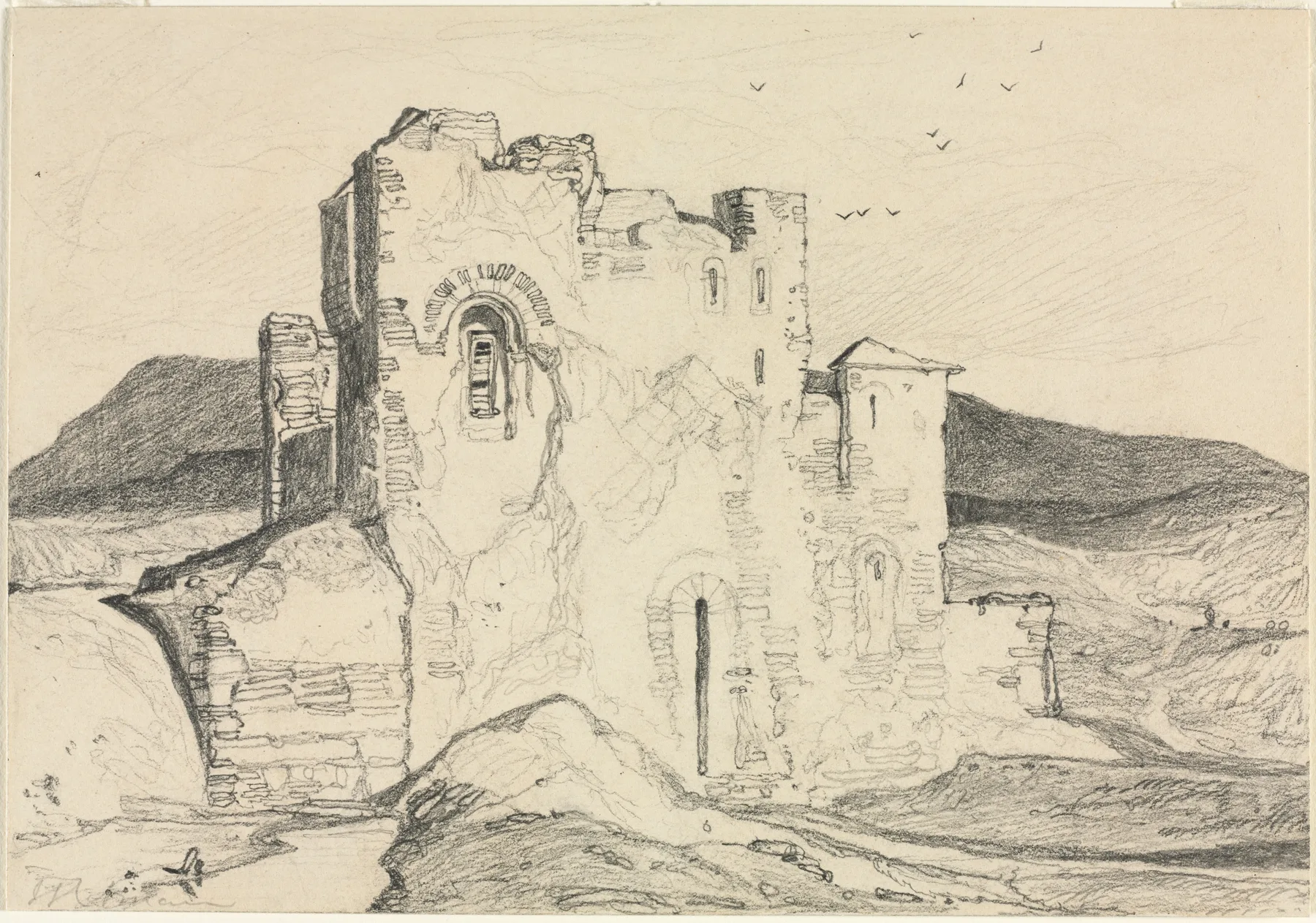
Cotman, A Castle in Normandy, c. 1800–1842. graphite.
Cotman, A Castle in Normandy (graphite). The keep's broken top edge is drawn with more care than anything else on the sheet.
The Cleveland Museum of Art · Dudley P. Allen Fund
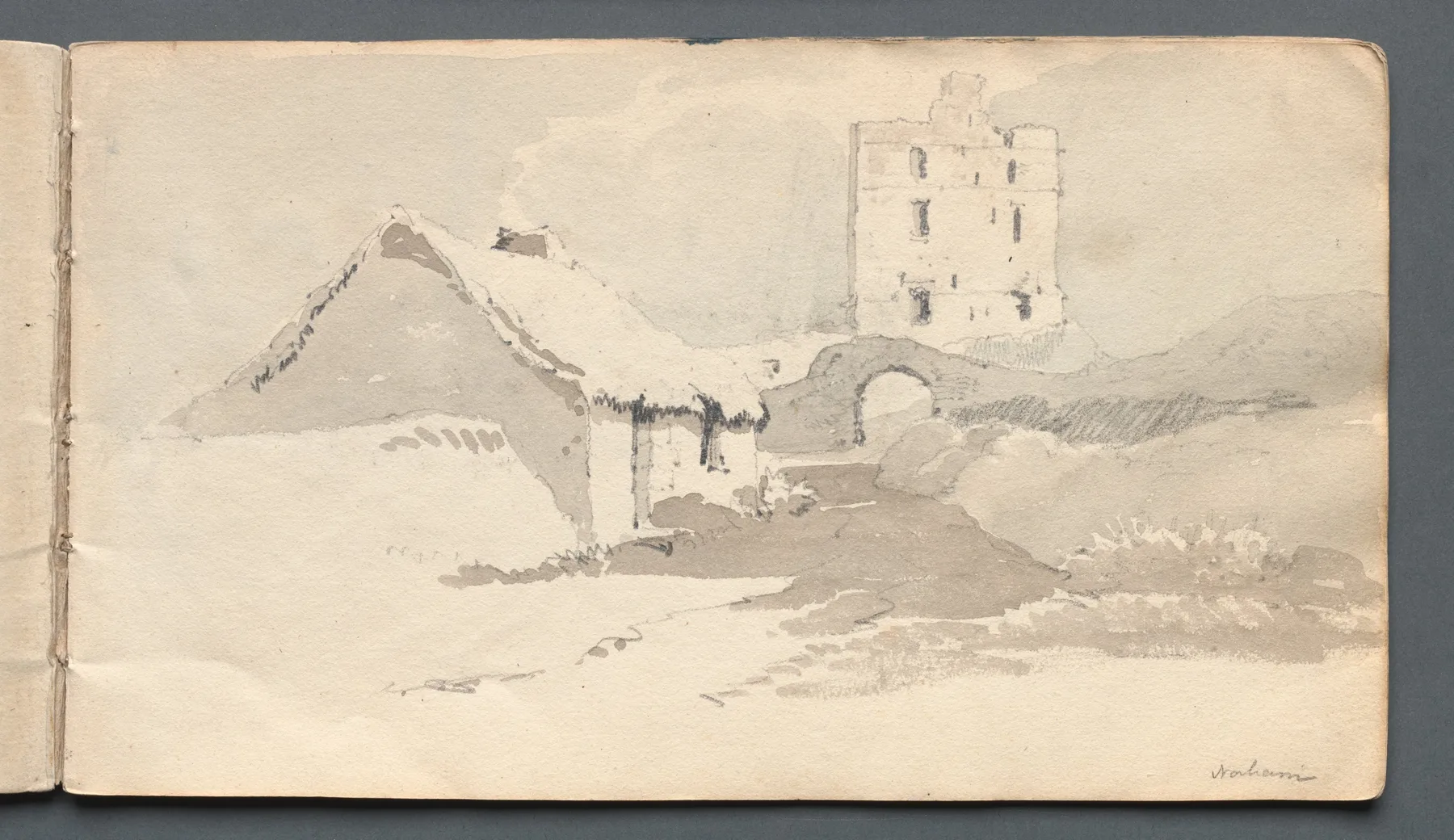
Prout, Sketchbook: Norham, 1814. graphite with gray and brown wash.
Prout, Sketchbook: Norham (1814). A ruined Borders castle on its hill, pencil and a little wash, the silhouette first and the rest left open.
The Cleveland Museum of Art · Gift of Mr. and Mrs. Herbert N. Bier, London
Pitfalls
What
Every void drawn the same dark.
Why
The ruin reads as a facade with black windows, not as a broken shell.
Fix
Decide for each opening whether sky or wall is behind it. Mix them.