La Cervara, the Roman Campagna
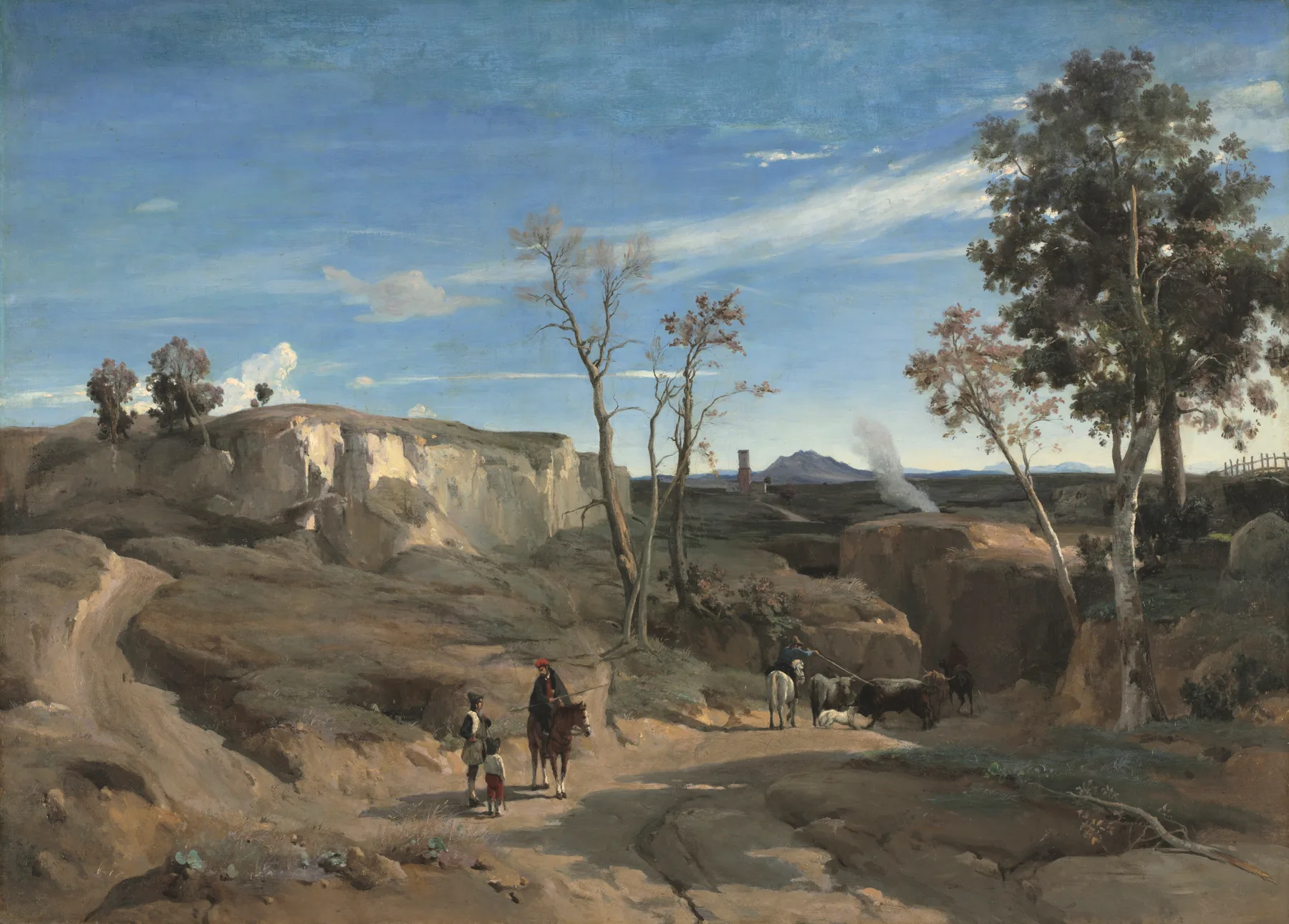
Corot, La Cervara, the Roman Campagna, c. 1830–31. oil on fabric.
Pins mark where to look before you draw.
The Cleveland Museum of Art · Leonard C. Hanna Jr. Fund
La Cervara, the Roman Campagna
The three divisions of light, in paint
A valley in the Campagna south of Rome, painted around 1830 to 1831 from studies made on the first Italian trip: pale mountains, a halftone valley with a river bend, and a dark near slope. It is Corot's three divisions of light laid out like a diagram. You will not paint it. You will squint it to three values and draw those.
In pencilA painting studied in graphite: toggle the 3-value view on the plate, draw the three flat shapes with the side of the pencil, no lines, no detail. The point is the design, not the picture.
- Difficulty
- Time
- about 1.5 h
- You draw with
- 2B, 4B, 6B graphite on their sides
Why this one
- It is the clearest three-zone landscape in the catalogue.
- Working from a painting forces you to read value through colour, which is the skill the phone's greyscale setting cannot teach you.
From your kit
The whole kit →- 1Grafwood 2B, 4B, 6B 2B, 4B, 6B for the darks, on their sides for mass. Long points from the Blackwing on everything up to B.
- 2Pitt Matt 8B to 12B for the big tone passages: matt, so the dark mass reads as tone, not shine.
- 3Kneaded eraser (warm it) and the clean Mono Zero lift the lights out of the mass; the Mono Zero for sky holes and lit edges.
- 4Alpha sketchbook 9 x 6 draw at the book's size and keep the proportions; date the page.
In general, this study asks for
- Copier paper and drawing pad
- 2B, 4B, 6B on their sides
- Kneaded eraser
- Viewfinder cards
- Phone set to greyscale
Watch first
All videos →Two- and three-value notan, the exact exercise the Mass studies start with.
YouTube Train your eyes to see valuesProko · Squinting, value scales and why beginners under-read darks.
 Aerial perspective tutorialWindy Lampson · Five hills, five values, in graphite.
 Documentaire sur Corot: la peinture de paysage en révolutionCanal Éducatif à la Demande · The best full documentary on Corot available free. French narration; turn on auto-translated captions.
The plan
3 stages · ~60 min- 1
Three values, two inches
10 minToggle the 3-value view. On copier paper, a two-inch rectangle: three flat shapes, side of the pencil, no lines. Three minutes. Do it twice more.
FigureThree is Corot's working number. Checklist0 / 1 - 2
Enlarge to a half sheet
40 minEnlarge the best thumbnail. Lay the far zone first (2B feather), then the mid (2B and 4B), then the near (4B and 6B). Keep each zone inside its range. Soften the far edges with a pass of the side of the pencil.
FigureEach zone its own range. The far never borrows a dark. Checklist0 / 2 - 3
Audit
10 minSquint at the plate and at your sheet. Same three shapes? If a dark crept into the distance, lift it.
Checklist0 / 2
What it should look like
- A three-zone landscape that reads at arm's length as pale, mid, dark.
Where it goes wrong
- Drawing the river and the shrubs. Detail is comfortable. Side of the pencil only. If it has an edge you drew with the point, erase it.
Log this session
Start the clock when you pick up the pencil. Stop it when you put it down. Log it. Every session counts toward the box.
Status
How did it go?
Before this, ideally
Related studies
 Master study
Corot · Oil studies, read as value
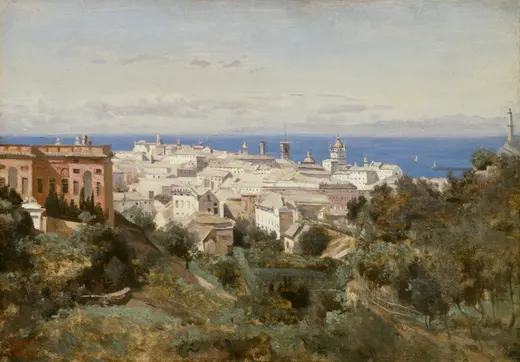
View of Genoa
A whole city as four values
2h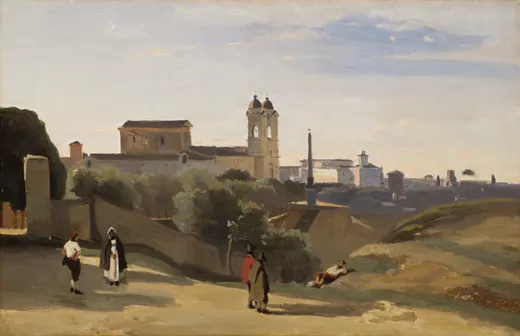 Master study
Corot · Oil studies, read as value
Monte Pincio, Rome
Architecture as a light shape against sky
2h- Foundation
Corot · Unit 3
The three divisions of light
Copy the structure of Bent Tree by the Water, then build your own
1h