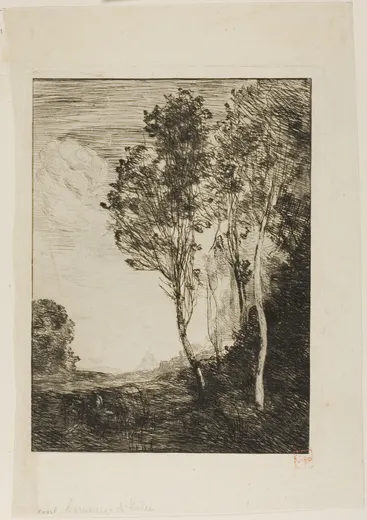
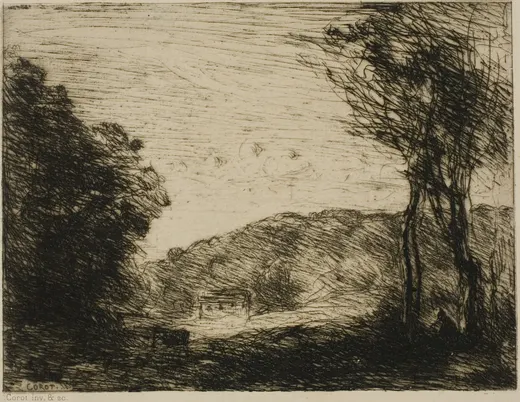
In the Dunes: Souvenir of the Woods of The Hague
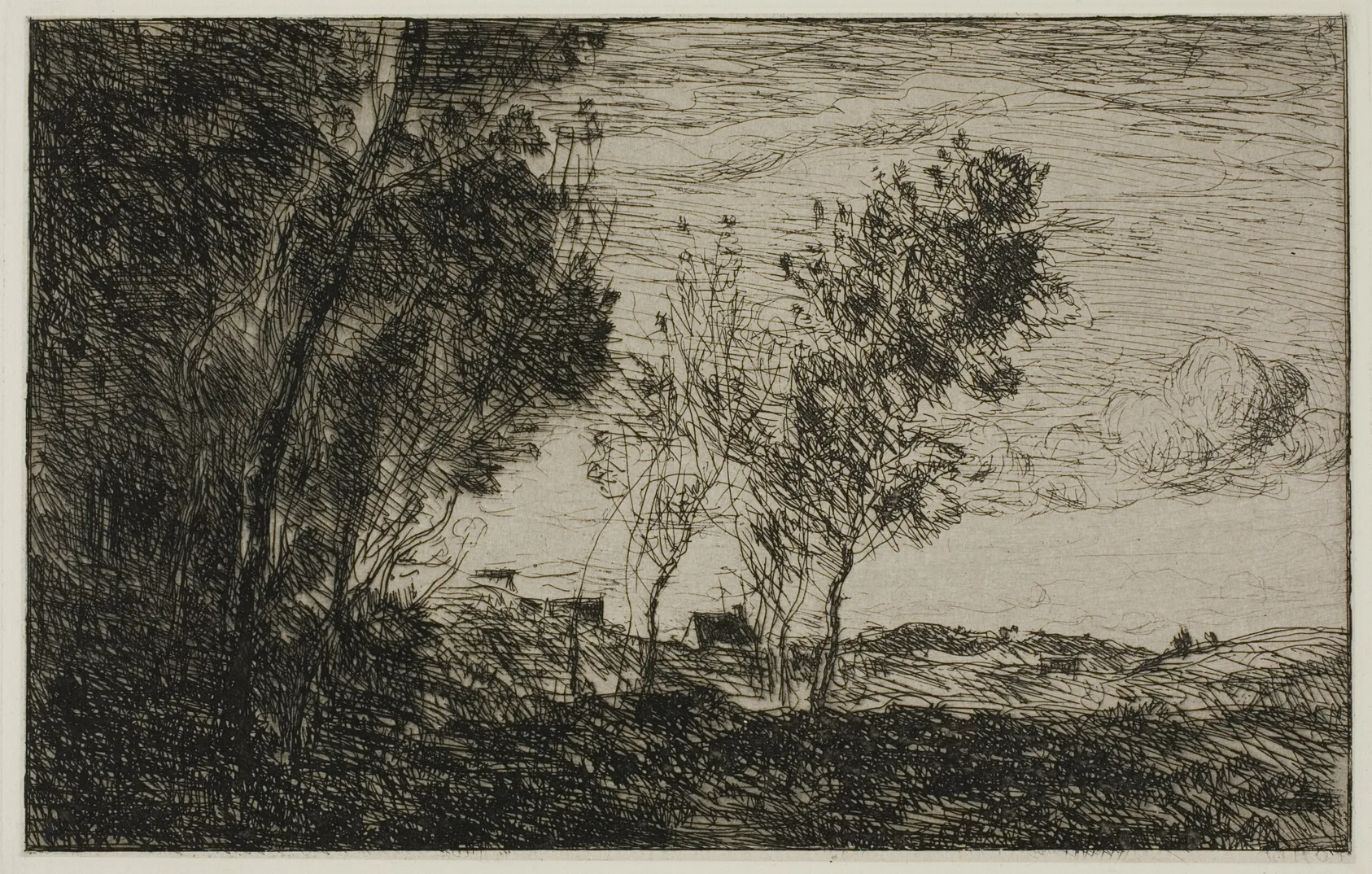
Corot, In the Dunes: Souvenir of the Woods of the Hague, 1869. Etching on ivory laid paper laid down on ivory laid paper (chine collé).
Pins mark where to look before you draw.
The Art Institute of Chicago · The Charles Deering Collection
In the Dunes: Souvenir of the Woods of The Hague
A Dutch memory, Corot's last etching
1869, from a visit to Holland fifteen years earlier: a wood on dunes, low light, long horizontal strokes for the ground, trees as dark masses against a pale sky. Among the last of his etchings and the loosest. A good plate for learning how little a landscape needs.
- Difficulty
- Time
- about 2.5 h
- You draw with
- H, HB and 2B graphite
Why this one
- Ground as long horizontal hatch: the simplest ground plane in the catalogue.
- Loose foliage that still reads as mass when squinted.
From your kit
The whole kit →- 1Grafwood H, HB, 2B H, HB for layout and line; 2B for the darks. Long points from the Blackwing on everything up to B.
- 2Kneaded eraser and the Mono Zero press-and-lift corrections only; the Mono Zero for a single sharp light.
- 3Alpha sketchbook 9 x 6 draw at the book's size and keep the proportions; date the page.
In general, this study asks for
- Drawing pad or smooth cartridge
- 2H and H with long points
- HB for accents
- Kneaded eraser
- Sandpaper block
Watch first
All videos →Permission to be loose. Watch the side-of-the-stick strokes.
YouTube
The plan
3 stages · ~105 min- 1
Two masses
15 minThumbnail: trees as two dark masses, ground as one halftone, sky as paper.
Checklist0 / 1 - 2
Ground in long lines
30 minHorizontal strokes from the shoulder across the whole ground, one layer, slightly closer under the trees.
Checklist0 / 1 - 3
Trees loose but grouped
60 minOpen scribbled hatch for the foliage, but keep each clump's silhouette. Trunks last. Squint often.
Checklist0 / 2
What it should look like
- A loose wood on a flat ground that reads as two masses over one plane.
Where it goes wrong
- Foliage so loose it loses its silhouette. Scribble without a boundary. Draw the clump outline faintly first; scribble inside it.
Log this session
Start the clock when you pick up the pencil. Stop it when you put it down. Log it. Every session counts toward the box.
Status
How did it go?
Before this, ideally