Mass
MassThe receding ground
Near ground: darker, more texture, more contrast. Far ground: a pale flat wash. A cast shadow glues everything to it. Without one, things float.
The ground is a plane that goes away from you, and it has to be drawn going away. In daylight it is usually lighter than the uprights on it (it faces the sky), but within itself it grades: nearest to you it shows the most texture and contrast (grass blades, stones, ruts), and as it recedes it smooths and lightens toward the value of the distance. A few marks of texture in the near foreground and nothing in the far field is enough to lay the whole plane down.
Everything that stands on the ground casts a shadow on it, and that shadow is what anchors the thing. A tree with no cast shadow floats. A building with no cast shadow is a stage flat. The shadow is darkest and sharpest at the contact point and softens as it moves away.
Draw the ground's texture with strokes that lie along the plane: horizontal or receding, never vertical. Vertical marks on the ground read as things standing on it.
From your kit
The whole kit →- 1Pitt Matt 6B to 12B, on their sides mass is laid, not drawn; matt graphite reads as tone, not shine.
- 2Kneaded eraser, warmed, plus the clean Mono Zero the lights are lifted out of the mass, not left.
- 3Grafwood 4B, long point the one accent inside the mass: a trunk, a dark doorway.
Visuals
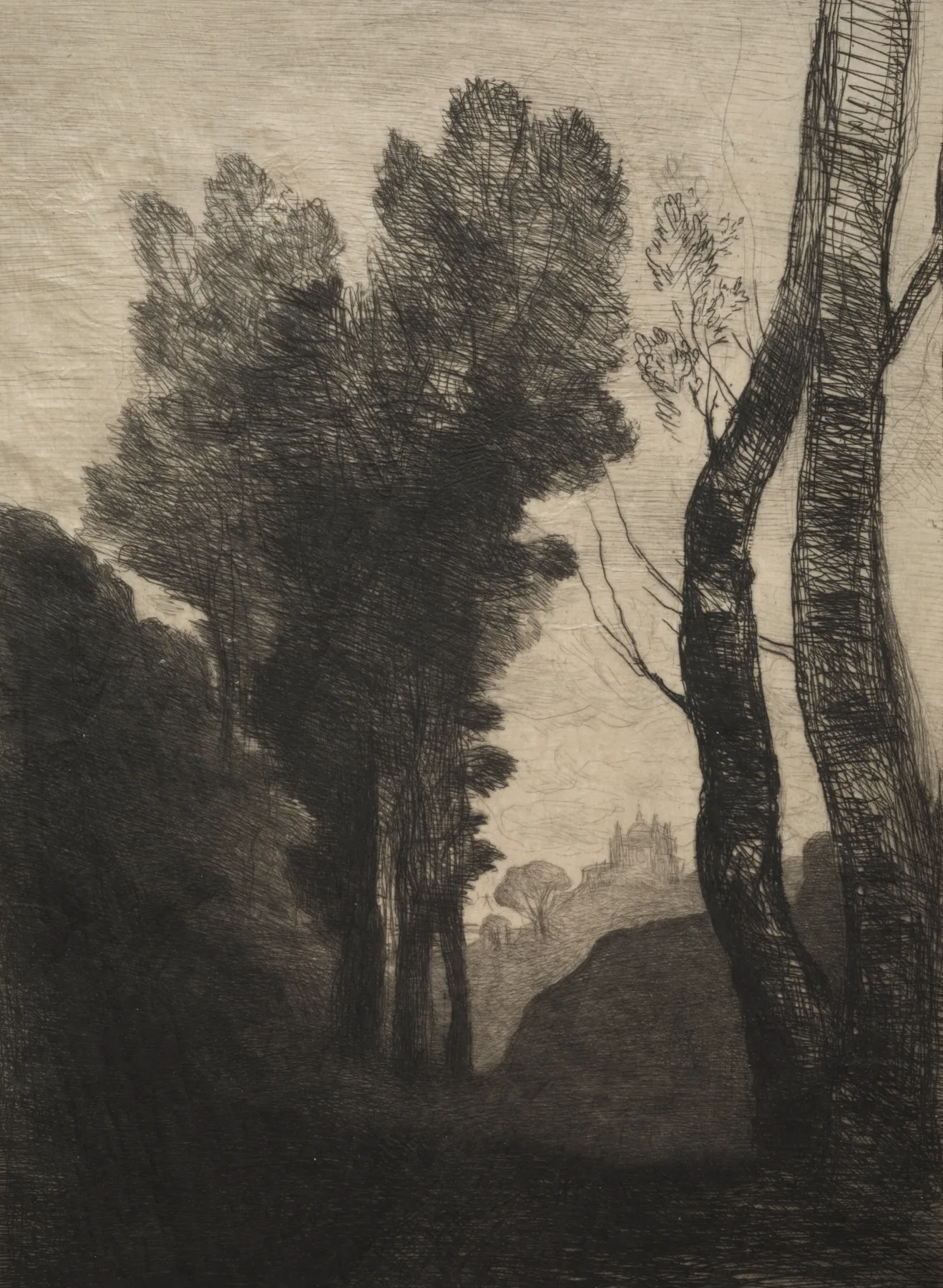
Corot, Environs of Rome, 1866. etching.
Corot, Environs of Rome. The dark near ground has strokes and weight; the plain beyond is a pale wash; the trees are anchored by shadow at their feet.
The Cleveland Museum of Art · Gift of Frederick Keppel and Co., Inc., The Frederick Keppel Memorial
Pitfalls
What
Even texture across the whole ground.
Why
The plane stops receding and stands up like a wall.
Fix
Texture in the nearest third only. Erase the rest to flat tone.