View of Marino
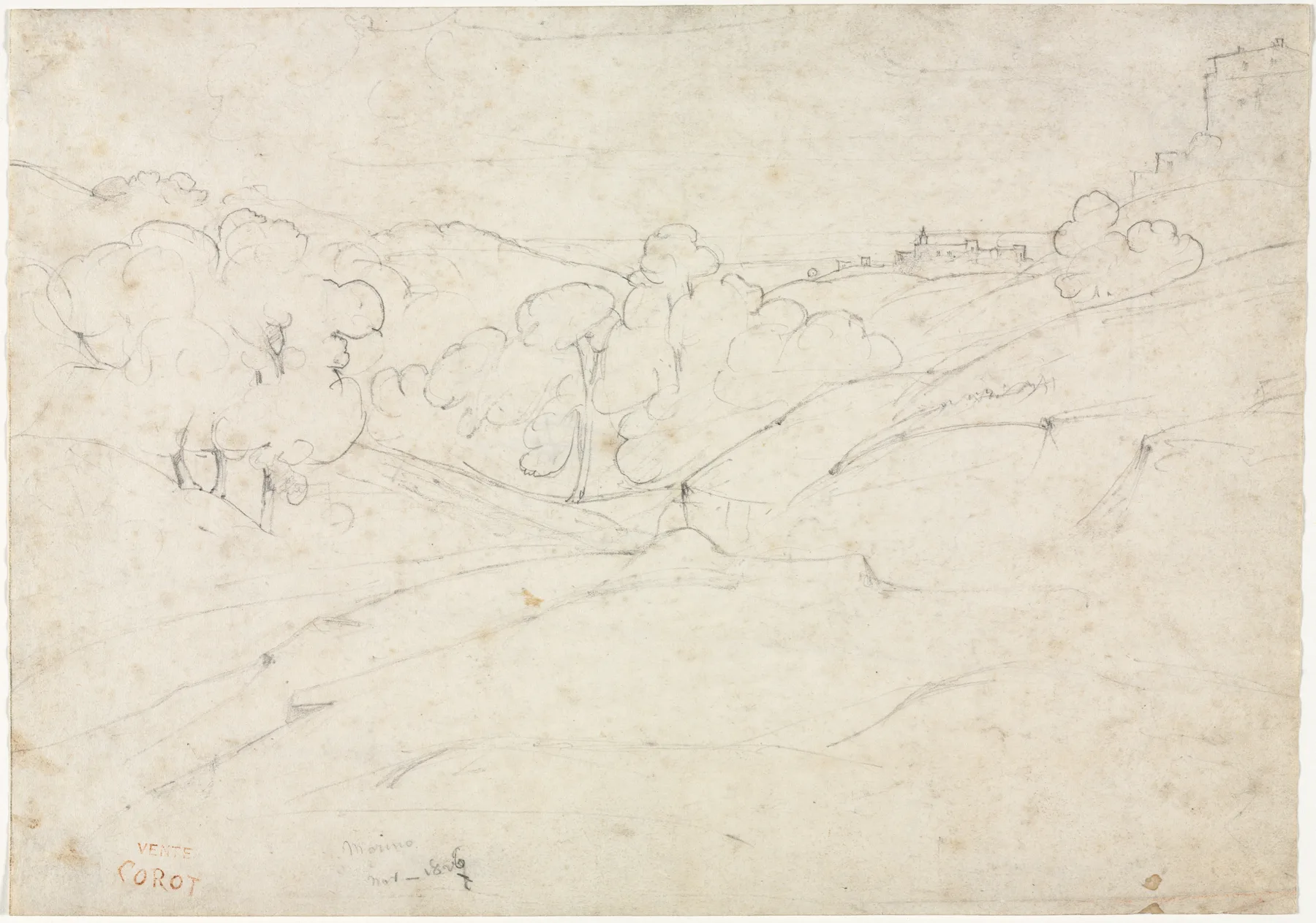
Corot, View of Marino (recto), 1827. graphite.
Pins mark where to look before you draw.
The Cleveland Museum of Art · Gift of Robert Hays Gries
View of Marino
A hill town in forty lines
Marino, 1827: a town on its ridge in the upper right, two lobed trees lower left, and a hillside described by five long lines. Most of the sheet is untouched paper. This is the purest statement of the young Corot's method, and the first master copy in the catalogue because it asks for placement and restraint before it asks for anything else.
- Difficulty
- Time
- about 2 h
- You draw with
- 2H and H graphite
Why this one
- It teaches that a line placed exactly can carry a whole building, and that the paper does the rest.
- The envelope, the sighted angle and comparative measurement all show on one sheet with nothing to hide behind.
- It is the opposite of the late charcoals, and you need both ends of Corot in your hand.
From your kit
The whole kit →- 1Grafwood 2H, H 2H, H for layout and line. Long points from the Blackwing on everything up to B.
- 2Kneaded eraser and the Mono Zero press-and-lift corrections only; the Mono Zero for a single sharp light.
- 3Alpha sketchbook 9 x 6 draw at the book's size and keep the proportions; date the page.
In general, this study asks for
- Drawing pad or smooth cartridge
- 2H and H with long points
- HB for accents
- Kneaded eraser
- Sandpaper block
Watch first
All videos →Comparative measurement with a straight arm, demonstrated on a still life.
YouTube Proportion: sighting anglesDrawing Fundamentals · Sighting angles with a pencil against level and plumb.
 Learn to see negative space and draw everything betterSketchbook Skool · The negative-shape habit, which places Prout's pinnacles and Corot's branches.
 Jean Baptiste Camille CorotRichard Green Gallery · A dealer's short introduction to the hand: Italy, Ville-d'Avray, the silvery late manner.
The plan
5 stages · ~95 min- 1
Read it for five minutes
5 minBefore any mark, look. Where is the town on the sheet (measure it against the width)? Where is the horizon of the far ridge? Which lines are long and which are short? Say aloud what is left blank.
Checklist0 / 2 - 2
Envelope the three masses
15 minDraw a rectangle in the sheet's proportion (about 7 by 10). With the 2H, enclose the town, the tree group and the main ridge line as three simple shapes. Sight the angle of the ridge against level. Measure the town's width as a fraction of the page. Nothing else yet.
FigureEnvelope first. Half your time belongs here. Checklist0 / 2 - 3
The town, one line at a time
35 minSwitch to the H. Place the town's lines one at a time: ghost each, land it once, pressure so light the line is barely there. Roofs first, then walls, then the few window marks. Where Corot leaves a wall open, leave it open.
Check the town against the envelope every five lines. If it grows, stop and measure again.
Corot, View of Marino (recto), 1827. graphite.
The town, upper right: compare your count of lines with his.
The Cleveland Museum of Art · Gift of Robert Hays Gries
Checklist0 / 2 - 4
Terrain and trees
30 minThe hillside: five long contour lines from the shoulder, following the slope, none of them straight. The trees: lobed outlines drawn by their negative shapes against the paper, then a few strokes of hatch on the shadow side only.
Resist shading. If your hand wants to add tone, put the pencil down and look at the original again.
FigureDraw the shape of paper beside the tree; the tree arrives. Checklist0 / 2 - 5
Compare and note
10 minSide by side with the original. Where did you add? Beginners always add. Where did you darken? Write one sentence on the sheet: what did he leave out that I wanted to put in? Date it, box it.
Checklist0 / 2
What it should look like
- A pale, exact drawing with more empty paper than you were comfortable leaving.
- A town you could count the lines of, each in the right place.
Where it goes wrong
- Shading crept in. Empty paper feels unfinished. Lift it out with the kneaded eraser. The emptiness is the drawing.
- The town is too big. It is the interesting part. Measure it against the sheet. It is small.
Log this session
Start the clock when you pick up the pencil. Stop it when you put it down. Log it. Every session counts toward the box.
Status
How did it go?
Before this, ideally
Related studies
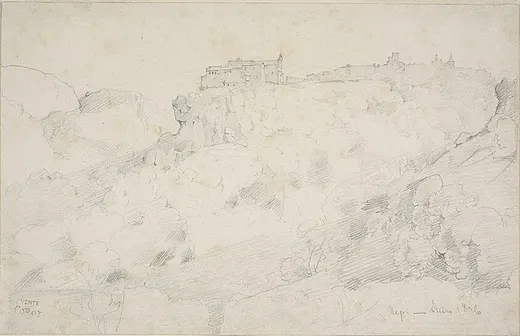 Master study
Corot · Italy in pencil
View of Nepi
Terrain as long contour
2h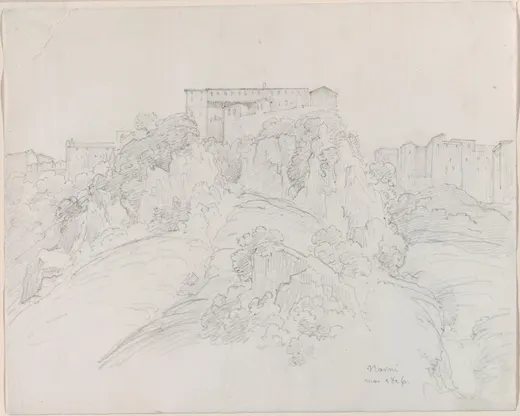 Master study
Corot · Italy in pencil
View of Narni
The set-up for a famous painting
2.5h Master study
Corot · Italy in pencil
Sketch for a Landscape (verso)
The two-minute envelope
0.5h Foundation
Corot · Unit 4
The young Corot: contour and economy
A master copy of View of Marino
1h