Le Martinet near Montpellier
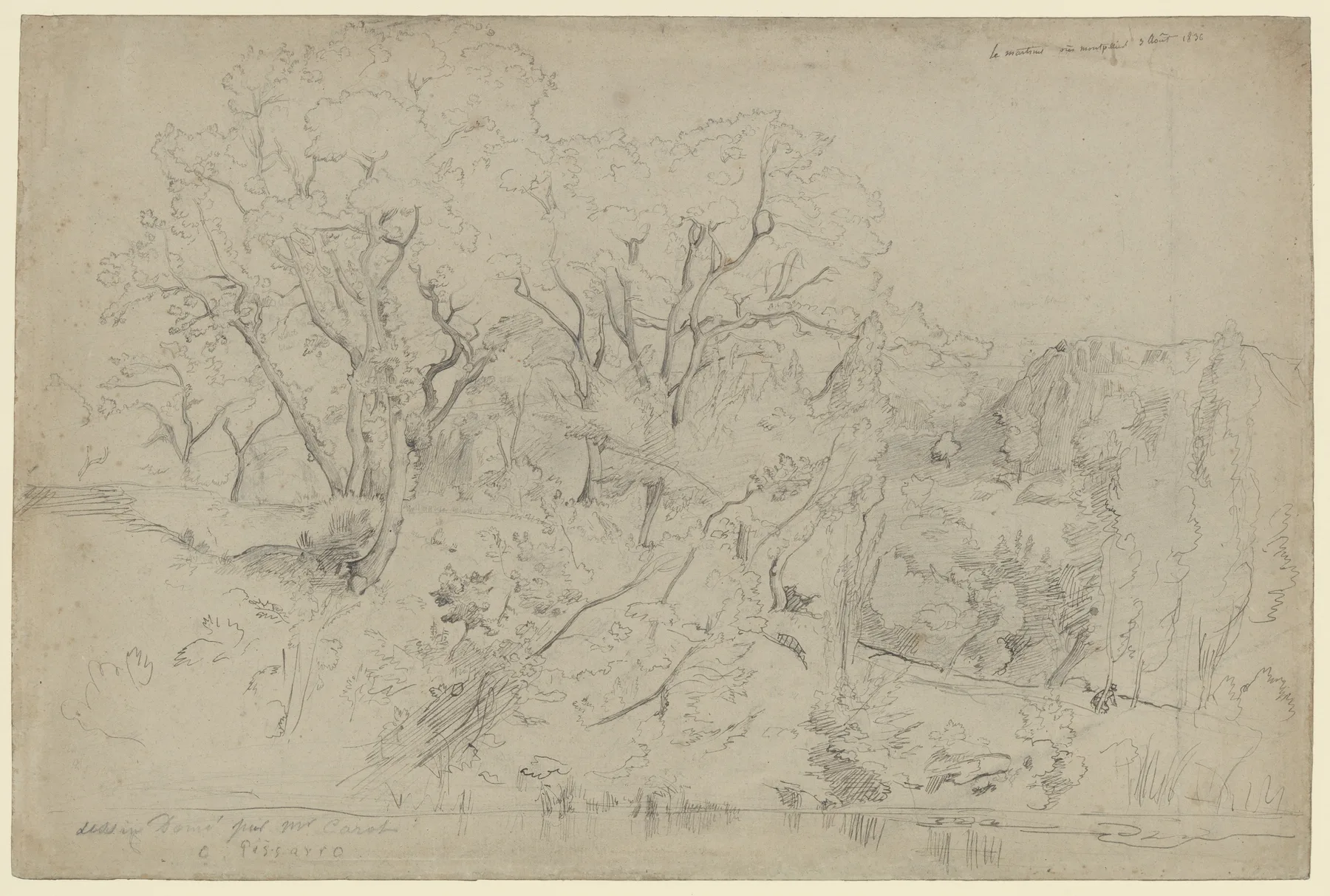
Corot, Le Martinet near Montpellier, 1836. Pen and black ink, graphite on light blue laid paper.
Pins mark where to look before you draw.
The Metropolitan Museum of Art · Rogers Fund, 1926
Le Martinet near Montpellier
Pen over pencil
1836, on a journey through the south of France: a loose pencil lay-in of trees and buildings, gone over in pen and black ink with quick, broken, searching lines. The pen does not trace the pencil; it decides. This is the sheet to learn the two-pass method on: structure in graphite, commitment in ink.
- Difficulty
- Time
- about 2 h
- You draw with
- H graphite, fine pen
Why this one
- It teaches the pencil-then-pen discipline that every architectural sketcher uses.
- The pen line is broken and wiry, a decade before Prout's manner reached France.
From your kit
The whole kit →- 1Grafwood H H for layout and line. Long points from the Blackwing on everything up to B.
- 2Grafwood H for the lay-in; a fine pen if you have bought one, else a needle-pointed Grafwood F the pen studies are about the broken line, not the ink.
- 3Kneaded eraser and the Mono Zero press-and-lift corrections only; the Mono Zero for a single sharp light.
- 4Alpha sketchbook 9 x 6 draw at the book's size and keep the proportions; date the page.
In general, this study asks for
- Drawing pad
- H graphite for the lay-in
- A fine fibre-tip (0.1 to 0.3) or a dip pen and ink
- Kneaded eraser
Watch first
All videos →Line weight hierarchy and when to stop, from an architect.
YouTube Line quality: cross-hatchingLZM Studio · On the quality of each individual line inside a hatch, which is what separates Meryon from a beginner.
 Architectural pencil drawing tutorialMinty Sainsbury · Structure first, then tone, on a real stone building. The method of the Architecture studies in a modern hand.
The plan
3 stages · ~100 min- 1
Pencil lay-in
25 minH, lightly: envelope, the big tree masses, the building shapes. No detail. It should be nearly invisible from arm's length.
Checklist0 / 1 - 2
Pen, deciding
60 minFine pen. Go over the lay-in without tracing it: re-look at the original for every line, and let the pen break and restart. Busy at the foliage edges, quiet inside. Where the pencil was wrong, ignore it; the pen is the drawing.
FigureThe broken line draws age and air alike. Checklist0 / 2 - 3
Erase and compare
15 minLift the pencil out with the kneaded eraser. What remains is the pen. Compare, note, box.
Checklist0 / 2
What it should look like
- A pen drawing that looks decided, over a pencil drawing that looks like it never happened.
Where it goes wrong
- Tracing the pencil with the pen. It feels safe. Look at the original, not the lay-in, for every stroke.
Log this session
Start the clock when you pick up the pencil. Stop it when you put it down. Log it. Every session counts toward the box.
Status
How did it go?
Before this, ideally
Related studies
 Master study
Corot · France in pen and pencil
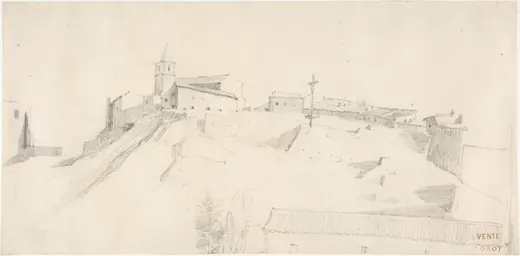
View of a Hill Town with a Crucifix
Walls, a road, a cross: the French Corot in pencil
2h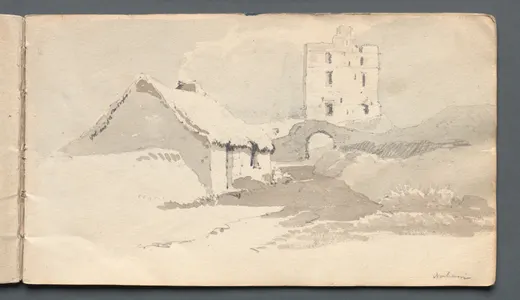 Master study
Prout
Prout's sketchbook: Norham
What a real field page looks like
1h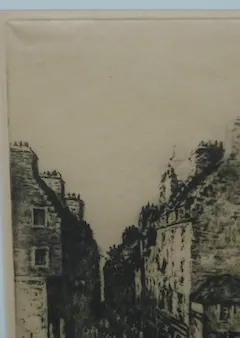 Master study
Forrest · The Edinburgh closes
Old College Wynd, Edinburgh
A close in one-point perspective
3h