Old College Wynd, Edinburgh
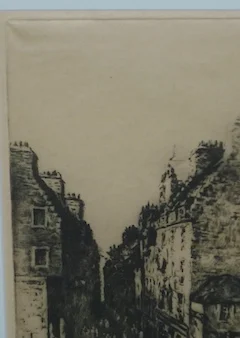
Forrest, Old College Wynd, Edinburgh, exh. 1908 to 1934. etching, signed and titled in pencil.
Pins mark where to look before you draw.
William Shannon Fine Art · Scan courtesy William Shannon Fine Art (originalscottishart.com). The etching is in the public domain (artist d. 1943).
Old College Wynd, Edinburgh
A close in one-point perspective
Old College Wynd ran from the Cowgate up to the Old College of the University, one of the steepest and oldest lanes in the city; most of it was swept away when Chambers Street was cut in the 1870s. Forrest's plate looks up the wynd between tall rubble tenements with crow-stepped gables, figures on the cobbles, and light at the top. It is a one-point perspective problem with a high eye level, weathered masonry, and the broken line throughout. The first Forrest copy, and the model for every close after it.
- Master
- Robert Smith Forrest
- Difficulty
- Time
- about 3 h
- You draw with
- H, HB and 2B graphite with sharp long points, fine pen optional
Why this one
- One-point perspective in a real place with a real slope, which is harder than a flat street.
- Masonry suggested with broken courses and tone, never a drawn net.
- The light at the far end is the design: a dark frame of walls around a bright gap.
From your kit
The whole kit →- 1Grafwood H, HB, 2B H, HB for layout and line; 2B for the darks. Long points from the Blackwing on everything up to B.
- 2Grafwood H for the lay-in; a fine pen if you have bought one, else a needle-pointed Grafwood F the pen studies are about the broken line, not the ink.
- 3Kneaded eraser and the Mono Zero press-and-lift corrections only; the Mono Zero for a single sharp light.
- 4Alpha sketchbook 9 x 6 draw at the book's size and keep the proportions; date the page.
In general, this study asks for
- Drawing pad or smooth cartridge
- 2H and H with long points
- HB for accents
- Kneaded eraser
- Sandpaper block
Watch first
All videos →A street in one point from a blank page. The Old College Wynd set-up.
YouTube Architectural pencil drawing tutorialMinty Sainsbury · Structure first, then tone, on a real stone building. The method of the Architecture studies in a modern hand.
 How Rembrandt made his prints: a demonstrationChristie's · Filmed at the Rembrandt House. The clearest view of drawing with a needle through ground, which is why etched line looks the way it does.
 In the studio with graphite pencil artist Minty SainsburyArtfully Crafted · A living architectural pencil draughtsman at work. The closest modern analogue to the Forrest side of this course.
The plan
5 stages · ~180 min- 1
Find the eye level and the point
15 minHold a pencil level across the plate and slide it until the sills below it rise toward the centre and the lintels above it fall. That is the eye level. Mark the vanishing point where the two walls' lines meet. Draw the eye-level line faintly across your sheet.
FigureEverything receding aims at one point on the eye level. Checklist0 / 2 - 2
The two walls
30 minNear verticals of each wall, plumb. Their tops and bottoms to the vanishing point. The slope of the cobbles is a second pair of lines rising to the same point.
Checklist0 / 2 - 3
Openings and gables by division
40 minWindows and doors in receding rows: divide the near edge, connect to the point, and place each opening on the convergence. The crow-steps as short horizontals climbing the gable.
FigureReceding rows shrink; construct them. Checklist0 / 2 - 4
Broken line and counted tone
70 minGo over the structure with the broken line: lift the pencil every inch, let it wobble. Courses as broken horizontals. Then hatch: one layer on the shadow wall, two under the gables and in the openings, three in the deepest pend. The far gap stays paper.
FigureBroken reads as old. Checklist0 / 3 - 5
Figures and audit
25 minThree figures: dots on the eye level, strokes to the feet. Squint: dark frame, light gap? Box.
Checklist0 / 2
What it should look like
- A steep lane between two old walls that visibly converge to a bright gap, with figures that give it a width.
Where it goes wrong
- Vanishing point off the eye level. Guessed. It is on the line where sills turn to lintels. Re-find it.
- Every stone drawn. Thoroughness. Courses only, broken; stones at corners and openings; tone in the middle.
Log this session
Start the clock when you pick up the pencil. Stop it when you put it down. Log it. Every session counts toward the box.
Status
How did it go?
Related studies
 Master study
Forrest · The Edinburgh closes
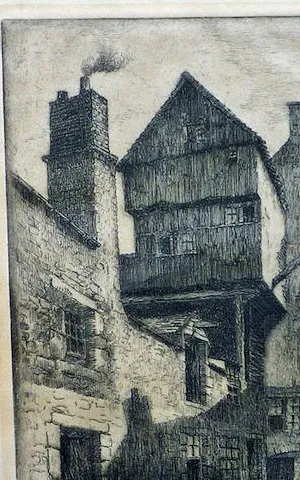
The Back of Advocates Close
A timber-fronted tenement, straight up
2.5h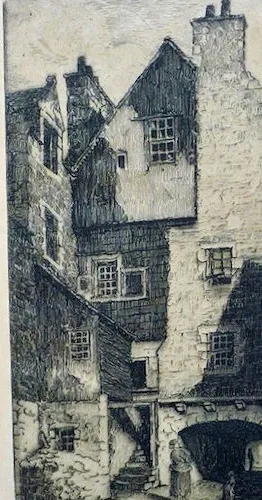 Master study
Forrest · The Edinburgh closes
Bakehouse Close
A pend arch under a crow-stepped gable
2.5h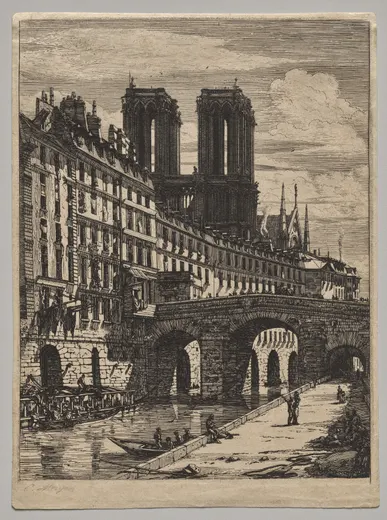 Master study
Meryon
The Petit Pont
Eye level through the figures, a bridge, towers behind
3h Master study
Corot · France in pen and pencil
View of a Hill Town with a Crucifix
Walls, a road, a cross: the French Corot in pencil
2h