Masonry coursing
Masonry coursing
A wall passage after Cotman, then a real wall
Draw a stone wall with courses that run, stones suggested only where needed, and tone carrying the rest.
- Master
- John Sell Cotman
- Difficulty
- Time
- about 1 h
- You draw with
- HB, 2B
Why this one
- Unit 5 of the program: Architecture.
- A wall where hundreds of stones are implied and perhaps forty are drawn.
From your kit
The whole kit →- 1Grafwood HB, 2B HB for layout and line; 2B for the darks. Long points from the Blackwing on everything up to B.
- 2Kneaded eraser and the Mono Zero press-and-lift corrections only; the Mono Zero for a single sharp light.
- 3Alpha sketchbook 9 x 6 draw at the book's size and keep the proportions; date the page.
In general, this study asks for
- Drawing pad
- HB, 2B
- A real stone or brick wall nearby, or a photo
Watch first
All videos →Trees as masses in graphite, with the edge texture where it belongs.
YouTube Sketch like an architect: techniques and tips from a real project30X40 Design Workshop · Line weight hierarchy and when to stop, from an architect.
 How to draw realistic textures with pencils: brick and stone wallAsif Rasheed Art · Stone and brick texture; use it for the near courses only and let tone do the rest.
The plan
4 stages · ~50 min- 1
Count Cotman's stones
15 minLook at the shadow face of the Haute Allemagne tower. Count the stones that are actually drawn as closed shapes. Then notice where they are: along the corner, around the arches, at the base. The middle of the face is courses and tone.
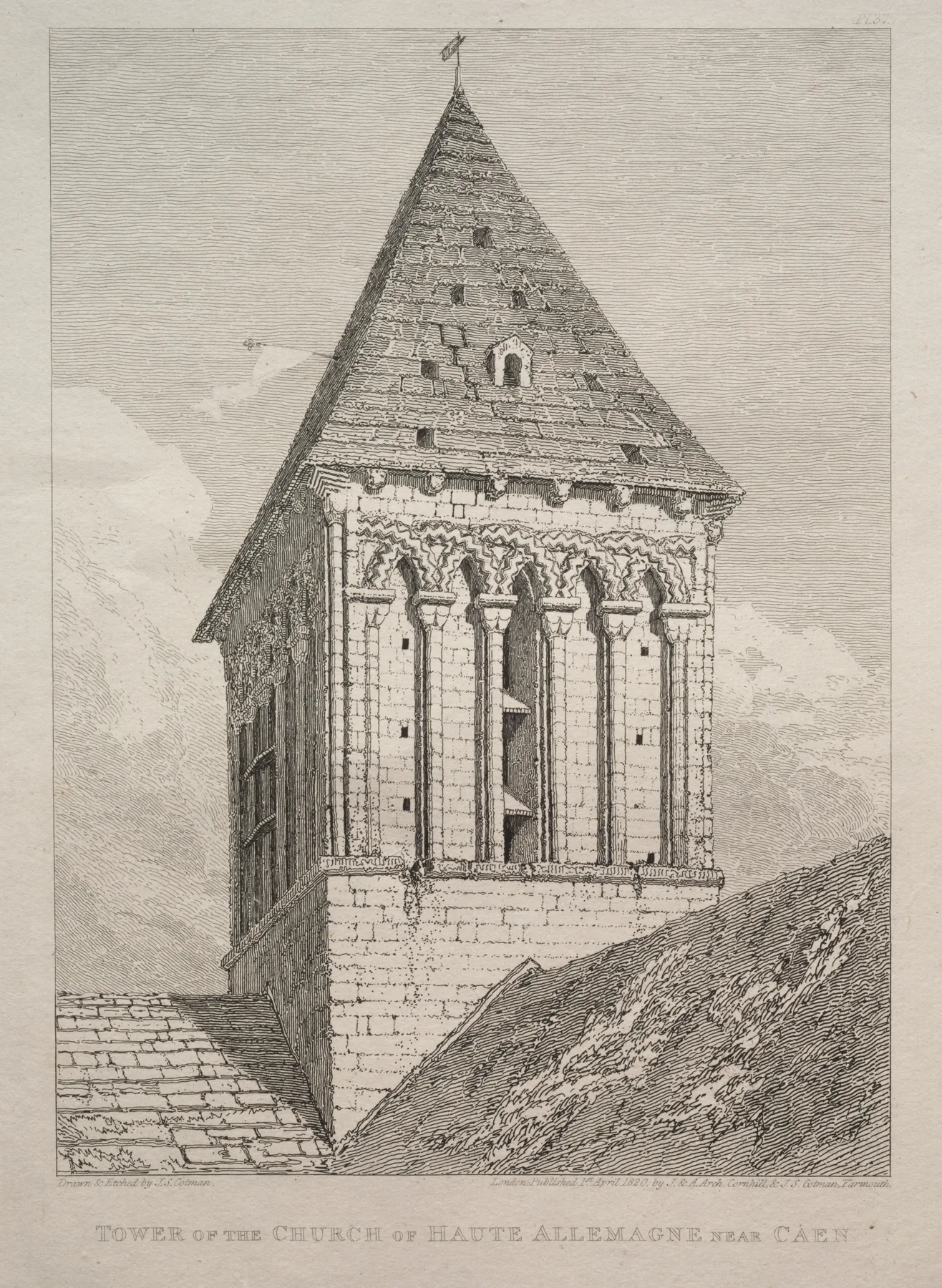
Cotman, Tower of the Church of Haute Allemagne near Caen, 1822. etching.
Cotman. Count the drawn stones; notice where they sit.
The Cleveland Museum of Art · Gift of William C. Keough
Checklist0 / 1 - 2
The net and the wall
15 minTwo four-inch squares. In the first, draw every stone: a net. In the second, run the courses as broken horizontals, add vertical joints only in the top corner, around a small arched opening, and along the bottom, then lay a light tone over the whole face with the side of the pencil. Compare. The second is a wall.
FigureA net versus a wall. Checklist0 / 1 - 3
A real wall
15 minFrom life or photo, a wall with an opening. Same method. If it is rubble, the courses are rougher but the rule holds: a few stones near edges and openings, tone in the middle. Twenty minutes, then stop.
Checklist0 / 1 - 4
Self-check
5 minTick each item honestly. If one is a no, the session is not finished; go back to that step.
Checklist0 / 3
What it should look like
- A wall where hundreds of stones are implied and perhaps forty are drawn.
Where it goes wrong
- The net. Thoroughness. Erase the middle. Keep the edges. Add tone.
Log this session
Start the clock when you pick up the pencil. Stop it when you put it down. Log it. Every session counts toward the box.
Status
How did it go?