Ruins of the Château of Crémieux
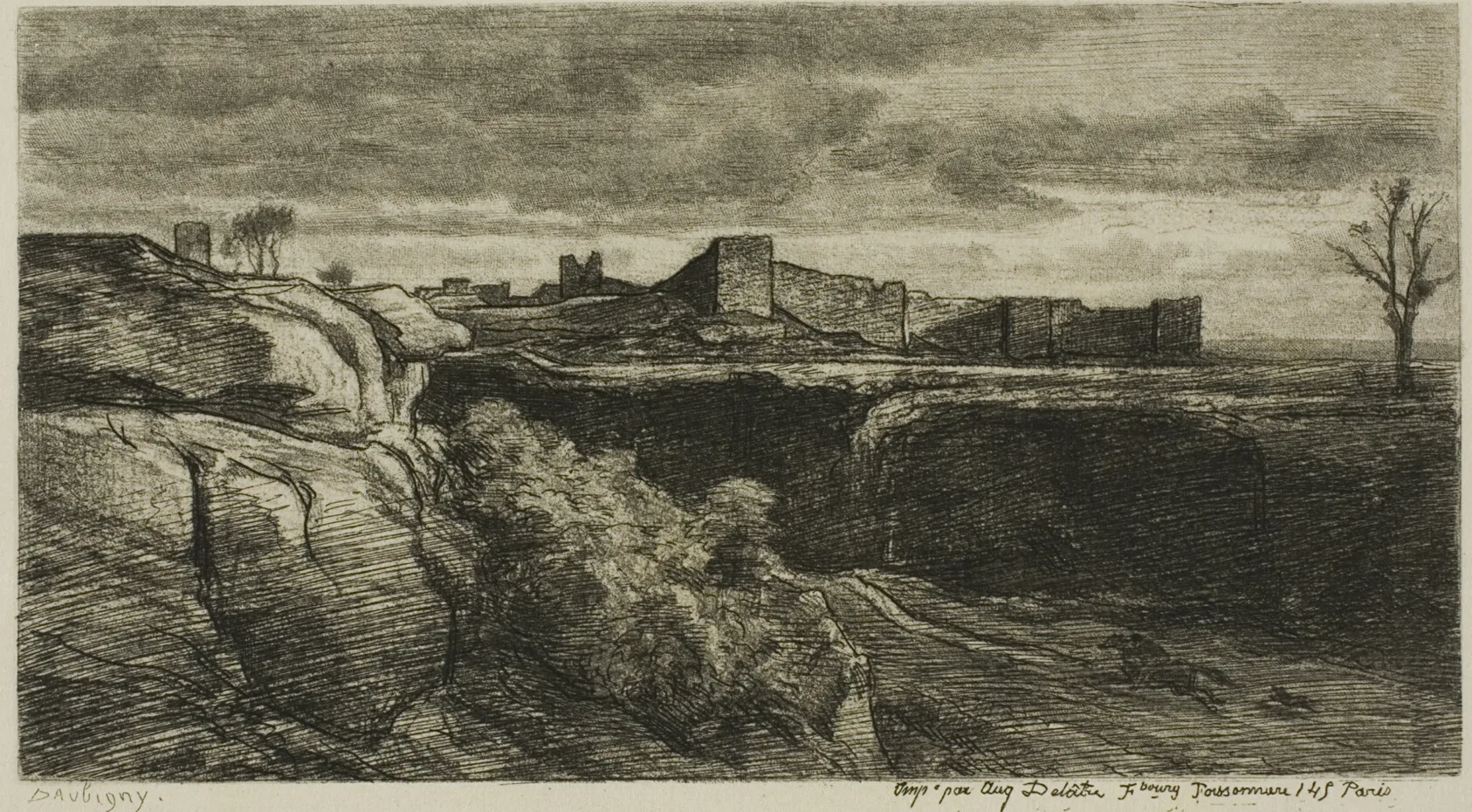
Daubigny, Ruins of the Château of Crémieux (Isère), 1850. Etching, roulette and aquatint on cream Japanese paper.
Pins mark where to look before you draw.
The Art Institute of Chicago · The Charles Deering Collection
Ruins of the Château of Crémieux
A dark landscape with a ruin on the ridge and the sky as the only light
An 1850 etching with roulette and aquatint: rocks in the foreground, a ruined castle along the ridge, a pale sky above a dark land. The aquatint makes it a tonal plate, and the lesson is a landscape built from two values with a ruin as the edge between them.
In pencilAquatint and roulette give this plate its grainy tone. Lay the land as a 4B field with the side of the lead, lift the lit rock tops and the ruin's lit face with the kneaded eraser, and keep the sky a pale even gradient.
- Difficulty
- Time
- about 2 h
- You draw with
- 2B, 4B, 6B graphite on their sides, kneaded eraser
Why this one
- A two-value landscape: dark land, pale sky, with the ruin on the join.
- Rocks as masses with lit tops.
- A ruin as silhouette against the only light.
From your kit
The whole kit →- 1Grafwood 2B, 4B, 6B 2B, 4B, 6B for the darks, on their sides for mass. Long points from the Blackwing on everything up to B.
- 2Pitt Matt 8B to 12B for the big tone passages: matt, so the dark mass reads as tone, not shine.
- 3Kneaded eraser (warm it) and the clean Mono Zero lift the lights out of the mass; the Mono Zero for sky holes and lit edges.
- 4Alpha sketchbook 9 x 6 draw at the book's size and keep the proportions; date the page.
In general, this study asks for
- Drawing pad, medium tooth
- 2B, 4B, 6B with long points
- Kneaded eraser
- Precision eraser
- Slip sheet
Watch first
All videos →Two- and three-value notan, the exact exercise the Mass studies start with.
YouTube Subtractive drawing: symmetry and value in charcoalNathan Orosco · Laying a charcoal ground and lifting the lights out, the late-Corot method.
 How to sketch buildings and architecture: Greek ruinsPhil Davies Artist · A ruin blocked in from the envelope. Ink and wash, but the construction is identical in pencil.
The plan
4 stages · ~90 min- 1
Notan
10 minTwo values: sky paper, land dark. Thumbnail the land's top edge, with the ruin's silhouette as part of it.
FigureTwo values first. Checklist0 / 2 - 2
Lay the land
30 min4B on its side: the whole land as one dark field up to the ridge line, ruin included. The sky as a pale gradient with the 2B, lightest at the top.
FigureA smooth gradient for the sky. Checklist0 / 3 - 3
Lift the lights
40 minKneaded eraser: the lit tops of the rocks, the ruin's lit face, the path. 6B: the darkest crevices. Keep the ruin's silhouette crisp against the sky and its base lost into the land.
FigureCrisp top, lost base. Checklist0 / 3 - 4
Compare
10 minNote, date, box.
Checklist0 / 2
What it should look like
- A dark land under a pale sky with a ruin on the join.
- Rock tops that were lifted out, not drawn around.
Where it goes wrong
- Drawing the stones of the ruin. A ruin is stones. At this distance it is a silhouette. Lift one lit face and stop.
Log this session
Start the clock when you pick up the pencil. Stop it when you put it down. Log it. Every session counts toward the box.
Status
How did it go?
Before this, ideally
Related studies
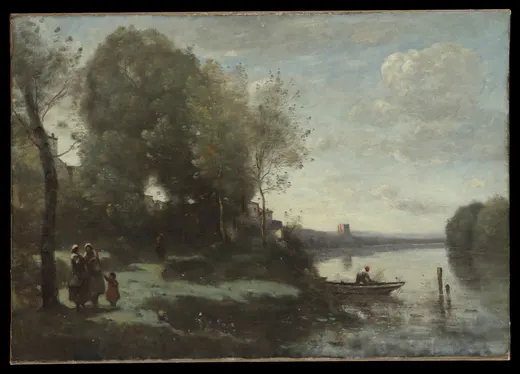 Master study
Corot · Souvenirs: the late paintings
River with a Distant Tower
Five planes to a tower
1.5h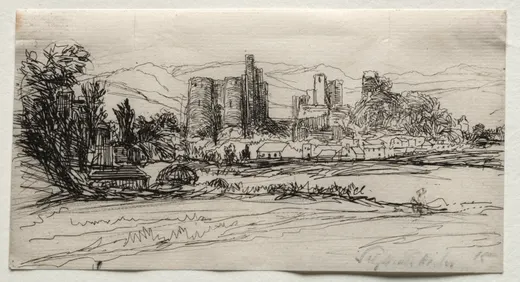 Master study
Seymour Haden
Kidwelly Castle
A castle on its hill, a river under it, drawn from nature in an afternoon
2h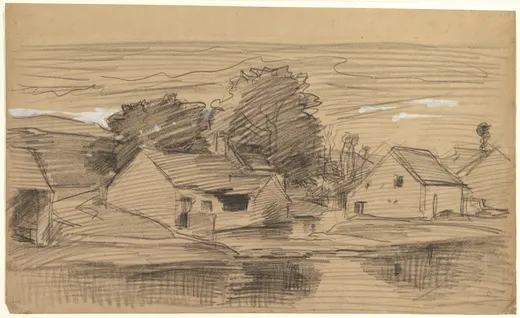 Master study
Daubigny
The Hamlet of Optevoz
Roofs and trees in charcoal, with the lights picked out in white
2h