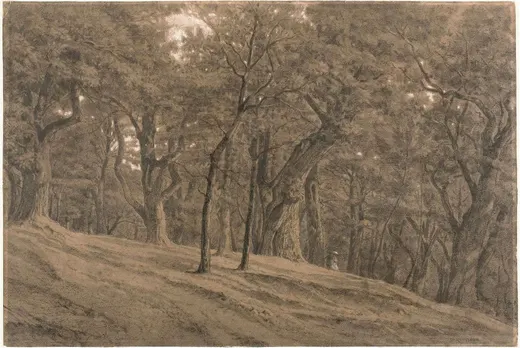
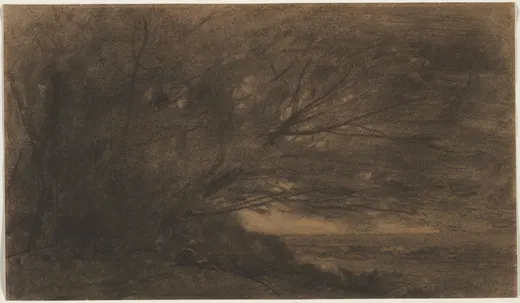
A Woodland Study
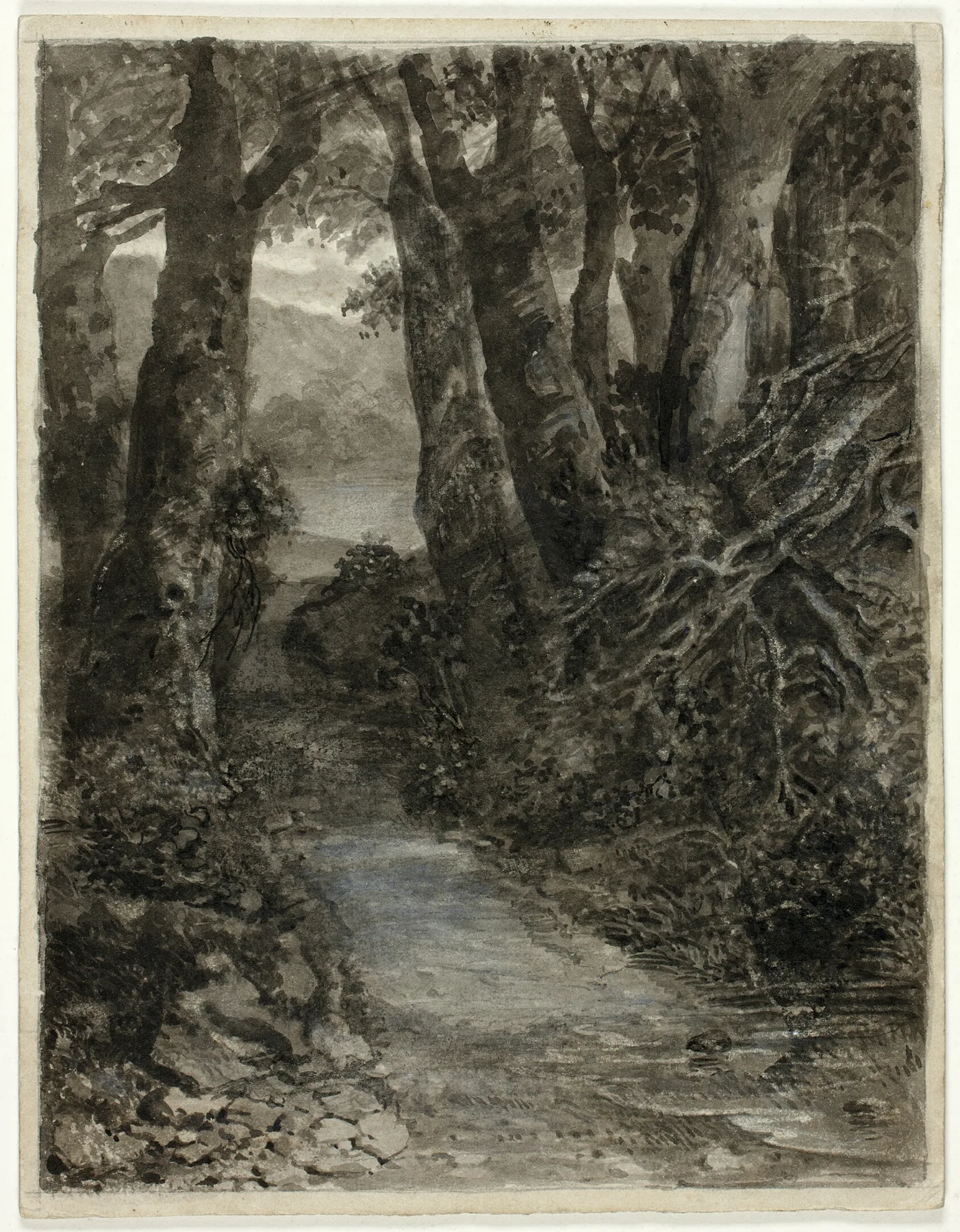
Palmer, A Woodland Study, c. 1856. Brush and black and brown washes, with white gouache and scraping, ruled in graphite, on ivory paperboard.
Pins mark where to look before you draw.
The Art Institute of Chicago · Gift of Dorothy Braude Edinburg to the Harry B. and Bessie K. Braude Memorial Collection
A Woodland Study
A dark wood with one lit path, in brush and wash
A wash drawing of about 1856: tree trunks in a dense wood, a path catching light at the bottom, a gap of sky at the top. Palmer in wash is as tonal as he is linear in etching, and the lesson is a single lit path through a dark mass.
In pencilBrush and wash lay flat tones in two or three steps. Lay the wood as a 4B field with the side of the lead, deepen the trunks with 6B, and lift the path and the sky gap with the kneaded eraser.
- Master
- Samuel Palmer
- Difficulty
- Time
- about 2 h
- You draw with
- 2B, 4B, 6B graphite on their sides, kneaded eraser
Why this one
- One lit path as the whole composition.
- Trunks as a dark rhythm with the light behind them.
- Wash as flat tone: translate it to graphite fields.
From your kit
The whole kit →- 1Grafwood 2B, 4B, 6B 2B, 4B, 6B for the darks, on their sides for mass. Long points from the Blackwing on everything up to B.
- 2Pitt Matt 8B to 12B for the big tone passages: matt, so the dark mass reads as tone, not shine.
- 3Kneaded eraser (warm it) and the clean Mono Zero lift the lights out of the mass; the Mono Zero for sky holes and lit edges.
- 4Alpha sketchbook 9 x 6 draw at the book's size and keep the proportions; date the page.
In general, this study asks for
- Drawing pad, medium tooth
- 2B, 4B, 6B with long points
- Kneaded eraser
- Precision eraser
- Slip sheet
Watch first
All videos →Broad charcoal masses and lifted lights; the closest thing on YouTube to a late Corot being made.
YouTube
The plan
4 stages · ~90 min- 1
The path first
10 minThumbnail: the dark wood as one mass, the path and the sky gap as the two lights. Nothing else.
FigureTwo lights, one mass. Checklist0 / 2 - 2
Lay the wood
30 min4B on its side: the wood as a middle-dark field; 6B for the trunks as vertical masses, nearer darker. Sky gap and path left pale.
FigureMass before branch. Checklist0 / 3 - 3
Lift and lose
40 minKneaded eraser: the path lifted clean, the sky gap lifted soft, a little light between the far trunks. Lose the trunk bases into the ground. Three or four branches with a 4B point, into the mass.
FigureLose the base. Checklist0 / 3 - 4
Compare
10 minNote, date, box.
Checklist0 / 2
What it should look like
- A dark wood you want to walk into because of one lit path.
- Trunks without outlines.
Where it goes wrong
- Light everywhere between the trees. You know there is sky behind them. Palmer let one path and one gap glow. Keep the rest dark.
Log this session
Start the clock when you pick up the pencil. Stop it when you put it down. Log it. Every session counts toward the box.
Status
How did it go?
Before this, ideally