Kidwelly Castle
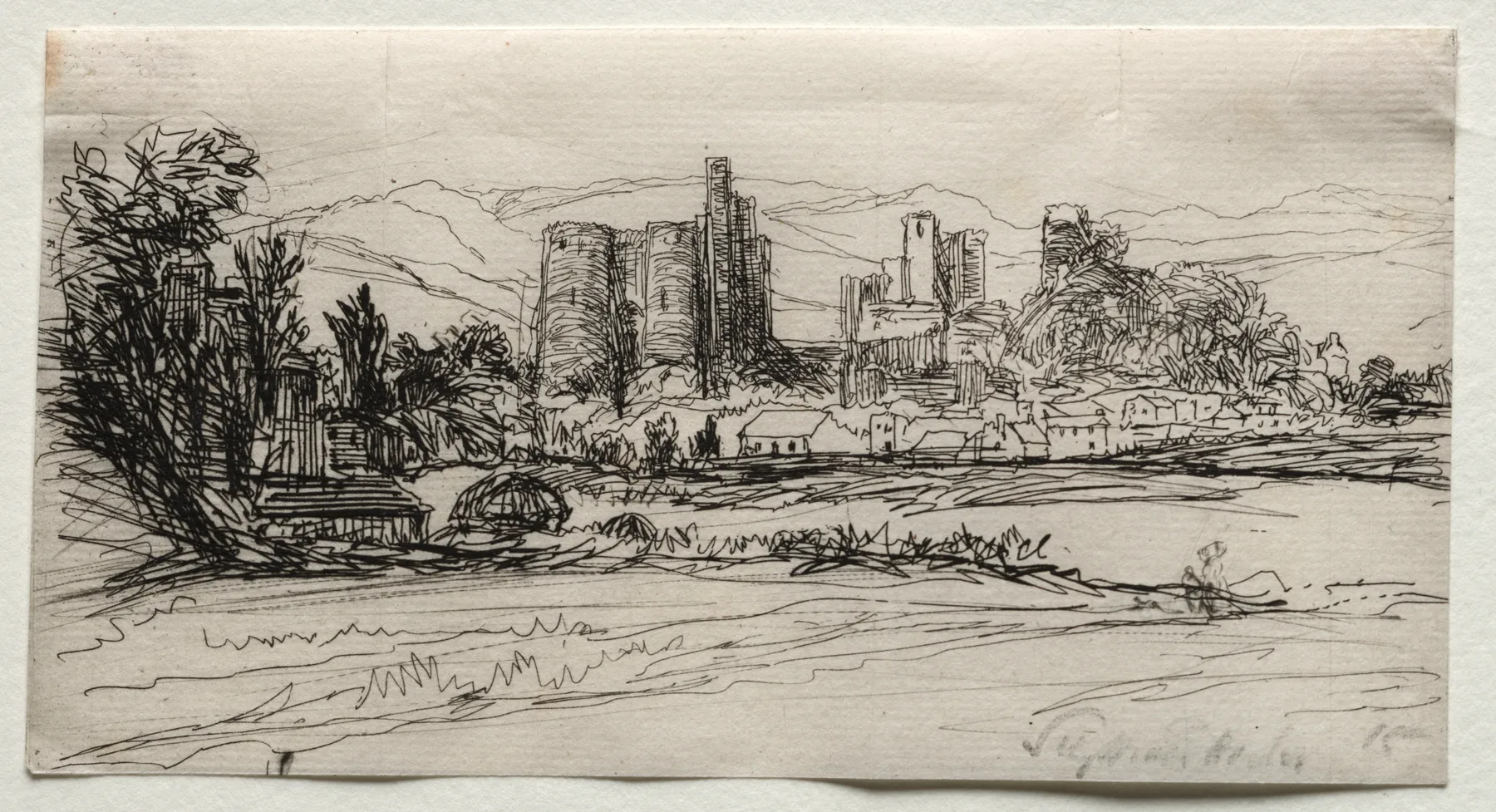
Seymour Haden, Kidwelly Castle, 1859. etching.
Pins mark where to look before you draw.
The Cleveland Museum of Art · In memory of Ralph King, gift of Mrs. Ralph King; Ralph T. Woods, Charles G. King; and Frances King Schafer
Kidwelly Castle
A castle on its hill, a river under it, drawn from nature in an afternoon
Etched on the plate in front of the castle in 1859: the keep and curtain wall as a silhouette on the hill, trees against it, the river in the foreground carrying a soft reflection. Haden's speed shows and is the lesson: the line is quick, truthful and never fussed.
In pencilAn etched line is a drawn line. Copy it with hard grades and long points: tone from the spacing and direction of lines, cross-hatching only in the darkest third, no smudging anywhere.
- Difficulty
- Time
- about 2 h
- You draw with
- H, HB, 2B graphite
Why this one
- A ruin as silhouette, with the sky doing the work behind it.
- Reflection as a softer, broken repeat.
- Speed as a method: nothing here was drawn twice.
From your kit
The whole kit →- 1Grafwood H, HB, 2B H, HB for layout and line; 2B for the darks. Long points from the Blackwing on everything up to B.
- 2Kneaded eraser and the Mono Zero press-and-lift corrections only; the Mono Zero for a single sharp light.
- 3Alpha sketchbook 9 x 6 draw at the book's size and keep the proportions; date the page.
In general, this study asks for
- Drawing pad or smooth cartridge
- 2H and H with long points
- HB for accents
- Kneaded eraser
- Sandpaper block
Watch first
All videos →A ruin blocked in from the envelope. Ink and wash, but the construction is identical in pencil.
YouTube How to create realistic water reflections with graphite pencilsPeonypaint · Vertical strokes, darker lights, horizontal breaks: the pond at Ville-d'Avray in method.
 Printmaking process: intaglioMinneapolis Institute of Art · Four minutes that make every etching in this catalogue legible: ground, needle, acid, ink, wipe, press.
The plan
4 stages · ~100 min- 1
Silhouette
15 minH: the castle's outline as one shape, broken top edge and all, on the hill. The horizon and the river bank as two lines. Nothing inside anything.
FigureOne stable mass, a broken top. Checklist0 / 2 - 2
Trees and the reflection
40 minHB: the near tree as a mass with a few branches, fast. The castle's reflection: the same silhouette upside down, softer, broken by horizontal strokes. 2B for the tree's darks and the water's darkest band.
FigureA softer, broken repeat. Checklist0 / 3 - 3
Tone from line, fast
35 minHaden hatched quickly: parallel lines following the hill, the wall, the water. Match his spacing in each area in under forty minutes. If you are slower, you are fussing.
FigureSpacing is the value. Checklist0 / 2 - 4
Compare
10 minWhere did you slow down and fuss? Note it. Date, box.
Checklist0 / 2
What it should look like
- A castle you read as one shape.
- A reflection you believe without counting its stones.
- A drawing that looks like it took an afternoon.
Where it goes wrong
- Stones in the castle. A castle is made of stones. At this distance it is made of one value. Draw that.
Log this session
Start the clock when you pick up the pencil. Stop it when you put it down. Log it. Every session counts toward the box.
Status
How did it go?
Before this, ideally