Cardigan Bridge
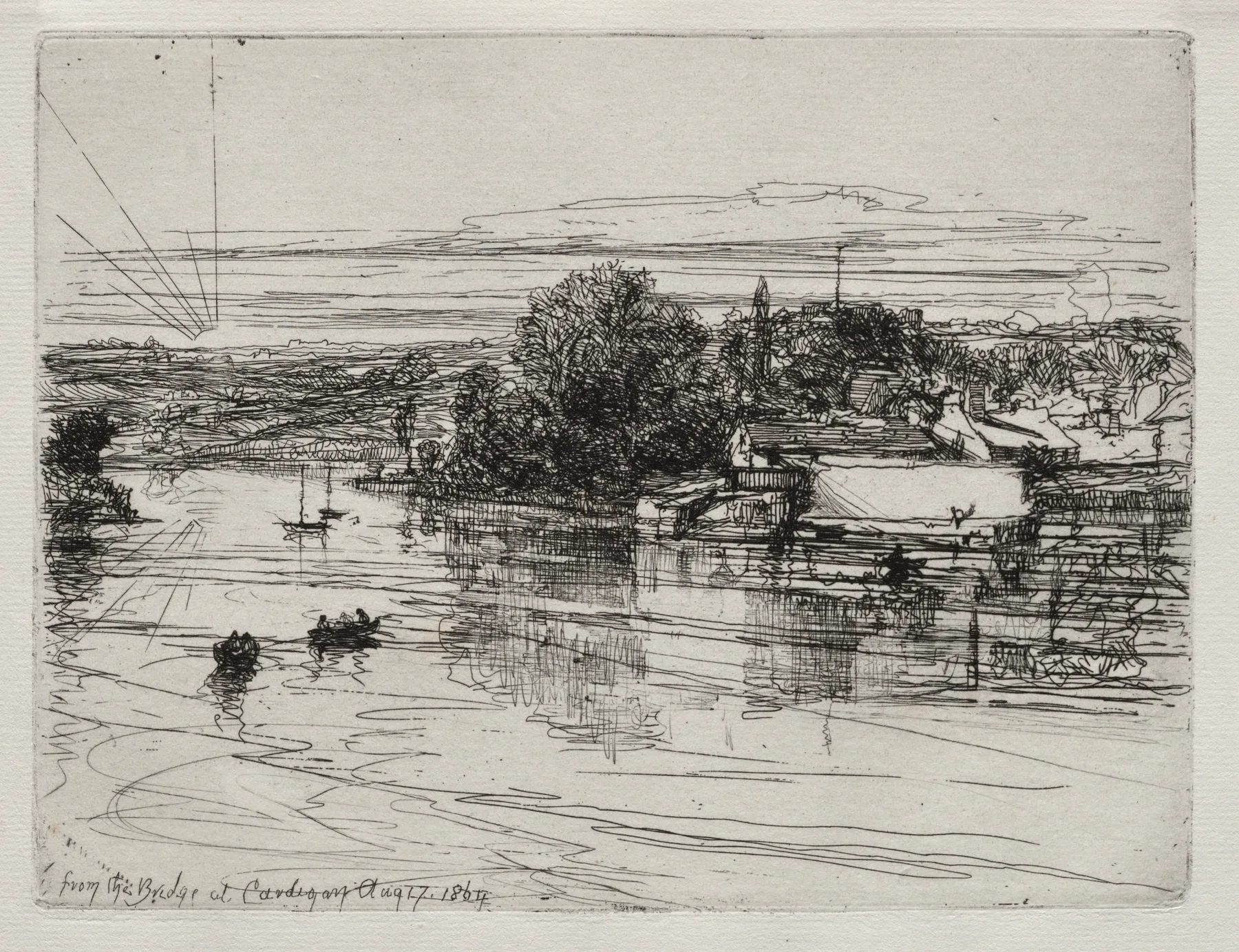
Seymour Haden, Cardigan Bridge, 1864. etching.
Pins mark where to look before you draw.
The Cleveland Museum of Art · Gift of The Print Club of Cleveland
Cardigan Bridge
A river scene built from three bands and a boat
The 1864 plate of the Teifi at Cardigan: bridge and town across the middle, trees in a dark mass at the right, a boat and its reflection in the foreground, sky left open. Three horizontal bands and one dark accent make the whole design.
In pencilAn etched line is a drawn line. Copy it with hard grades and long points: tone from the spacing and direction of lines, cross-hatching only in the darkest third, no smudging anywhere.
- Difficulty
- Time
- about 2 h
- You draw with
- H, HB, 2B graphite
Why this one
- A composition in horizontal bands: sky, town and trees, water.
- A single boat as the near accent that sets the depth.
- Reflections that are darker than the thing reflected.
From your kit
The whole kit →- 1Grafwood H, HB, 2B H, HB for layout and line; 2B for the darks. Long points from the Blackwing on everything up to B.
- 2Kneaded eraser and the Mono Zero press-and-lift corrections only; the Mono Zero for a single sharp light.
- 3Alpha sketchbook 9 x 6 draw at the book's size and keep the proportions; date the page.
In general, this study asks for
- Drawing pad or smooth cartridge
- 2H and H with long points
- HB for accents
- Kneaded eraser
- Sandpaper block
Watch first
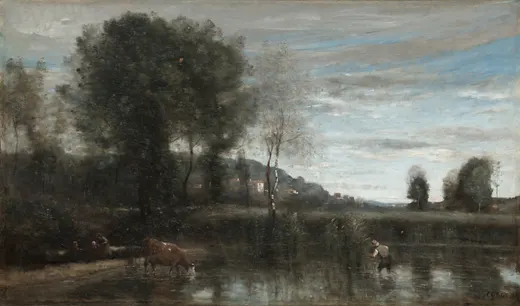
All videos →Vertical strokes, darker lights, horizontal breaks: the pond at Ville-d'Avray in method.
YouTube
The plan
4 stages · ~95 min- 1
Three bands
15 minThumbnail: sky, middle band (town, bridge, trees), water. Three values, three bands. Place the boat as a dark dot in the water band.
FigureNear, middle, far. Checklist0 / 2 - 2
The middle band
35 minH and HB: bridge arches as low half-circles, the town as a row of simple shapes, the tree mass at the right darkest. Keep the band's top edge soft against the sky.
Checklist0 / 3 - 3
Water and the boat
35 minReflections as vertical strokes under each dark, softened and broken by horizontals; the water darker than the sky. 2B: the boat and its reflection, the darkest thing on the sheet.
FigureDarker below, softer, broken. Checklist0 / 3 - 4
Compare
10 minNote, date, box.
Checklist0 / 2
What it should look like
- Three bands you can name.
- A boat that is the nearest thing.
- Water that sits flat.
Where it goes wrong
- Water lighter than sky. Water looks bright. In daylight the sky is the lightest thing; the water reflects it a step darker.
Log this session
Start the clock when you pick up the pencil. Stop it when you put it down. Log it. Every session counts toward the box.
Status
How did it go?
Before this, ideally