The Pigeon Tower
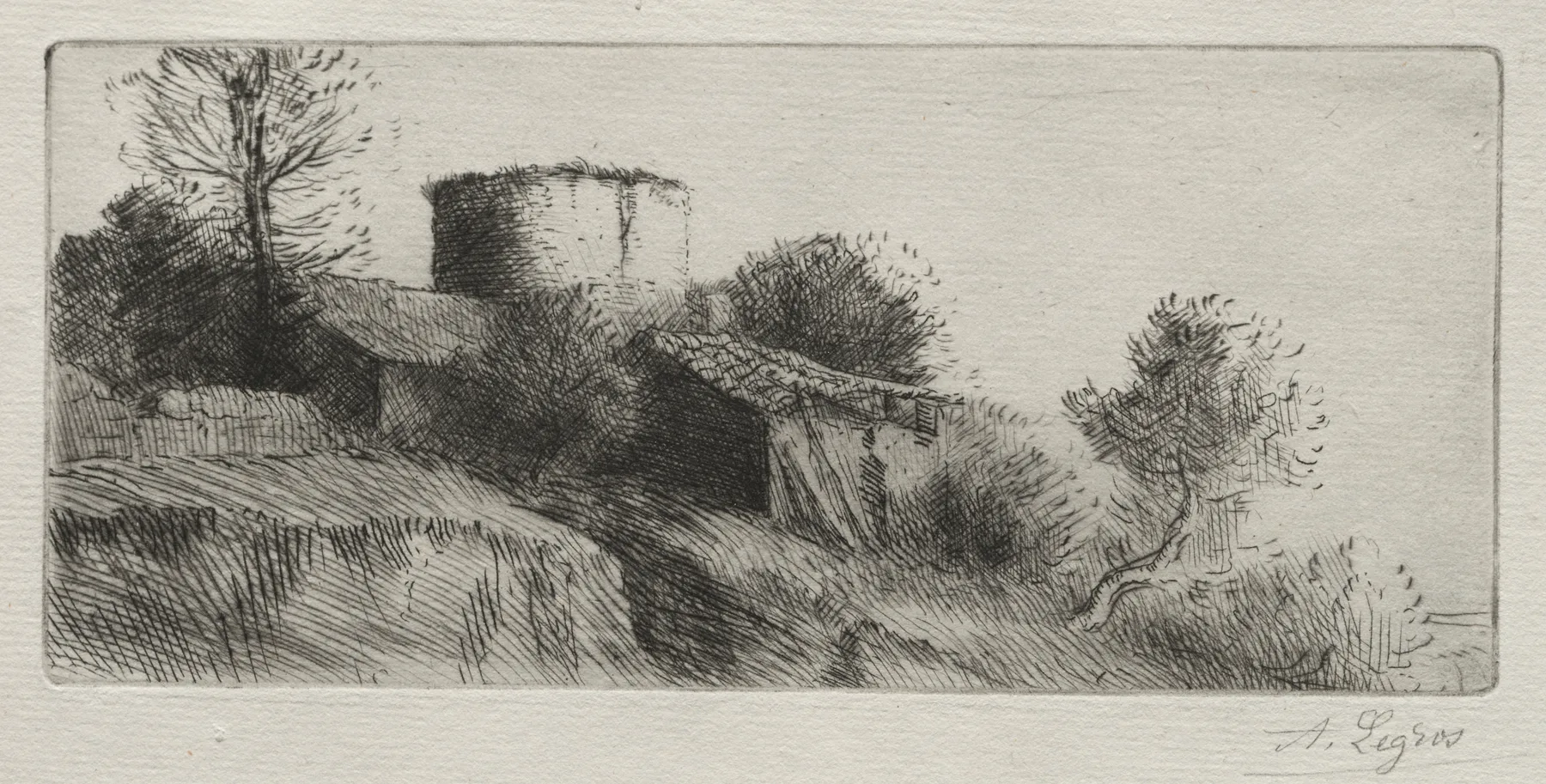
Legros, Pigeon Tower, c. 1857–1911. etching.
Pins mark where to look before you draw.
The Cleveland Museum of Art · Gift of Ralph King
The Pigeon Tower
A round tower on a low hill, the simplest landscape in the catalogue
A dovecote on a bank, a few trees, a horizon, sky. Legros draws it in perhaps two hundred lines. It is the plate to copy when you want to learn how little a landscape needs, and how a round tower is drawn as a cylinder before it is drawn as stone.
In pencilAn etched line is a drawn line. Copy it with hard grades and long points: tone from the spacing and direction of lines, cross-hatching only in the darkest third, no smudging anywhere.
- Master
- Alphonse Legros
- Difficulty
- Time
- about 1.5 h
- You draw with
- H, HB graphite
Why this one
- A cylinder in light: the round tower as a form.
- Economy: count the lines and try to use fewer.
- A low horizon and a sky left completely alone.
From your kit
The whole kit →- 1Grafwood H, HB H, HB for layout and line. Long points from the Blackwing on everything up to B.
- 2Kneaded eraser and the Mono Zero press-and-lift corrections only; the Mono Zero for a single sharp light.
- 3Alpha sketchbook 9 x 6 draw at the book's size and keep the proportions; date the page.
In general, this study asks for
- Drawing pad or smooth cartridge
- 2H and H with long points
- HB for accents
- Kneaded eraser
- Sandpaper block
Watch first
All videos →All six mark families in one sitting.
YouTube
The plan
3 stages · ~75 min- 1
Horizon and cylinder
15 minH: horizon line placed by measurement; the tower as a cylinder with an ellipse for its top edge, plumb sides, a conical roof.
FigureRound forms begin as ellipses. Checklist0 / 3 - 2
The turning shadow
30 minHB: the shadow side of the cylinder as vertical hatching that opens toward the light side, so the edge of the shadow is soft. The roof's shadow side. The bank's few strokes.
FigureForm turns; shadow softens. Checklist0 / 3 - 3
Trees and compare
30 minTrees as a few long lines and a loose mass. Count your lines against the plate's. Note, date, box.
Checklist0 / 2
What it should look like
- A tower that is round.
- Two hundred lines, no more.
- Sky untouched.
Where it goes wrong
- A hard shadow edge on the tower. You drew the shadow as a shape. The form turns; open the hatching gradually toward the light.
Log this session
Start the clock when you pick up the pencil. Stop it when you put it down. Log it. Every session counts toward the box.
Status
How did it go?
Before this, ideally