The Lonely Tower
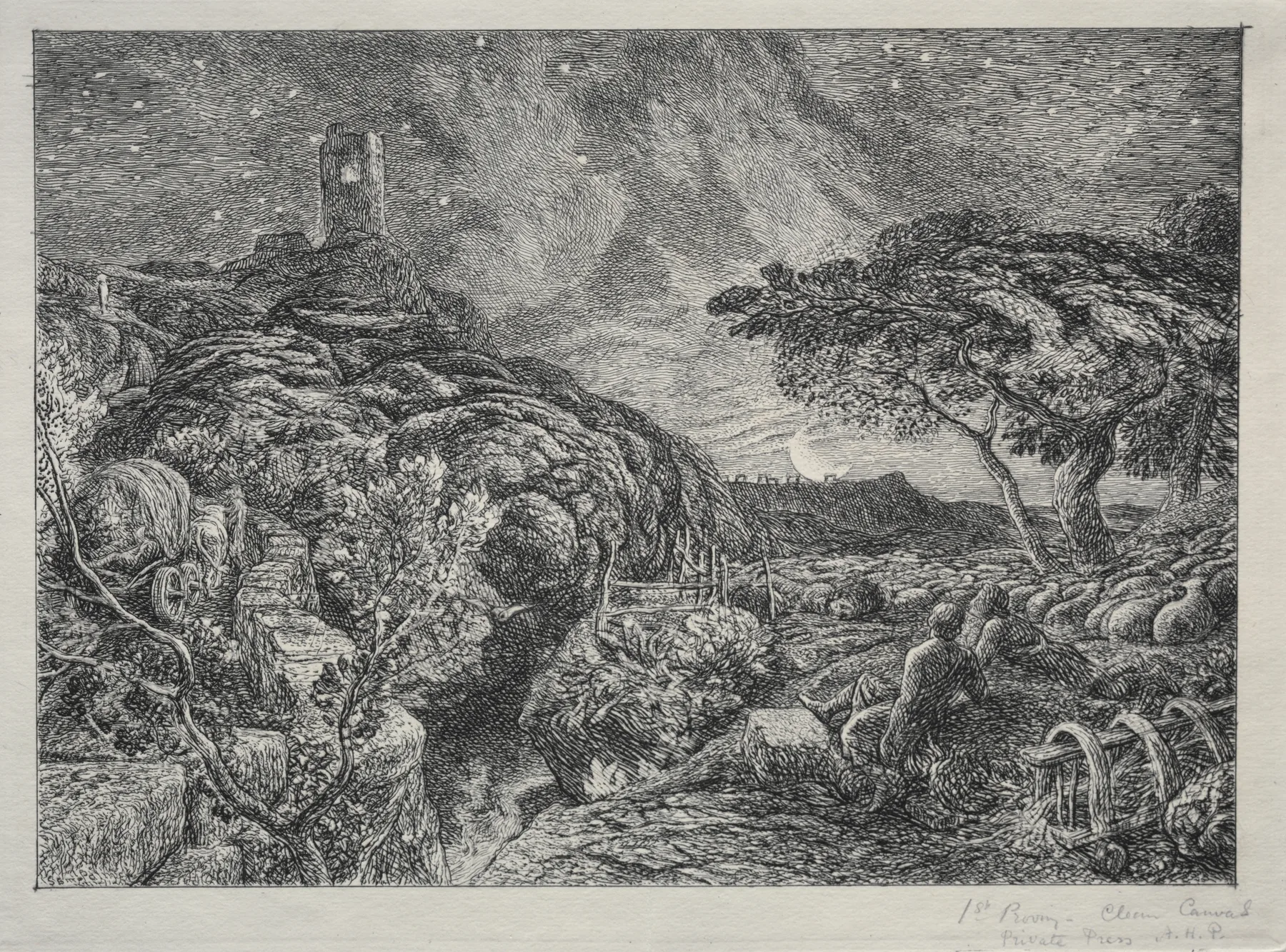
Palmer, The Lonely Tower, 1879. etching.
Pins mark where to look before you draw.
The Cleveland Museum of Art · Gift of Mr. and Mrs. Lewis B. Williams, presented in honor of Henry Sayles Francis, Curator of Prints
The Lonely Tower
Palmer's night, to set beside Corot's: a point of light in a web of line
Palmer's 1879 etching after Milton's Il Penseroso: a tower on a hill against a night sky, a crescent moon, two figures in the foreground, and the whole plate woven from thousands of fine lines in layers. Draw it beside Corot's lithograph of the same title: Corot's tower is a mass in air, Palmer's is a glow in a web.
In pencilAn etched line is a drawn line. Copy it with hard grades and long points: tone from the spacing and direction of lines, cross-hatching only in the darkest third, no smudging anywhere.
- Master
- Samuel Palmer
- Difficulty
- Time
- about 3 h
- You draw with
- H, HB, 2B, 4B graphite
Why this one
- Tone built from many fine lines in layers, each layer a different direction.
- A night scene where everything is a value darker than you think, except one light.
- The direct companion to Corot's Lonely Tower in this catalogue.
From your kit
The whole kit →- 1Grafwood H, HB, 2B, 4B H, HB for layout and line; 2B, 4B for the darks. Long points from the Blackwing on everything up to B.
- 2Kneaded eraser and the Mono Zero press-and-lift corrections only; the Mono Zero for a single sharp light.
- 3Alpha sketchbook 9 x 6 draw at the book's size and keep the proportions; date the page.
In general, this study asks for
- Drawing pad or smooth cartridge
- 2H and H with long points
- HB for accents
- Kneaded eraser
- Sandpaper block
Watch first
All videos →All six mark families in one sitting.
YouTube

The plan
4 stages · ~135 min- 1
Map the values
15 minSquint: the plate is four values and one point of light. Thumbnail them. Mark the lit window as the only paper.
FigureEverything serves one point. Checklist0 / 2 - 2
First layer
40 minH: the whole sheet except the window hatched in one direction at a wide spacing, the sky included. This is the night's first layer.
FigureSix families of mark; start with one. Checklist0 / 2 - 3
Layers in new directions
70 minHB, then 2B, then 4B: each darker zone gets another layer in a new direction, the tower's silhouette and the hill getting the most. The sky gets one more layer away from the moon. Stop when the window is the only paper and it glows.
FigureLayers, not pressure. Checklist0 / 3 - 4
Compare
10 minSide by side with Corot's tower. Note what each does. Date, box.
Checklist0 / 2
What it should look like
- A night woven from fine lines.
- One point of light that glows because everything else is dark.
- No pressure visible anywhere.
Where it goes wrong
- Pressing for the night. It needs to be dark. Four layers of H and HB are darker than one layer of 6B and far more luminous.
Log this session
Start the clock when you pick up the pencil. Stop it when you put it down. Log it. Every session counts toward the box.
Status
How did it go?
Related studies
 Master study
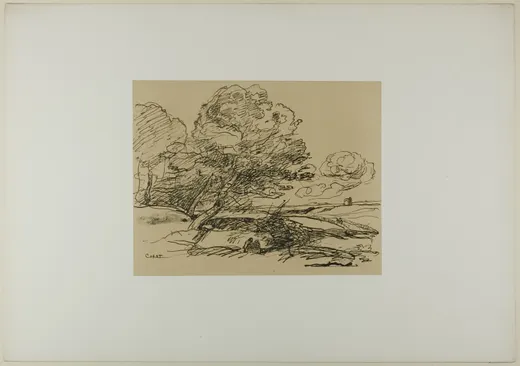
Corot · The lithographs
The Lonely Tower
A tower as one mass among trees, in crayon
2h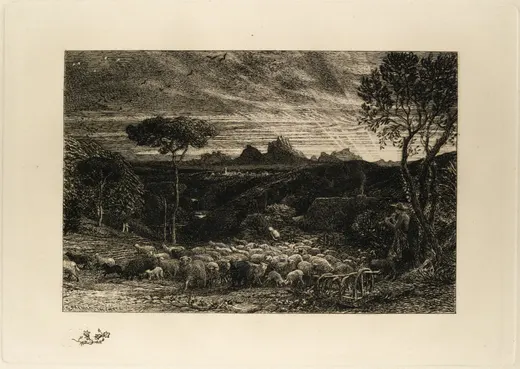 Master study
Palmer
Opening the Fold, or Early Morning
A sunrise built from line: the brightest thing is the least drawn
2.5h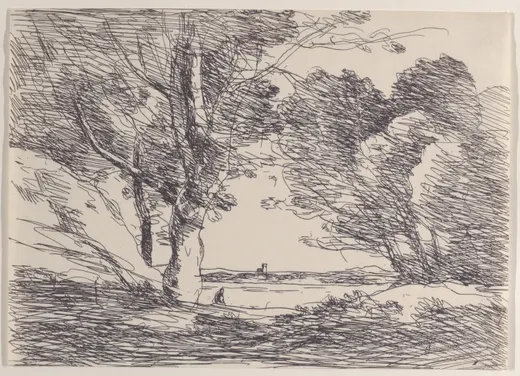 Master study
Corot · Towers, forts and bell towers
Tower at the Lake's Horizon
Big tree, far tower, scratched glass
1.5h