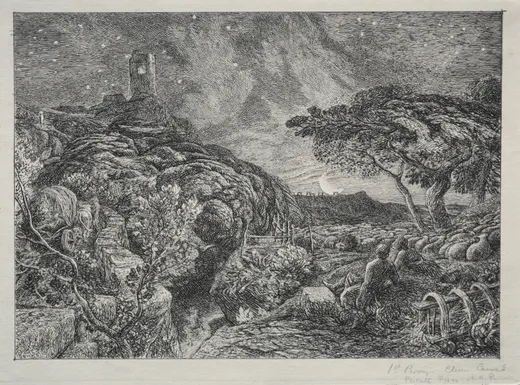
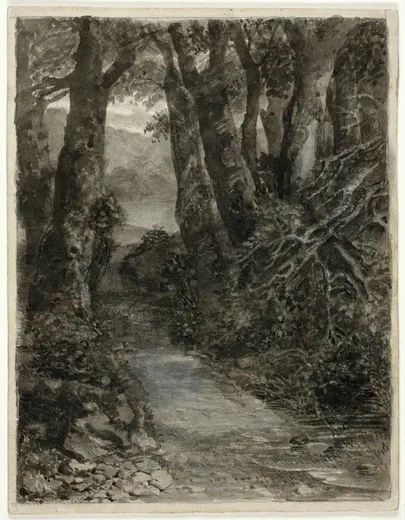
Opening the Fold, or Early Morning
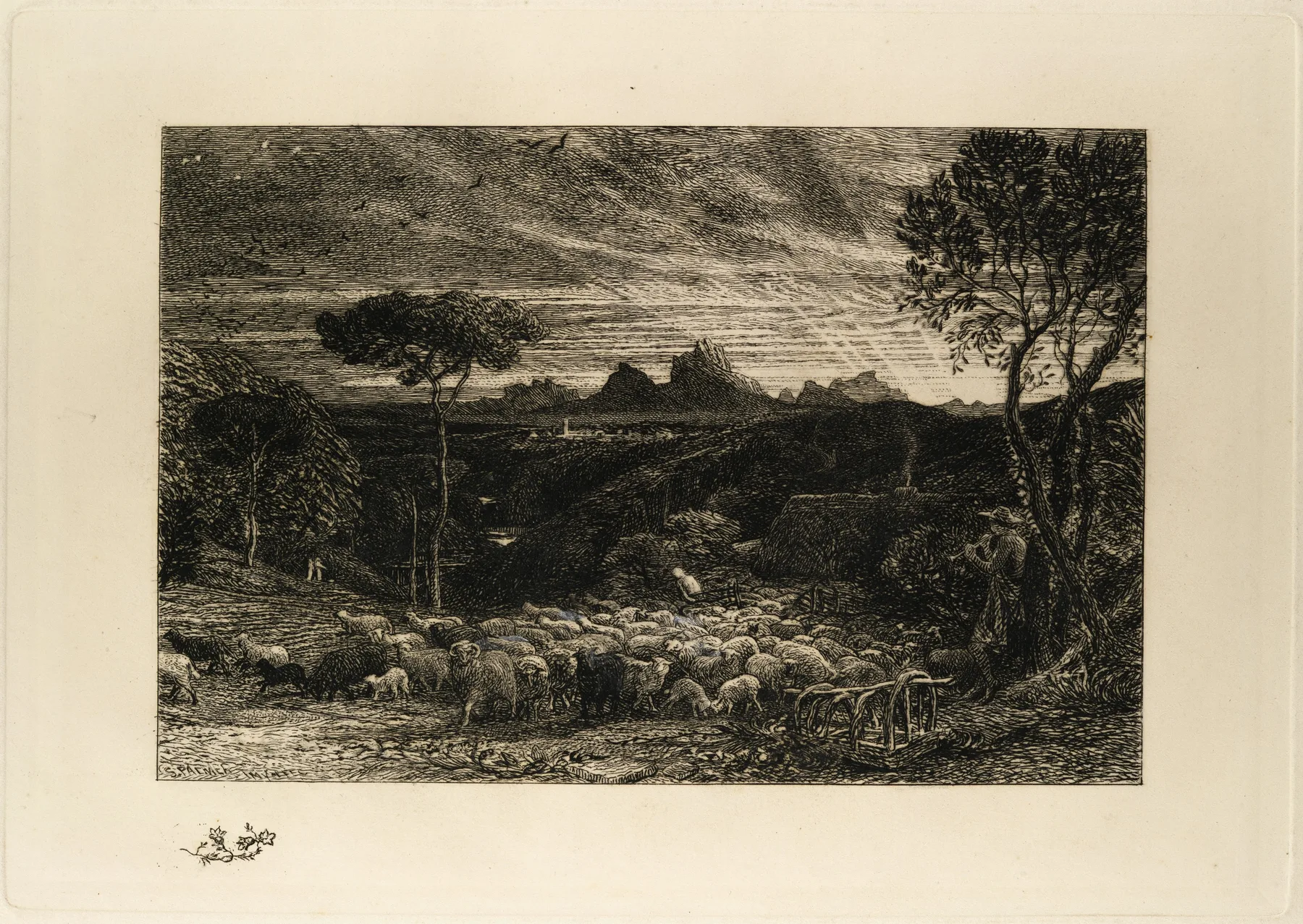
Palmer, Opening the Fold, or Early Morning, 1880. Etching; third state of ten, retouched in graphite.
Pins mark where to look before you draw.
The Metropolitan Museum of Art · Gift of G. L. Winthrop, 1917
Opening the Fold, or Early Morning
A sunrise built from line: the brightest thing is the least drawn
Palmer's last etching, 1880: the sun rising behind trees, a shepherd opening the fold, sheep spilling out. The glow is made by leaving paper inside a dense web of hatching; the trees against it are the darkest things on the plate.
In pencilAn etched line is a drawn line. Copy it with hard grades and long points: tone from the spacing and direction of lines, cross-hatching only in the darkest third, no smudging anywhere.
- Master
- Samuel Palmer
- Difficulty
- Time
- about 2.5 h
- You draw with
- H, HB, 2B graphite
Why this one
- A light source drawn by what surrounds it.
- Trees as dark silhouettes against light: the reverse of the usual.
- Sheep and figure as a texture of small darks on a light ground.
From your kit
The whole kit →- 1Grafwood H, HB, 2B H, HB for layout and line; 2B for the darks. Long points from the Blackwing on everything up to B.
- 2Kneaded eraser and the Mono Zero press-and-lift corrections only; the Mono Zero for a single sharp light.
- 3Alpha sketchbook 9 x 6 draw at the book's size and keep the proportions; date the page.
In general, this study asks for
- Drawing pad or smooth cartridge
- 2H and H with long points
- HB for accents
- Kneaded eraser
- Sandpaper block
Watch first
All videos →All six mark families in one sitting.
YouTube
The plan
4 stages · ~120 min- 1
Rings of spacing
20 minH: around the sun, hatching whose spacing opens toward the light and closes away from it, in rough rings. The sun itself stays paper.
FigureSpacing is the value. Checklist0 / 2 - 2
The dark trees
40 min2B: the trees as silhouettes against the glow, their edges crisp where they meet the light, their interiors layered dark. Branches drawn into the mass, not on it.
FigureLight through dark. Checklist0 / 3 - 3
Fold, sheep, shepherd
50 minHB: the fold's rails, the shepherd dark, the sheep as a textured mass of small darks with their tops left light. Ground hatched toward the sun like the sky.
FigureTexture, not individuals. Checklist0 / 3 - 4
Compare
10 minNote, date, box.
Checklist0 / 2
What it should look like
- A sunrise you squint at.
- Black trees on a bright sky.
- A flock, not a count of sheep.
Where it goes wrong
- Drawing the sun. It is the subject. It is the one place you do nothing. Draw everything around it.
Log this session
Start the clock when you pick up the pencil. Stop it when you put it down. Log it. Every session counts toward the box.
Status
How did it go?
Before this, ideally