Focal hierarchy and edges
Focal hierarchy and edges
One place where everything coincides
Give a drawing exactly one focal point by concentrating contrast, sharpness and detail there and subordinating everything else.
- Master
- Charles Meryon
- Difficulty
- Time
- about 1 h
- You draw with
- HB, 2B, 6B
Why this one
- Unit 6 of the program: Composition.
- A drawing where you can point to the focal point and where everything else is quieter than it.
From your kit
The whole kit →- 1Grafwood HB, 2B, 6B HB for layout and line; 2B, 6B for the darks. Long points from the Blackwing on everything up to B.
- 2Kneaded eraser and the Mono Zero press-and-lift corrections only; the Mono Zero for a single sharp light.
- 3Alpha sketchbook 9 x 6 draw at the book's size and keep the proportions; date the page.
In general, this study asks for
- Drawing pad
- HB, 2B, 6B
- Kneaded eraser
- Last session's drawing, or a new subject
Watch first
All videos →Squinting, value scales and why beginners under-read darks.
YouTube Practice simplifying values with notan studiesProko · Two- and three-value notan, the exact exercise the Mass studies start with.
 How to simplify your light and shadow shapesDrawing Tutorials Online · Shadow shapes as flat masses first. Shown on a portrait, but the principle is identical for a tree or a tower.
The plan
4 stages · ~59 min- 1
Choose the point
18 minDecide where the eye should go: a doorway, a tower top against sky, a trunk against the brightest distance. Off centre, on a third. Mark it with a faint cross.
FigureContrast, sharpness and detail in one place. Checklist0 / 1 - 2
Concentrate
18 minAt the cross: your 9 beside your 1, the sharpest edge in the drawing, and the only passage of real detail. Everywhere else: narrow the values toward the middle, soften edges with a pass of the side of the pencil, remove detail with the kneaded eraser. Yes, remove it.
Checklist0 / 1 - 3
Lose an edge on every form
18 minGo round every form. Where its value matches its neighbour, let the edge go entirely. At least one lost edge per form. Then compare with the Meryon, where the cathedral's skyline has the sharpest edges and the quays dissolve.
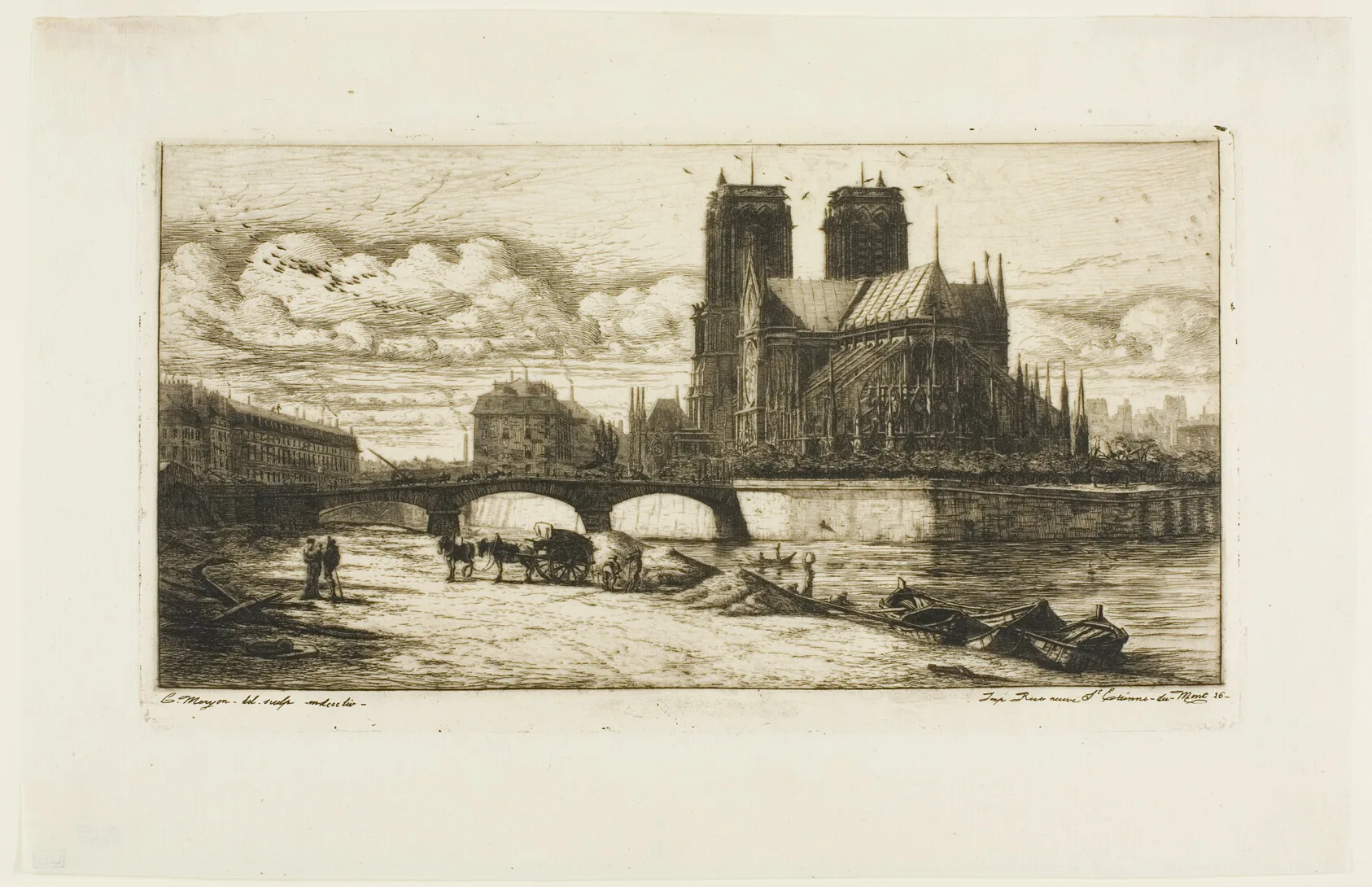
Meryon, The Apse of Notre-Dame, Paris, 1854. Etching and drypoint ivory laid paper.
Meryon, The Apse of Notre-Dame. Sharpest and darkest at the silhouette; everything else subordinate.
The Art Institute of Chicago · Clarence Buckingham Collection
Checklist0 / 1 - 4
Self-check
5 minTick each item honestly. If one is a no, the session is not finished; go back to that step.
Checklist0 / 3
What it should look like
- A drawing where you can point to the focal point and where everything else is quieter than it.
Where it goes wrong
- Two focal points. Could not choose. Soften one. Narrow its values.
- Detail everywhere, because it was already drawn. Sunk cost. The eraser is a drawing tool. Use it.
Log this session
Start the clock when you pick up the pencil. Stop it when you put it down. Log it. Every session counts toward the box.
Status
How did it go?