Page from a sketchbook
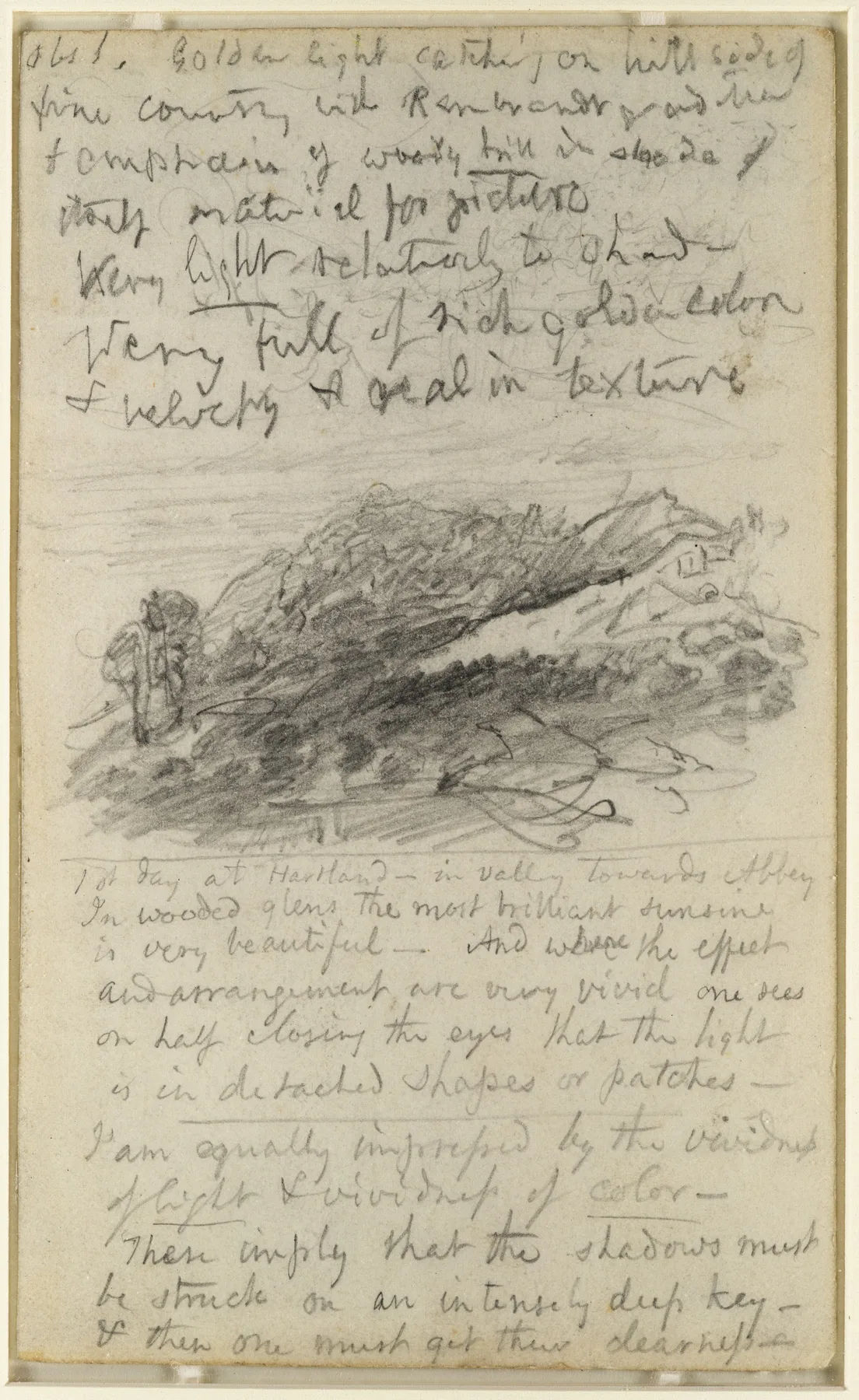
Palmer, Page from a sketchbook, ca. 1848 (?). Graphite.
The Metropolitan Museum of Art · Bequest of Mary Cushing Fosburgh, 1978
Page from a sketchbook
Palmer, ca. 1848 (?): a plate copy from graphite
Page from a sketchbook, ca. 1848 (?): Graphite, sheet: 7 3/16 x 4 7/16 in. (18.4 x 11.2 cm) (The Metropolitan Museum of Art). A plate copy: the standard protocol for graphite applied to this one sheet at the size of your book, with Palmer's own habits as the checklist. Find the brightest point. Measure how small it is.
- Master
- Samuel Palmer
- Difficulty
- Time
- about 2 h
- You draw with
- H, HB, 2B graphite
Why this one
- Tone built from many fine lines in layers, each layer a different direction.
- The tree trunk as the darkest, most worked passage, against a sky of pure paper or dense night.
- Moonlight: everything one value darker than you think, except the one light.
From your kit
The whole kit →- 1Grafwood H, HB, 2B H, HB for layout and line; 2B for the darks. Long points from the Blackwing on everything up to B.
- 2Kneaded eraser and the Mono Zero press-and-lift corrections only; the Mono Zero for a single sharp light.
- 3Alpha sketchbook 9 x 6 draw at the book's size and keep the proportions; date the page.
In general, this study asks for
- Drawing pad or the sketchbook
- 2H and H with long points
- HB and 2B for accents
- Kneaded eraser
- Precision eraser
Watch first
All videos →Timothy Wilcox on the Normandy tours and the Architectural Antiquities etchings. The architectural half of this course, explained by its curator.
YouTube Cotman in Normandy at Dulwich Picture GalleryDulwich Picture Gallery · Ten minutes with the drawings on the wall. Watch how few values Cotman uses.
 Giovanni Battista Piranesi etchings: the Views (Vedute di Roma)Busy Baçi · The whole Vedute series paged through. Note how small the figures are and how large Rome becomes.
The plan
5 stages · ~100 min- 1
Read the plate first
5 minBefore any mark, look at Page from a sketchbook for five minutes with the pencil down. Find the eye level or the horizon. Find the lightest light and the darkest dark and notice whether they touch. Count the big shapes: it is rarely more than four. Say what the picture is about in one sentence.
Checklist0 / 3 - 2
Envelope and masses
15 minMeasure the sheet's proportion and draw the envelope lightly at the size you will work. Place the horizon as a fraction of the height. Block the three or four big shapes as pale outlines, checking each against the others with the pencil held at arm's length. No detail yet; if a line is inside a shape, it is too early.
TipBeginners rush this stage. Masters spend half the drawing here.
Checklist0 / 3 - 3
The line, once
40 minWith the H and then the HB, draw the contours over the envelope, each line once, from the shoulder. Follow the original's economy: where it stops drawing, you stop. Where its line breaks, break yours. Keep the sky and the lit planes as untouched paper.
Decide the three darkest accents before you make them, and make them with the 2B last.
Checklist0 / 3 - 4
Tone from line
30 minWhere the original has tone, build it as the original does: parallel lines whose spacing is the value, following the plane. Squint at both sheets together and match the three values, not the detail.
Checklist0 / 2 - 5
Compare and note
10 minSide by side with the original: where did you add what was not there? Where did you darken what was light? Write one sentence on the sheet about what to change next time. Date it. Box it.
Checklist0 / 2
What it should look like
- A pale, exact drawing with more paper than pencil.
- Lines that can be counted, each one meaning something.
- Three values, with the darks saved for the end.
Where it goes wrong
- Everything the same weight. A single pressure flattens the space. Three weights: ghost for construction, firm for contour, heavy for the three accents.
- Shading creeps in early. Tone is comforting and hides a bad contour. No tone until the line is finished and checked.
Log this session
Start the clock when you pick up the pencil. Stop it when you put it down. Log it. Every session counts toward the box.
Status
How did it go?
Related studies
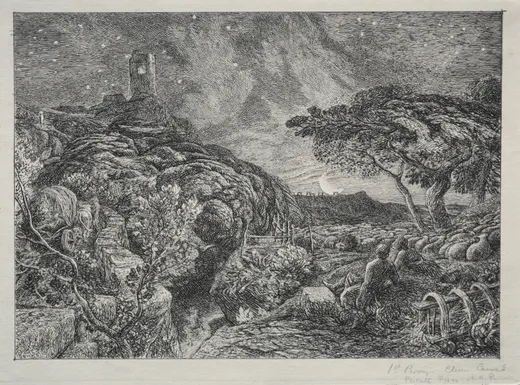 Master study
Palmer
The Lonely Tower
Palmer's night, to set beside Corot's: a point of light in a web of line
3h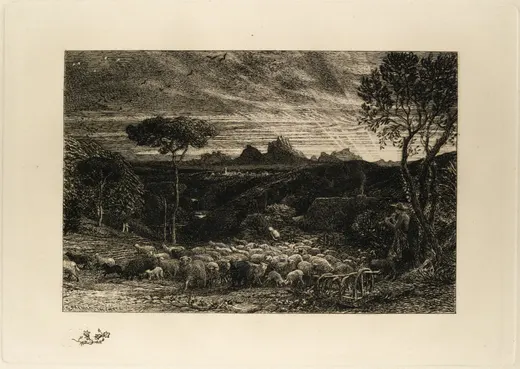 Master study
Palmer
Opening the Fold, or Early Morning
A sunrise built from line: the brightest thing is the least drawn
2.5h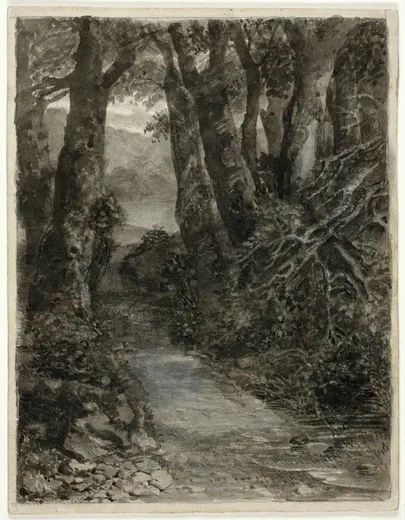 Master study
Palmer
A Woodland Study
A dark wood with one lit path, in brush and wash
2h