Tracery
Tracery
A two-light window from geometry, then the east window of Cley
Build a Gothic window from arcs and circles, and draw its bars by their dark negative shapes.
- Master
- John Sell Cotman
- Difficulty
- Time
- about 1 h
- You draw with
- 2H, HB, 2B
Why this one
- Unit 5 of the program: Architecture.
- A constructed window with correct proportions, whose tracery reads as stone bars over dark glass.
From your kit
The whole kit →- 1Grafwood 2H, HB, 2B 2H, HB for layout and line; 2B for the darks. Long points from the Blackwing on everything up to B.
- 2Kneaded eraser and the Mono Zero press-and-lift corrections only; the Mono Zero for a single sharp light.
- 3Alpha sketchbook 9 x 6 draw at the book's size and keep the proportions; date the page.
In general, this study asks for
- Drawing pad
- 2H, HB, 2B
- Compass optional
Watch first
All videos →Structure first, then tone, on a real stone building. The method of the Architecture studies in a modern hand.
YouTube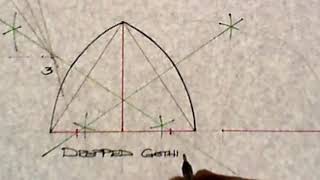

The plan
4 stages · ~59 min- 1
Construct a two-light window
18 minMain equilateral arch, four inches wide. Centre mullion. Two sub-arches, each two inches wide, equilateral. A circle in the spandrel touching the main arch and both sub-arches. Cusp the circle into a quatrefoil with four small arcs. Label the parts: arch, mullion, sub-arch, spandrel, quatrefoil.
FigureArch, mullion, two sub-arches, a circle, a quatrefoil. Checklist0 / 1 - 2
Negative shapes
18 minNow draw the same window again, but this time shade the dark glass shapes between the stone bars first, and let the bars be the paper left over. The bars come out in the right places and the window reads as stone with dark glass behind it.
Checklist0 / 1 - 3
Cley's east window
18 minFrom Cotman: sight the main arch, place the mullions, place the circle, strike the sub-arches, then shade the dark shapes. Suggest the cusps as dark notches; do not draw them as shapes. Fifteen minutes. Stop when it reads.
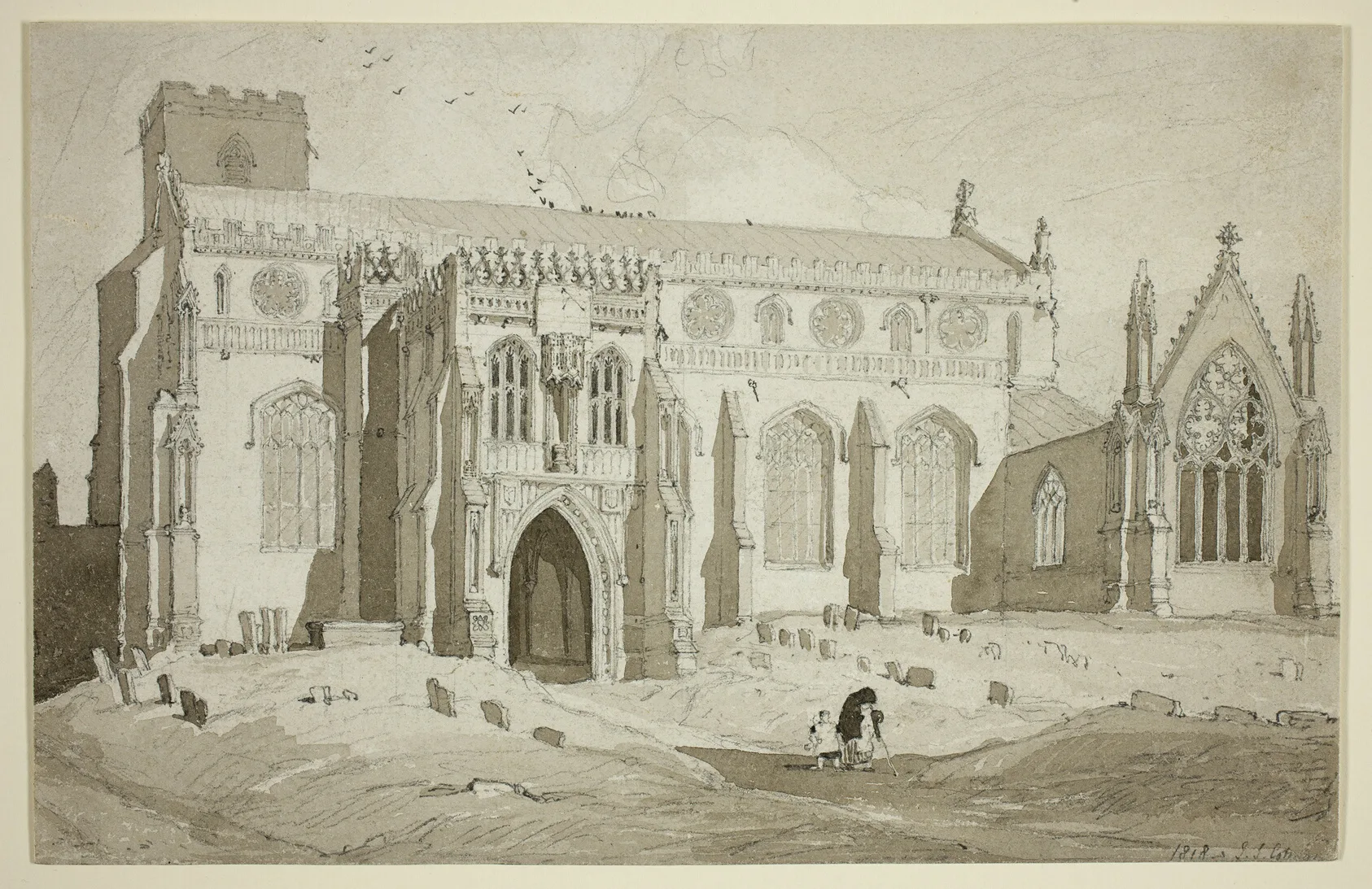
Cotman, Cley Church, Norfolk, 1818. Graphite and gray wash on ivory wove paper.
Cotman, Cley Church. The east window: nested arches and a circle, drawn freehand from geometry.
The Art Institute of Chicago · Gift of Dorothy Braude Edinburg to the Harry B. and Bessie K. Braude Memorial Collection
Checklist0 / 1 - 4
Self-check
5 minTick each item honestly. If one is a no, the session is not finished; go back to that step.
Checklist0 / 3
What it should look like
- A constructed window with correct proportions, whose tracery reads as stone bars over dark glass.
Where it goes wrong
- Tracery as a pattern drawn on the wall surface. The bars were drawn as lines, not as stone between dark shapes. Shade the glass shapes first.
Log this session
Start the clock when you pick up the pencil. Stop it when you put it down. Log it. Every session counts toward the box.
Status
How did it go?