Tone from line
Tone from line
A doorway in counted layers
Render a doorway in a wall using hatch layers only, each value a counted number of layers.
- Master
- Charles Meryon
- Difficulty
- Time
- about 1 h
- You draw with
- HB, sharp long point
Why this one
- Unit 4 of the program: Line: the Draughtsman's Half.
- A doorway whose depth and light are entirely described by how many hatch layers each plane carries.
From your kit
The whole kit →- 1Grafwood HB HB for layout and line. Long points from the Blackwing on everything up to B.
- 2Kneaded eraser and the Mono Zero press-and-lift corrections only; the Mono Zero for a single sharp light.
- 3Alpha sketchbook 9 x 6 draw at the book's size and keep the proportions; date the page.
In general, this study asks for
- Drawing pad or Bristol
- HB, sharp long point
- A photo of a doorway in a stone wall, in sun
Watch first
All videos →Timothy Wilcox on the Normandy tours and the Architectural Antiquities etchings. The architectural half of this course, explained by its curator.
YouTube Printmaking process: intaglioMinneapolis Institute of Art · Four minutes that make every etching in this catalogue legible: ground, needle, acid, ink, wipe, press.
 Rembrandt's printmaking process: 17th-century etchingNorwich Castle Museum · Shows how a plate is bitten in stages for lighter and darker line, the origin of counted tone.
The plan
4 stages · ~56 min- 1
Plan the counts
17 minDraw the doorway and its wall in light contour. Then, before hatching, write a number on each plane: lit wall 0 (paper) or 1, the reveal in shadow 2, the shadow under the lintel 3, the dark of the open door 4. The numbers are layers. Decide them all before the first hatch.
FigurePaper, one, two, three, four layers. Checklist0 / 1 - 2
Layer one everywhere it belongs
17 minLay the first layer, at forty-five degrees, over every plane numbered 1 or more. Even spacing, constant weight. Complete it before starting layer two. Then layer two at about one hundred and five degrees over every plane numbered 2 or more. Then three. Then four. Squint after each.
Checklist0 / 1 - 3
Accents and audit
17 minThe single darkest line is the underside of the lintel: a fifth layer or a firm stroke of 2B. Then squint and compare with the Cotman tower and the Meryon. Is each plane a clean, distinct value? If two merge, one more layer on the darker.
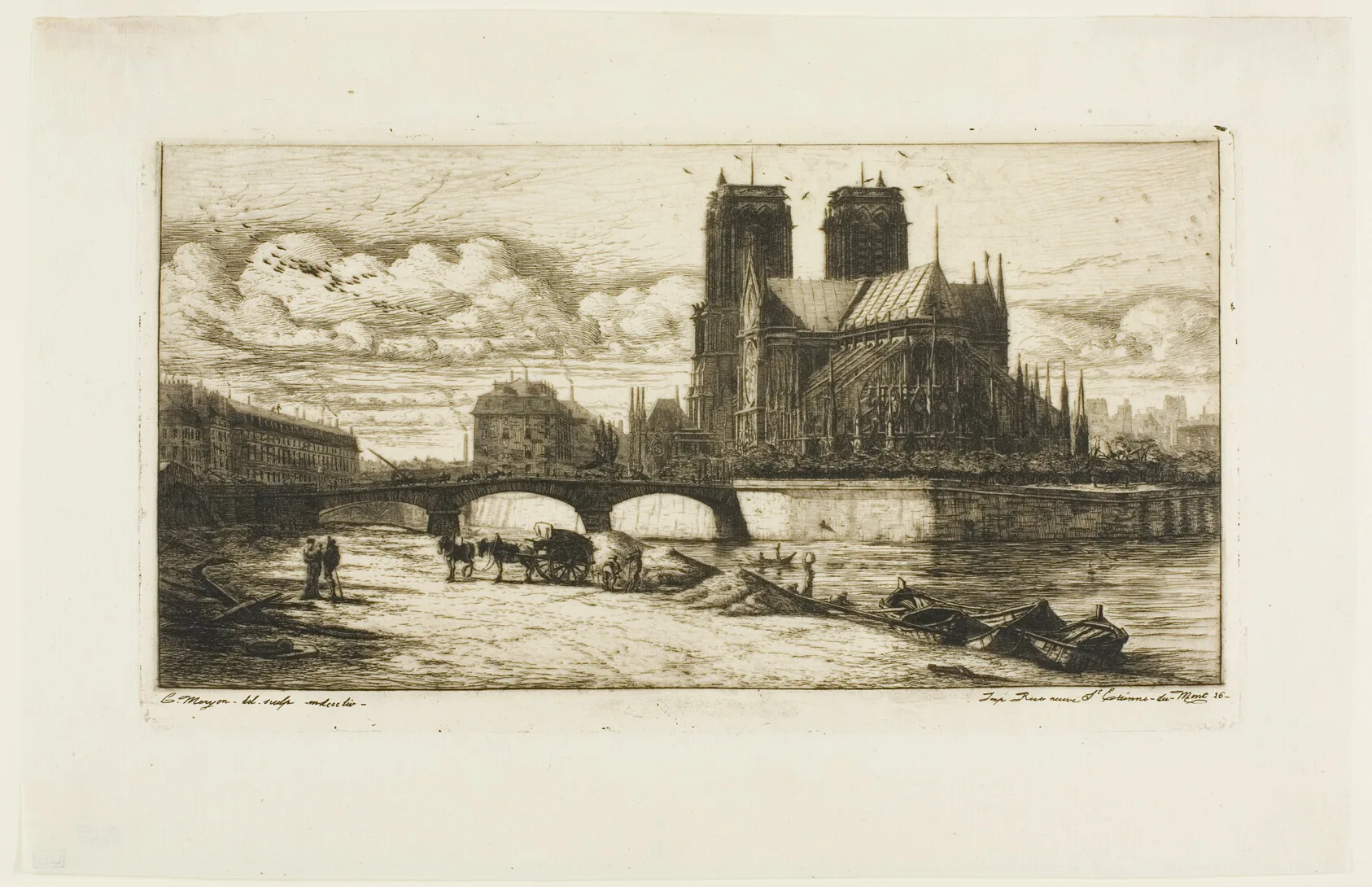
Meryon, The Apse of Notre-Dame, Paris, 1854. Etching and drypoint ivory laid paper.
Meryon, The Apse of Notre-Dame. Every value a count. Squint to see the values, open to count the layers.
The Art Institute of Chicago · Clarence Buckingham Collection
Checklist0 / 1 - 4
Self-check
5 minTick each item honestly. If one is a no, the session is not finished; go back to that step.
Checklist0 / 4
What it should look like
- A doorway whose depth and light are entirely described by how many hatch layers each plane carries.
Where it goes wrong
- Layers at ninety degrees. Screen effect. Forty-five, then about one hundred and five, then near horizontal.
- Deciding values as you go. The counts drift and the planes merge. Number every plane first. Hatch to the numbers.
Log this session
Start the clock when you pick up the pencil. Stop it when you put it down. Log it. Every session counts toward the box.
Status
How did it go?