Oak from Rocks
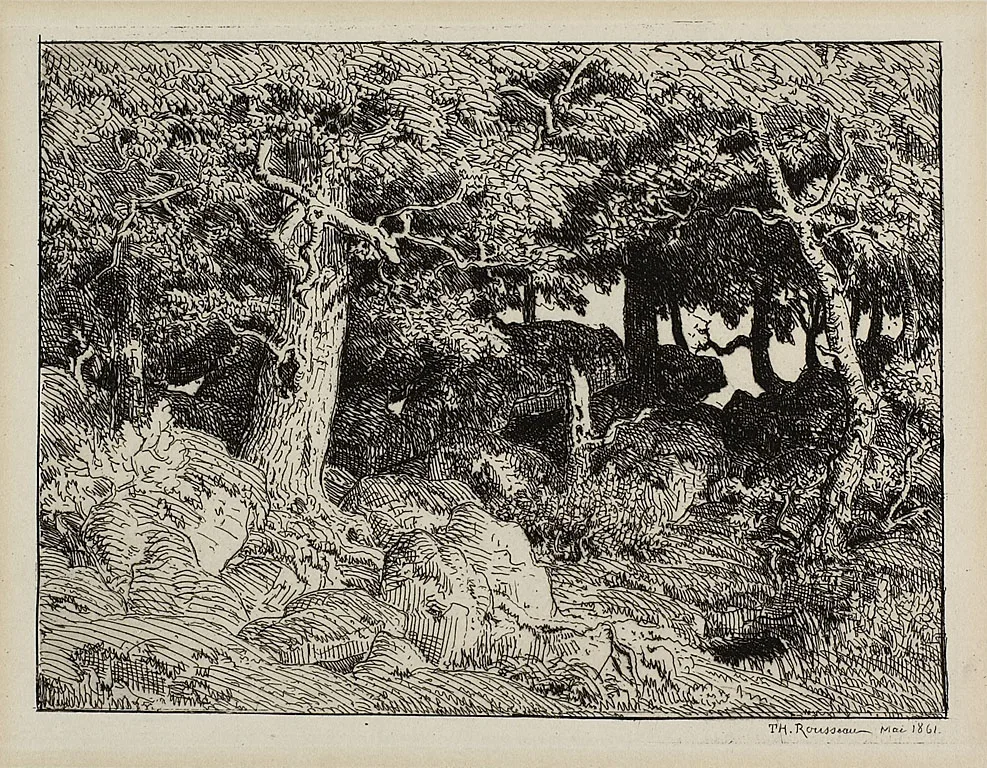
Rousseau, Oak from Rocks, 1861. Etching on ivory laid paper.
Pins mark where to look before you draw.
The Art Institute of Chicago · The Art Institute of Chicago
Oak from Rocks
A tree portrait: every fork followed from root to twig
An 1861 etching of a Fontainebleau oak growing out of the rocks, the whole branch system traced, the foliage a dense weave of fine lines with sky holes. Rousseau gives you the tree as an engineering drawing; Corot gives it as a mass. Draw this one and the Corot masses will sit on a skeleton you understand.
In pencilAn etched line is a drawn line. Copy it with hard grades and long points: tone from the spacing and direction of lines, cross-hatching only in the darkest third, no smudging anywhere.
- Master
- Théodore Rousseau
- Difficulty
- Time
- about 3 h
- You draw with
- H, HB, 2B graphite
Why this one
- Branch logic followed through every fork: the complete lesson.
- Foliage as texture built from line density, not as outlined leaves.
- Rocks and roots as part of the same structure.
From your kit
The whole kit →- 1Grafwood H, HB, 2B H, HB for layout and line; 2B for the darks. Long points from the Blackwing on everything up to B.
- 2Kneaded eraser and the Mono Zero press-and-lift corrections only; the Mono Zero for a single sharp light.
- 3Alpha sketchbook 9 x 6 draw at the book's size and keep the proportions; date the page.
In general, this study asks for
- Drawing pad or smooth cartridge
- 2H and H with long points
- HB for accents
- Kneaded eraser
- Sandpaper block
Watch first
All videos →Clump construction and sky holes.
YouTube
The plan
4 stages · ~130 min- 1
The skeleton
30 minH: trunk first, then every major limb, following each fork: it leans, it forks, each branch thinner than its parent, nothing crosses without a reason. Draw the skeleton as if there were no leaves.
FigureLean, fork, thin. Checklist0 / 3 - 2
The canopy as mass
30 minHB: around the skeleton, the foliage as clumps of hatching, dense at the centre of each clump, open at its edge. Leave sky holes where the plate leaves them, mostly near the canopy's edge.
FigureHoles near the edge, where the mass thins. Checklist0 / 2 - 3
Rocks, darks, texture
60 min2B: the darkest shadows in the canopy's underside and between the rocks. Rocks hatched along their surface. Leaf texture only at the edges of clumps, where leaves meet sky.
FigureTexture at the edge. Checklist0 / 3 - 4
Compare
10 minPick a branch on the plate and find it on yours. Note, date, box.
Checklist0 / 2
What it should look like
- A tree with a skeleton you could trace.
- Foliage that is dense but not solid.
- Rocks and roots that belong to each other.
Where it goes wrong
- Leaves drawn one by one. You can see them. Leaves are texture at the edge of a mass. Inside the mass they are tone.
Log this session
Start the clock when you pick up the pencil. Stop it when you put it down. Log it. Every session counts toward the box.
Status
How did it go?
Before this, ideally
Related studies
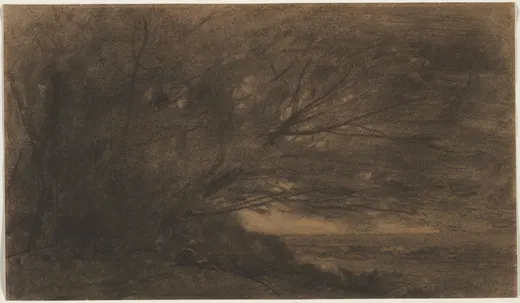 Master study
Corot · The late charcoals
Landscape (The Large Tree)
One dark mass, the lights lifted out
1.5h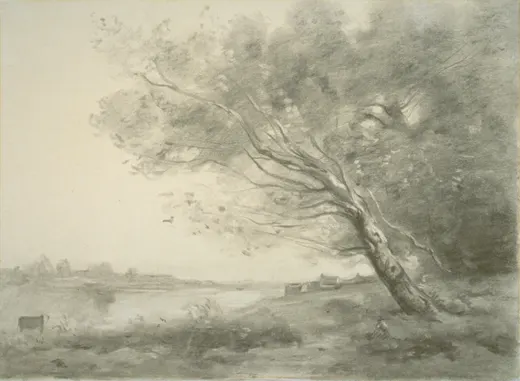 Master study
Corot · The late charcoals
Bent Tree by the Water
Three divisions of light, a cow, and a leaning trunk
2h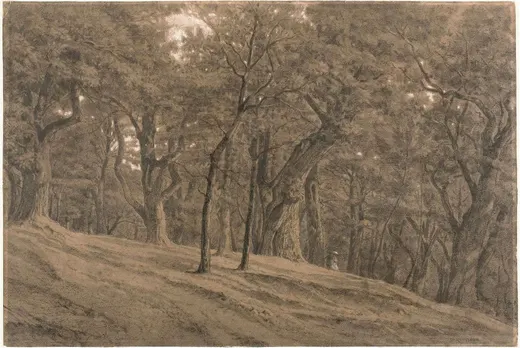 Master study
Rousseau
In the Forest of Fontainebleau
A screen of trunks in charcoal, with the light coming through
2h