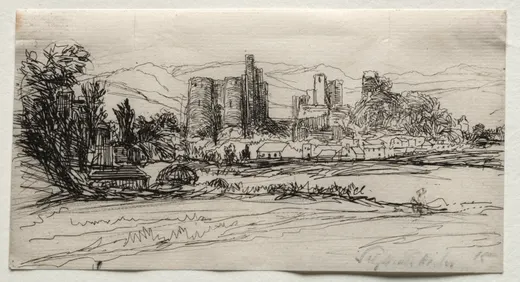
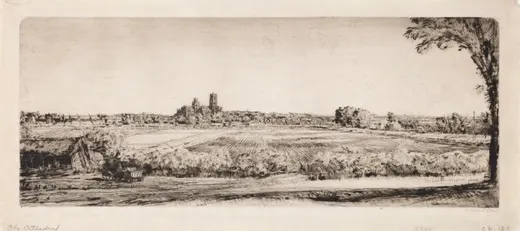
Sawley Abbey
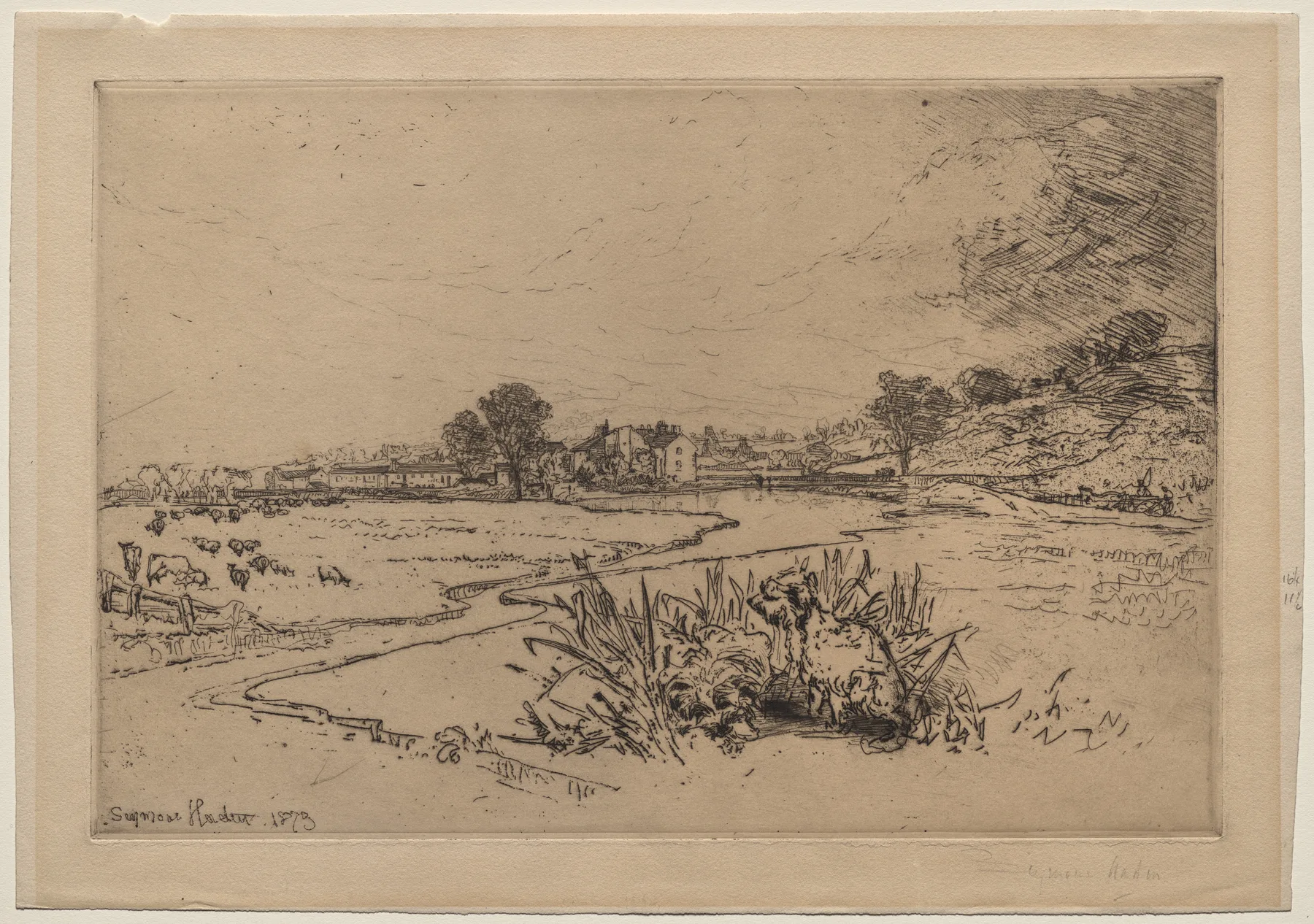
Seymour Haden, Sawley Abbey, 1873. etching.
Pins mark where to look before you draw.
The Cleveland Museum of Art · In memory of Ralph King, gift of Mrs. Ralph King; Ralph T. Woods, Charles G. King; and Frances King Schafer
Sawley Abbey
A ruin the size of a thumb in a sheet of sky and field
An 1873 plate: a wide flat valley, the Ribble, and the small ruin of the Cistercian abbey in the middle distance. Haden gives the ruin almost nothing and the field and sky almost everything. A study in how a landscape holds a small building.
In pencilAn etched line is a drawn line. Copy it with hard grades and long points: tone from the spacing and direction of lines, cross-hatching only in the darkest third, no smudging anywhere.
- Difficulty
- Time
- about 1.5 h
- You draw with
- H, HB, 2B graphite
Why this one
- The low horizon and the big sky: the Daubigny format in an English valley.
- A ruin drawn in five lines that still reads as an abbey.
- Field texture that changes with distance.
From your kit
The whole kit →- 1Grafwood H, HB, 2B H, HB for layout and line; 2B for the darks. Long points from the Blackwing on everything up to B.
- 2Kneaded eraser and the Mono Zero press-and-lift corrections only; the Mono Zero for a single sharp light.
- 3Alpha sketchbook 9 x 6 draw at the book's size and keep the proportions; date the page.
In general, this study asks for
- Drawing pad or smooth cartridge
- 2H and H with long points
- HB for accents
- Kneaded eraser
- Sandpaper block
Watch first
All videos →Five hills, five values, in graphite.
YouTube
The plan
3 stages · ~50 min- 1
Horizon low
10 minMeasure how low the horizon sits: about a third up. Draw the envelope, the horizon, the river band.
FigureA low horizon in a wide field. Checklist0 / 2 - 2
Three planes
30 minH for the far hills and the ruin; HB for the middle field and river; 2B for the near grass strokes. Spacing opens toward the horizon.
FigureSpacing opens with distance. Checklist0 / 3 - 3
Compare
10 minDid the ruin grow? It should not have. Note, date, box.
Checklist0 / 2
What it should look like
- A landscape with a small ruin in it, not a ruin with landscape around it.
- Sky as paper.
Where it goes wrong
- The ruin grows. It is the named subject. Measure its height against the sheet before you draw it, and again after.
Log this session
Start the clock when you pick up the pencil. Stop it when you put it down. Log it. Every session counts toward the box.
Status
How did it go?
Before this, ideally