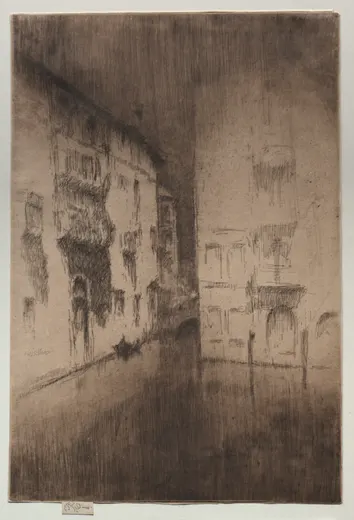
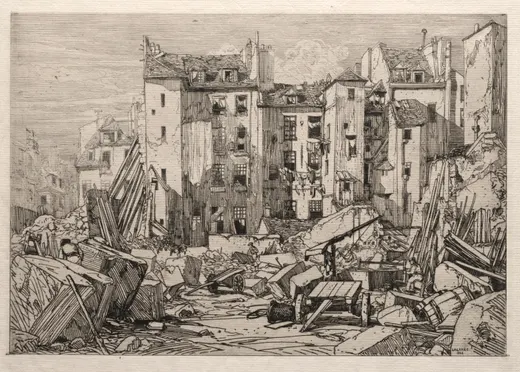
Le Pont des Arts at dusk
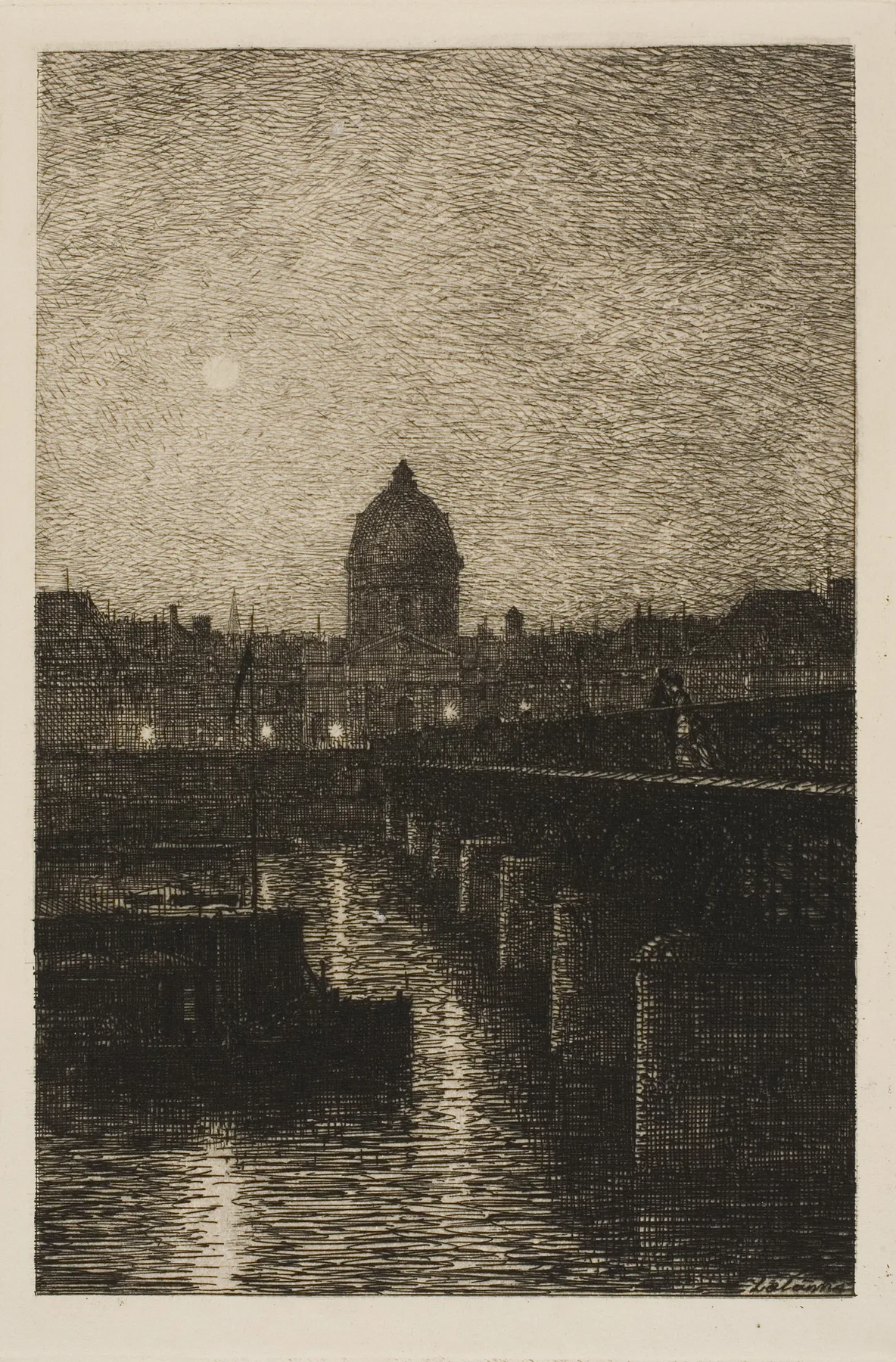
Lalanne, Le Pont des Arts, 1869. Etching and drypoint on cream laid paper.
Pins mark where to look before you draw.
The Art Institute of Chicago · The Art Institute of Chicago
Le Pont des Arts at dusk
A bridge, a lamp and a dome drawn as masses in failing light
An 1869 etching and drypoint of the iron footbridge with the Institut's dome behind it at dusk, a lamp lit, the river dark. Lalanne the charcoal draughtsman shows through the etching: the plate is masses first and lines second.
In pencilDrypoint burr gives this plate its velvet darks. Lay the masses with the side of the 4B and 6B, lift the lamp with the Mono Zero, and keep every edge soft but the lamp's.
- Master
- Maxime Lalanne
- Difficulty
- Time
- about 2 h
- You draw with
- 2B, 4B, 6B graphite on their sides, kneaded eraser
Why this one
- Lalanne's two habits in one plate: tone that keeps structure, line that behaves like tone.
- A lamp as the one light in a dusk drawing.
- Arches as dark voids in a dark bridge.
From your kit
The whole kit →- 1Grafwood 2B, 4B, 6B 2B, 4B, 6B for the darks, on their sides for mass. Long points from the Blackwing on everything up to B.
- 2Pitt Matt 8B to 12B for the big tone passages: matt, so the dark mass reads as tone, not shine.
- 3Kneaded eraser (warm it) and the clean Mono Zero lift the lights out of the mass; the Mono Zero for sky holes and lit edges.
- 4Alpha sketchbook 9 x 6 draw at the book's size and keep the proportions; date the page.
In general, this study asks for
- Drawing pad, medium tooth
- 2B, 4B, 6B with long points
- Kneaded eraser
- Precision eraser
- Slip sheet
Watch first
All videos →Laying a charcoal ground and lifting the lights out, the late-Corot method.
YouTube
The plan
4 stages · ~85 min- 1
Order the values
10 minName the values aloud from lightest to darkest: lamp, sky, dome, bridge, arches, water. Thumbnail them in four steps.
FigureIn daylight the sky is lightest; at dusk the lamp is. Checklist0 / 2 - 2
Masses
35 min4B on its side: sky palest, then the dome, then the bridge as a band, then the water. 6B: the arches as voids. No lines, no edges.
FigureGroup, then separate. Checklist0 / 3 - 3
Lamp and edges
30 minMono Zero: the lamp, one clean lift, and a broken vertical for its reflection. Then decide the two edges that stay sharp (the bridge's deck line, the lamp) and lose the rest.
FigureTwo hard edges. Checklist0 / 2 - 4
Compare
10 minNote, date, box.
Checklist0 / 2
What it should look like
- A dusk scene with one light and soft everything.
- Arches you read as a row of darks.
Where it goes wrong
- The sky stays white. Paper is the easy sky. At dusk the sky has a value; lay it and let the lamp be the only paper.
Log this session
Start the clock when you pick up the pencil. Stop it when you put it down. Log it. Every session counts toward the box.
Status
How did it go?