Demolition of Old Houses in Paris
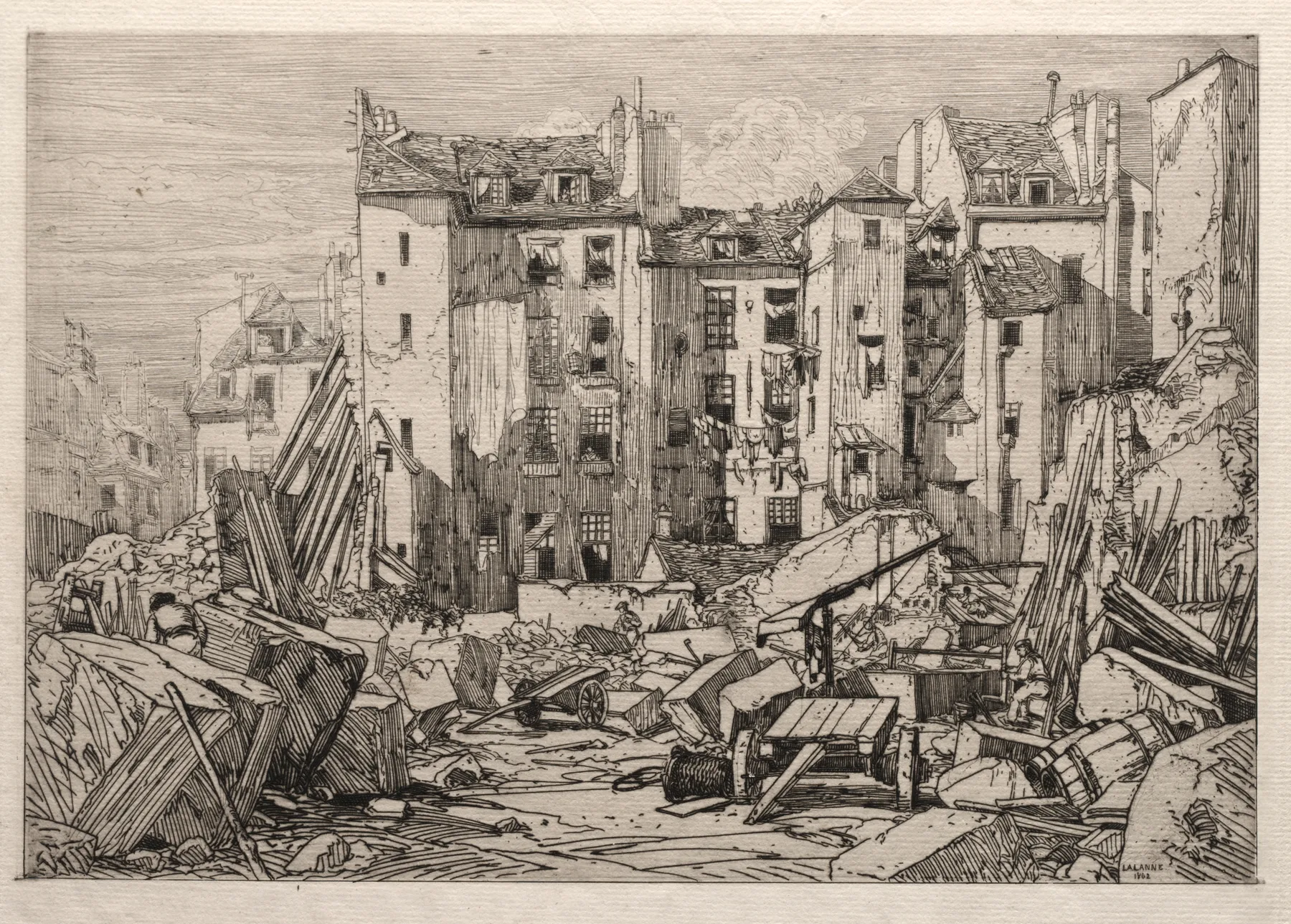
Lalanne, Demolition of Old Houses in Paris, 1862. etching.
Pins mark where to look before you draw.
The Cleveland Museum of Art · Gift of Frederick Keppel and Co., Inc., The Frederick Keppel Memorial
Demolition of Old Houses in Paris
Party walls, rubble and a city block as three planes
Haussmann's Paris being torn down, 1862: a row of houses with their party walls exposed, chimney breasts and wallpaper hanging in the air, a hill of rubble in the foreground. Lalanne builds the block from a few planes and hangs the chaos on them with hatching that always follows the plane it sits on.
In pencilAn etched line is a drawn line. Copy it with hard grades and long points: tone from the spacing and direction of lines, cross-hatching only in the darkest third, no smudging anywhere.
- Master
- Maxime Lalanne
- Difficulty
- Time
- about 3 h
- You draw with
- H, HB and 2B graphite
Why this one
- A city block as geometry first, chaos second.
- Hatching that changes direction with every plane: the Lalanne signature.
- Rubble as a mass with a texture, not a pile of drawn stones.
From your kit
The whole kit →- 1Grafwood H, HB, 2B H, HB for layout and line; 2B for the darks. Long points from the Blackwing on everything up to B.
- 2Kneaded eraser and the Mono Zero press-and-lift corrections only; the Mono Zero for a single sharp light.
- 3Alpha sketchbook 9 x 6 draw at the book's size and keep the proportions; date the page.
In general, this study asks for
- Drawing pad or smooth cartridge
- 2H and H with long points
- HB for accents
- Kneaded eraser
- Sandpaper block
Watch first
All videos →Cross-hatching taught as a value system, which is how the etchers used it.
YouTube

The plan
4 stages · ~130 min- 1
Eye level and planes
20 minFind the low eye level. Envelope the block, then divide it into its planes: street fronts, party walls, roofs. Mark the direction each plane faces.
FigureLow eye level: you look up. Checklist0 / 2 - 2
Structure
40 minH: the planes as converging rectangles, chimney breasts as vertical strips, window voids as rectangles. Keep the party walls as flat shapes; do not draw wallpaper yet.
FigureConverging to a point off the sheet. Checklist0 / 3 - 3
Hatching by plane
60 minHB: each plane hatched in its own direction, spacing set by its value: street fronts closest, party walls widest. 2B: the window voids and the rubble's base. Texture only at the rubble's top edge and where wallpaper hangs.
FigureTexture lives at the edge of a mass. Checklist0 / 3 - 4
Compare
10 minNote which planes read and which fused. Date, box.
Checklist0 / 2
What it should look like
- A block of houses you could walk around, torn open.
- Hatching that tells you which way each wall faces.
- Rubble as one dark mass.
Where it goes wrong
- All hatching one direction. Habit of the hand. Turn the sheet for each plane. Lalanne did.
Log this session
Start the clock when you pick up the pencil. Stop it when you put it down. Log it. Every session counts toward the box.
Status
How did it go?
Before this, ideally