Nocturne: Palaces
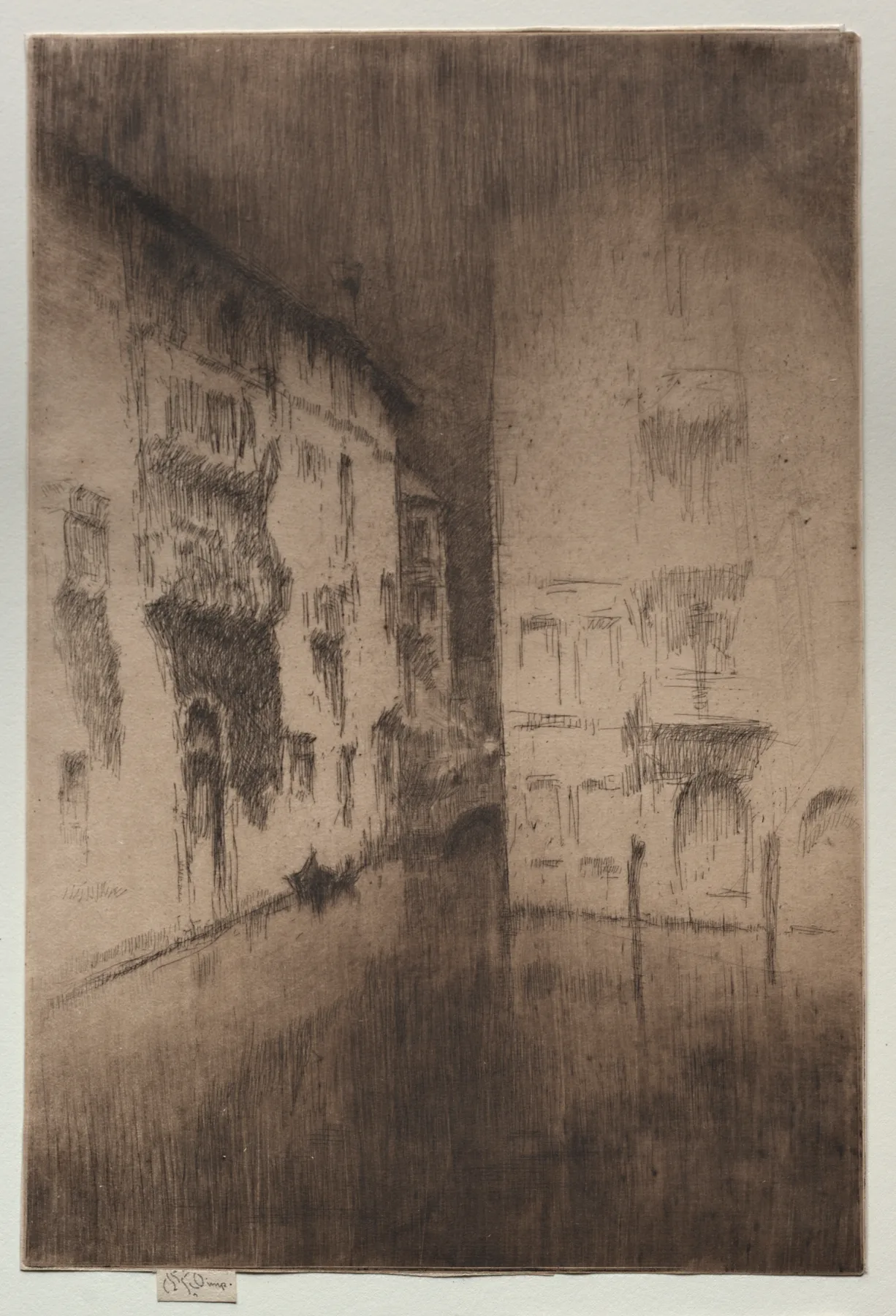
Whistler, Nocturne: Palaces, 1879–80. etching.
Pins mark where to look before you draw.
The Cleveland Museum of Art · Gift of Mr. and Mrs. Ralph King
Nocturne: Palaces
A canal at night, drawn with what is left out
From the second Venice set, 1879 to 1880: palaces along a canal at night, the plate tone left on the copper so the whole image swims in grey, a single lamp, a few windows, the water below. Whistler drew the dark and wiped the light. In pencil this is a subtractive study: lay the night, then take the lights out.
In pencilWhistler left a film of ink on the plate and wiped it away for the lights. Lay a 4B field with the side of the lead over the whole sheet, then draw the lights with the kneaded eraser and the Mono Zero, the lamp last and sharpest.
- Master
- James McNeill Whistler
- Difficulty
- Time
- about 2 h
- You draw with
- 2B, 4B, 6B graphite on their sides, kneaded eraser
Why this one
- The subtractive method in its purest form: a field of tone, then lifted lights.
- Architecture reduced to a few windows and an edge.
- A lesson in how little information a night scene needs.
From your kit
The whole kit →- 1Grafwood 2B, 4B, 6B 2B, 4B, 6B for the darks, on their sides for mass. Long points from the Blackwing on everything up to B.
- 2Pitt Matt 8B to 12B for the big tone passages: matt, so the dark mass reads as tone, not shine.
- 3Kneaded eraser (warm it) and the clean Mono Zero lift the lights out of the mass; the Mono Zero for sky holes and lit edges.
- 4Alpha sketchbook 9 x 6 draw at the book's size and keep the proportions; date the page.
In general, this study asks for
- Drawing pad, medium tooth
- 2B, 4B, 6B with long points
- Kneaded eraser
- Precision eraser
- Slip sheet
Watch first
All videos →Laying a charcoal ground and lifting the lights out, the late-Corot method.
YouTube
The plan
4 stages · ~95 min- 1
Lay the night
20 min4B on its side, slip sheet under the hand: an even field over the whole drawing area at a middle-dark value. Then 6B over the palace masses, slightly darker, edges soft. No lights yet.
FigureAn even field first. Checklist0 / 3 - 2
Take the lights out
45 minKneaded eraser, warmed, pressed to a chisel: the windows as soft pale rectangles. Pulled downward: their reflections. Mono Zero, clean: the lamp, one hard-edged lift, and its reflection as a broken vertical.
FigureA reflection is the light pulled downward. Checklist0 / 3 - 3
Edges
20 minDecide the one or two edges that are sharp (the lamp, maybe one roofline) and leave every other edge lost. Stand back. If anything but the lamp has a hard edge, soften it with a finger.
FigureOne hard edge in a sea of lost ones. Checklist0 / 2 - 4
Compare
10 minHow many windows did Whistler draw? How many did you? Note, date, box.
Checklist0 / 2
What it should look like
- A grey field with a few lights taken out of it.
- One sharp lamp and nothing else sharp.
- Palaces you believe without being able to count their storeys.
Where it goes wrong
- Drawing the palaces. You know what a palace looks like. Whistler did not draw them. He lifted eight windows. Do that.
- The field goes streaky. Pressure and tip. Side of the lead, three passes at three angles, slip sheet.
Log this session
Start the clock when you pick up the pencil. Stop it when you put it down. Log it. Every session counts toward the box.
Status
How did it go?
Related studies
 Master study
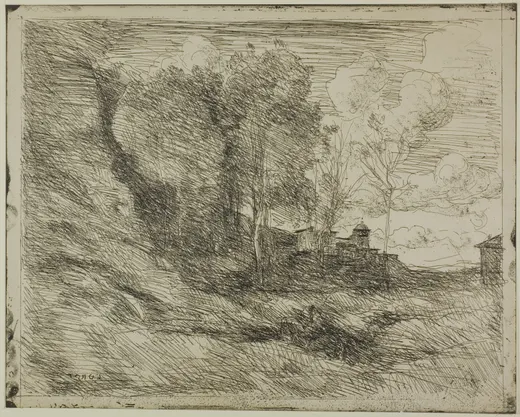
Corot · Cliché-verre: drawing on glass
Souvenir of Ostia
Your first negative drawing
1h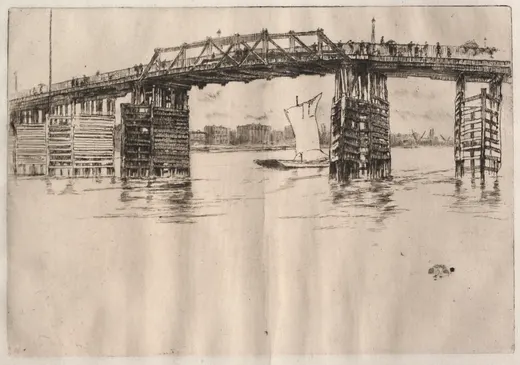 Master study
Whistler
Old Battersea Bridge
A timber bridge drawn in full, a river drawn in fragments
2h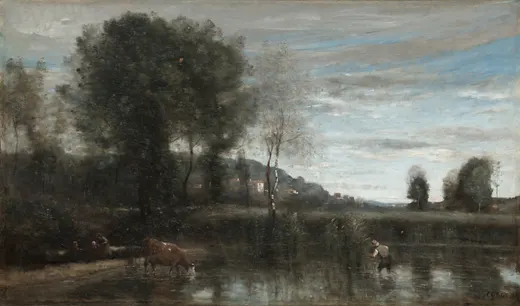 Master study
Corot · Souvenirs: the late paintings
Pond at Ville-d'Avray
The sky laid flat, a half-step darker
1.5h