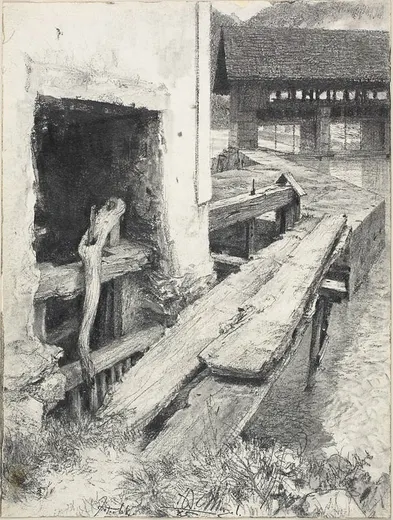
Falls of the Rhine at Schaffhausen
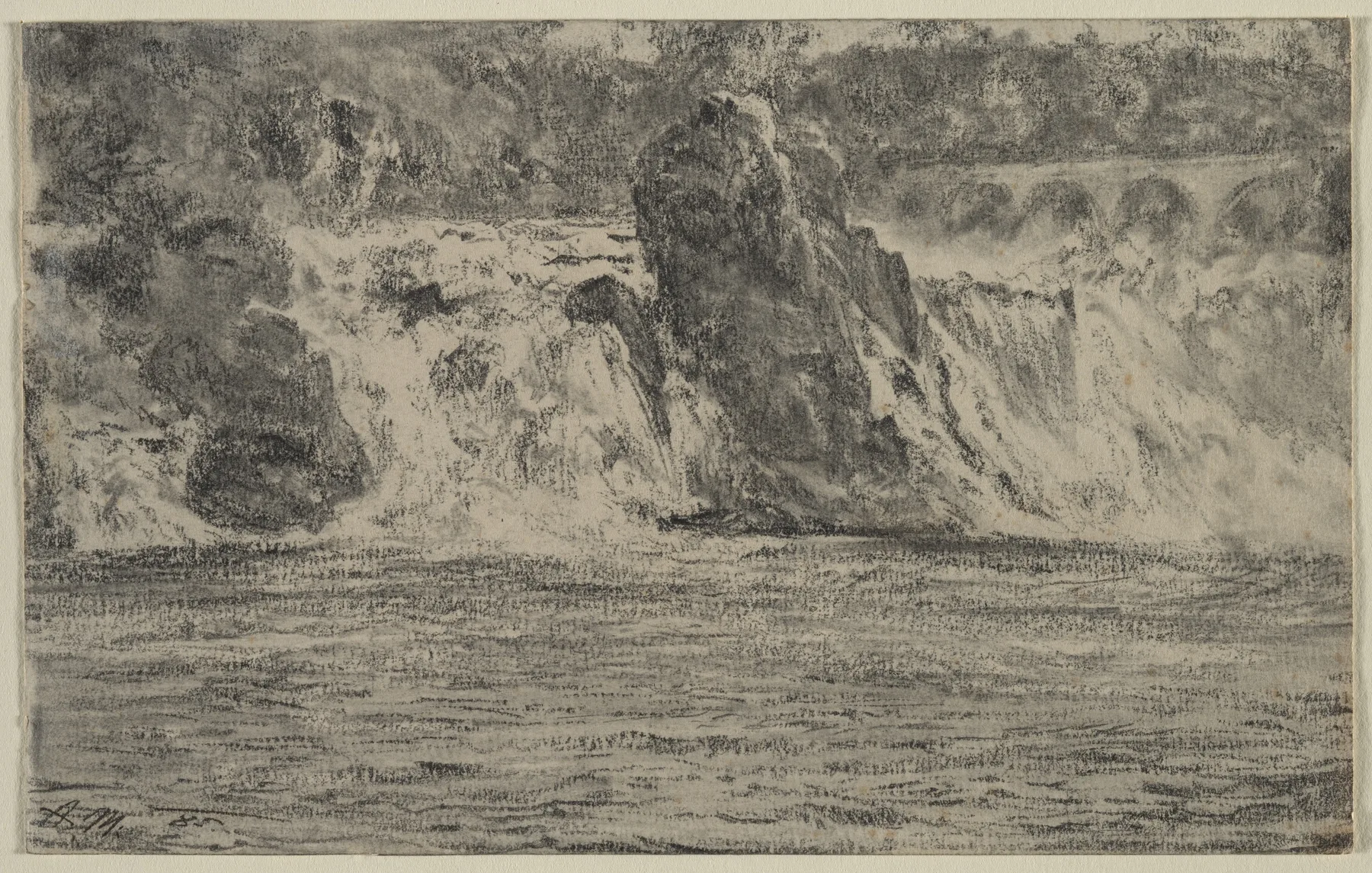
Menzel, Falls of the Rhine at Schaffhausen (Rheinfall von Schaffhausen), 1885. graphite, with stumping (traces of white paint, along left edge, unrelated to composition).
Pins mark where to look before you draw.
The Cleveland Museum of Art · Andrew R. and Martha Holden Jennings Fund
Falls of the Rhine at Schaffhausen
Falling water as lifted light, with stumping as the second tool
An 1885 graphite with stumping: the great falls, the rock in the middle of them, spray, the far bank. Menzel draws moving water the only way it can be drawn: as tone laid and lifted, with the stump doing the mist.
- Master
- Adolph Menzel
- Difficulty
- Time
- about 2 h
- You draw with
- 2B, 4B, 6B graphite on their sides, kneaded eraser, stump
Why this one
- Water as mass and lifted light, not as lines.
- The stump as a drawing tool for spray and mist.
- A rock as the one hard thing in a sheet of soft.
From your kit
The whole kit →- 1Grafwood 2B, 4B, 6B 2B, 4B, 6B for the darks, on their sides for mass. Long points from the Blackwing on everything up to B.
- 2Pitt Matt 8B to 12B for the big tone passages: matt, so the dark mass reads as tone, not shine.
- 3Kneaded eraser (warm it) and the clean Mono Zero lift the lights out of the mass; the Mono Zero for sky holes and lit edges.
- 4Alpha sketchbook 9 x 6 draw at the book's size and keep the proportions; date the page.
In general, this study asks for
- Drawing pad, medium tooth
- 2B, 4B, 6B with long points
- Kneaded eraser
- Precision eraser
- Slip sheet
Watch first
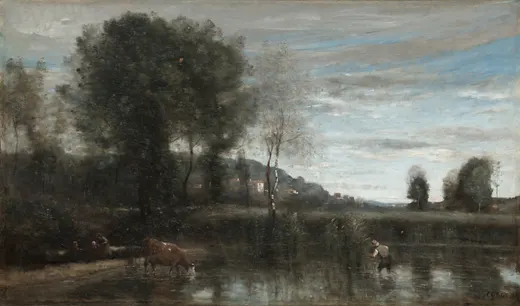
All videos →Vertical strokes, darker lights, horizontal breaks: the pond at Ville-d'Avray in method.
YouTube
The plan
3 stages · ~100 min- 1
Lay the greys
25 min4B on its side: the whole falls as a middle grey, the far bank darker, the sky palest. Stump everything soft.
FigureAn even field to lift from. Checklist0 / 2 - 2
Lift the water
40 minKneaded eraser pulled downward: the falling water as vertical lifts, strongest where the water is thickest. The spray as soft dabs. Leave grey between the lifts.
FigureWater is lifted light. Checklist0 / 3 - 3
The rock and compare
35 min6B point: the rock, with hard edges and the darkest value; its base lost into the foam. Compare. Note, date, box.
Checklist0 / 3
What it should look like
- Water that falls.
- One hard rock in soft everything.
- No lines in the water at all.
Where it goes wrong
- Water drawn as lines. Water has streaks. The streaks are lights. Lift them out of grey.
Log this session
Start the clock when you pick up the pencil. Stop it when you put it down. Log it. Every session counts toward the box.
Status
How did it go?
Before this, ideally