The Bridge
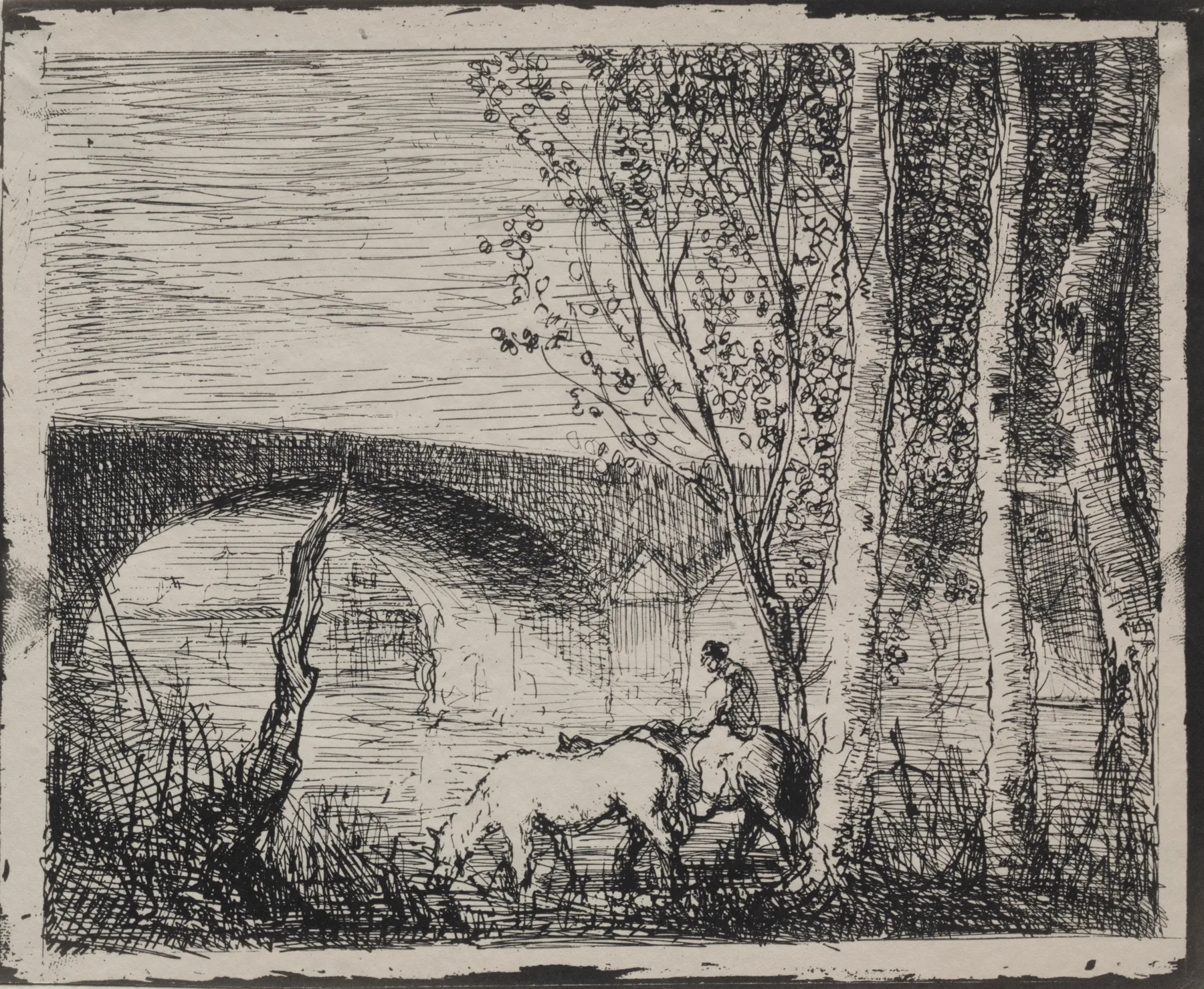
Daubigny, The Bridge, original impression 1862, printed in 1921. cliché-verre.
The Cleveland Museum of Art · Gift of The Print Club of Cleveland
The Bridge
Daubigny: a plate copy from a scratched line
The Bridge: cliché-verre, Sheet: 16.4 x 20.7 cm (6 7/16 x 8 1/8 in.) (The Cleveland Museum of Art). A plate copy: the standard protocol for a scratched line applied to this one sheet at the size of your book, with Daubigny's own habits as the checklist. Where is the horizon? Measure it against the height of the sheet.
In pencilA cliche-verre is drawn by scratching through an opaque coating on glass, then printed like a photograph: every scratched line prints dark, and the untouched coating prints white. The drawing is all line, with no tone except what line density gives. Copy it on scratchboard, or lay a flat 4B field and draw with the eraser as if it were the stylus.
- Difficulty
- Time
- about 1.5 h
- You draw with
- scratchboard and stylus, or 4B tone and a precision eraser
Why this one
- The low horizon and the big sky, with the trees as a screen against it.
- Water laid in long horizontals, trees in short verticals.
- Daubigny's cliche-verre: scratch through a dark ground and let the light draw.
From your kit
The whole kit →- 1Grafwood 4B laid flat, then the Mono Zero lay an even tone with the side, then draw the lights out with the eraser as if it were the stylus.
- 2Kneaded eraser (warm it) and the clean Mono Zero press-and-lift corrections only; the Mono Zero for a single sharp light.
- 3Alpha sketchbook 9 x 6 draw at the book's size and keep the proportions; date the page.
In general, this study asks for
- A scratchboard and stylus, or
- 4B graphite laid as a flat tone plus a precision eraser
Watch first
All videos →Timothy Wilcox on the Normandy tours and the Architectural Antiquities etchings. The architectural half of this course, explained by its curator.
YouTube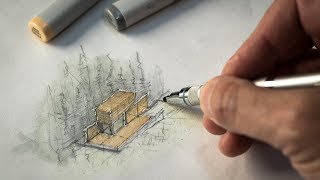 Sketch like an architect: techniques and tips from a real project30X40 Design Workshop · Line weight hierarchy and when to stop, from an architect.
 Trésors de Richelieu: voyage en clichés-verre avec Camille CorotINHA · Curators handle Corot's actual glass plates and prints. French; the images carry it even without captions.
The plan
5 stages · ~80 min- 1
Read the plate first
5 minBefore any mark, look at The Bridge for five minutes with the pencil down. Find the eye level or the horizon. Find the lightest light and the darkest dark and notice whether they touch. Count the big shapes: it is rarely more than four. Say what the picture is about in one sentence.
Checklist0 / 3 - 2
Envelope and masses
10 minMeasure the sheet's proportion and draw the envelope lightly at the size you will work. Place the horizon as a fraction of the height. Block the three or four big shapes as pale outlines, checking each against the others with the pencil held at arm's length. No detail yet; if a line is inside a shape, it is too early.
TipBeginners rush this stage. Masters spend half the drawing here.
Checklist0 / 3 - 3
Lay the field
15 minIf working in graphite: cover the drawing area with an even 4B field at a middle-dark value, side of the lead, slip sheet under the hand. This is your coated glass.
Checklist0 / 2 - 4
Draw the light out
40 minNow every mark takes tone away. With the precision eraser (or stylus), draw the lines the plate shows as light, and leave dark where it is dark. Density of scratched lines makes the lights; untouched field makes the darks. Work from the largest light to the smallest.
Checklist0 / 3 - 5
Compare and note
10 minSide by side with the original: where did you add what was not there? Where did you darken what was light? Write one sentence on the sheet about what to change next time. Date it. Box it.
Checklist0 / 2
What it should look like
- A drawing that reads as light lines on dark.
- No shading: only the density of scratched line.
Where it goes wrong
- Thinking in positive line. Every habit says draw the dark. Say 'I am drawing the light' before each stroke.
Log this session
Start the clock when you pick up the pencil. Stop it when you put it down. Log it. Every session counts toward the box.
Status
How did it go?
Related studies
 Master study
Daubigny
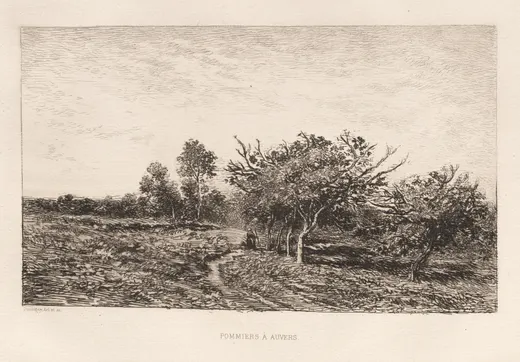
Apple Trees at Auvers
Trees as a screen, horizon low, sky two-thirds of the sheet
1.5h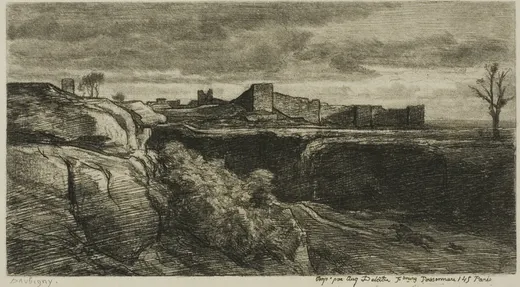 Master study
Daubigny
Ruins of the Château of Crémieux
A dark landscape with a ruin on the ridge and the sky as the only light
2h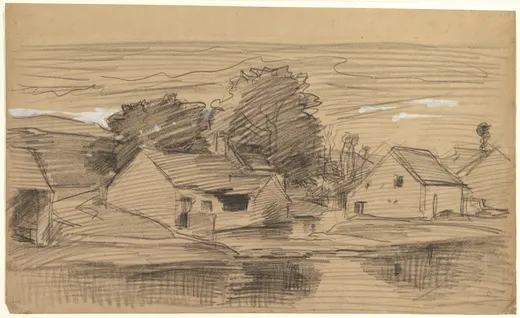 Master study
Daubigny
The Hamlet of Optevoz
Roofs and trees in charcoal, with the lights picked out in white
2h