Apple Trees at Auvers
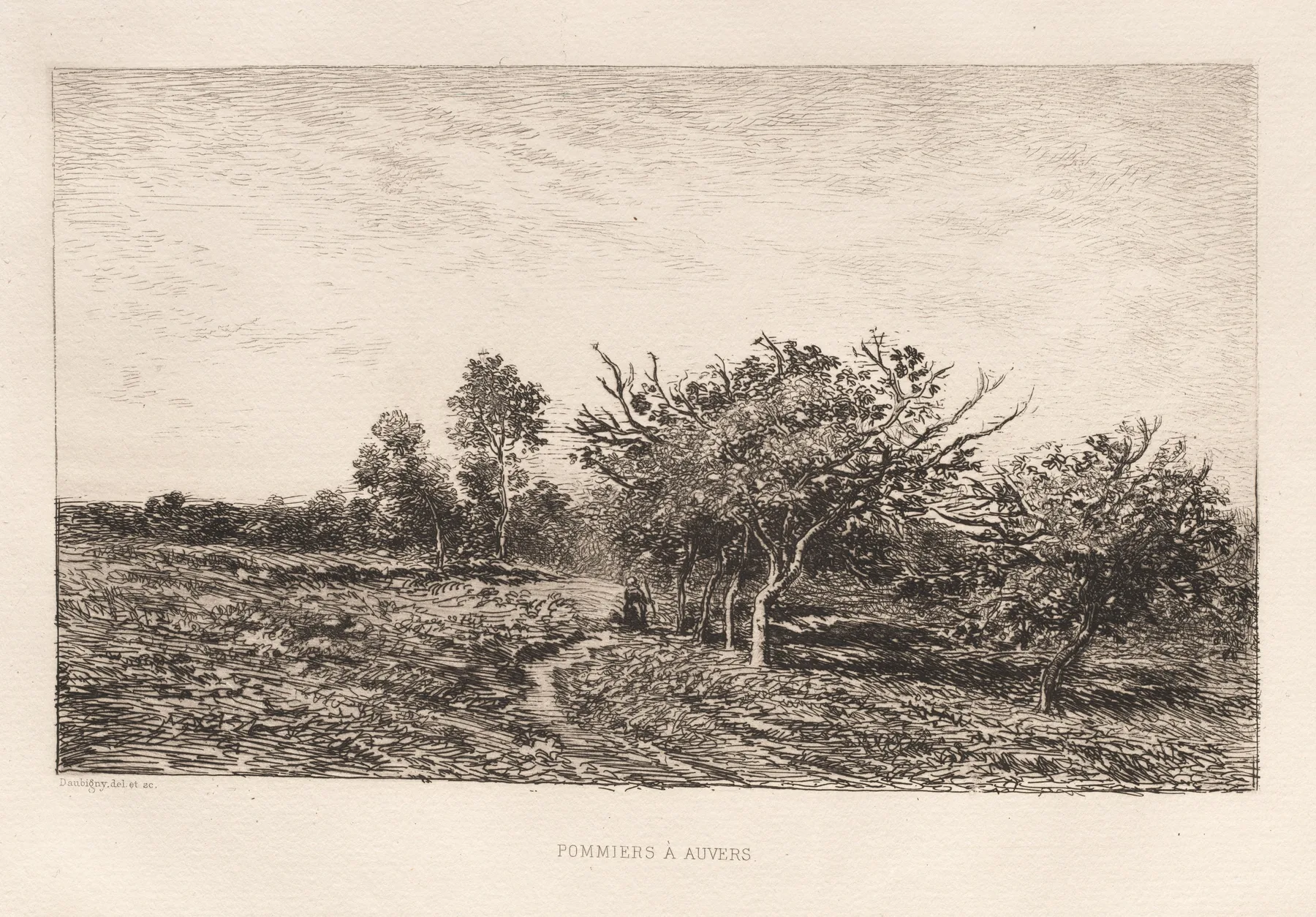
Daubigny, Apple Trees at Auvers (Pommiers à Auvers), 1877. etching.
Pins mark where to look before you draw.
The Cleveland Museum of Art · Gift of John Bonebrake
Apple Trees at Auvers
Trees as a screen, horizon low, sky two-thirds of the sheet
An 1877 etching, one of Daubigny's last: a clump of apple trees on a field, horizon low, sky enormous and empty. The format Corot used for the Souvenirs, in its plainest form. Copy three Daubignys and you own that format.
In pencilAn etched line is a drawn line. Copy it with hard grades and long points: tone from the spacing and direction of lines, cross-hatching only in the darkest third, no smudging anywhere.
- Difficulty
- Time
- about 1.5 h
- You draw with
- H, HB, 2B graphite
Why this one
- The low horizon and the big sky, as a habit.
- A tree clump as one mass with a broken edge.
- A sheet that is mostly paper and still a finished picture.
From your kit
The whole kit →- 1Grafwood H, HB, 2B H, HB for layout and line; 2B for the darks. Long points from the Blackwing on everything up to B.
- 2Kneaded eraser and the Mono Zero press-and-lift corrections only; the Mono Zero for a single sharp light.
- 3Alpha sketchbook 9 x 6 draw at the book's size and keep the proportions; date the page.
In general, this study asks for
- Drawing pad or smooth cartridge
- 2H and H with long points
- HB for accents
- Kneaded eraser
- Sandpaper block
Watch first
All videos →Trees as masses in graphite, with the edge texture where it belongs.
YouTube
The plan
3 stages · ~70 min- 1
Horizon at a third
10 minMeasure and draw the horizon a third up. Envelope the clump as one shape above it.
FigureLow horizon, big sky. Checklist0 / 2 - 2
The clump as mass
30 minHB: hatch the clump as one mass, darkest at its base and centre, opening toward the top edge where the sky breaks in. Trunks as three short darks under it.
FigureMass first. Checklist0 / 3 - 3
Ground and compare
30 minHorizontal strokes across the field, closer near the bottom. Leave the sky. Note, date, box.
Checklist0 / 3
What it should look like
- A clump of trees on a line, under a great deal of nothing.
- Mass with a broken edge, not leaves.
Where it goes wrong
- Filling the sky. Two-thirds of nothing feels wrong. Daubigny left it. The emptiness is the picture.
Log this session
Start the clock when you pick up the pencil. Stop it when you put it down. Log it. Every session counts toward the box.
Status
How did it go?
Related studies
 Master study
Corot · The etchings
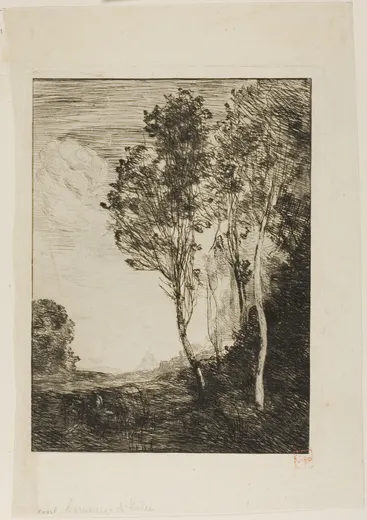
Souvenir of Italy (etching)
A tall plate: trees, a road, a town in the gap
3h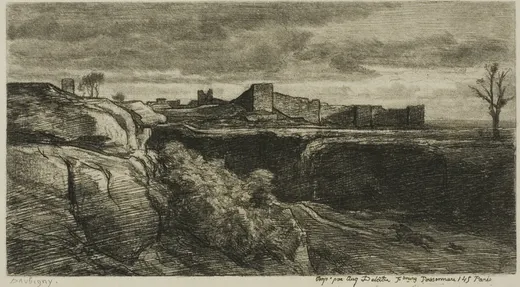 Master study
Daubigny
Ruins of the Château of Crémieux
A dark landscape with a ruin on the ridge and the sky as the only light
2h Master study
Seymour Haden
Sawley Abbey
A ruin the size of a thumb in a sheet of sky and field
1.5h