The Convoy of Prisoners through a Woods
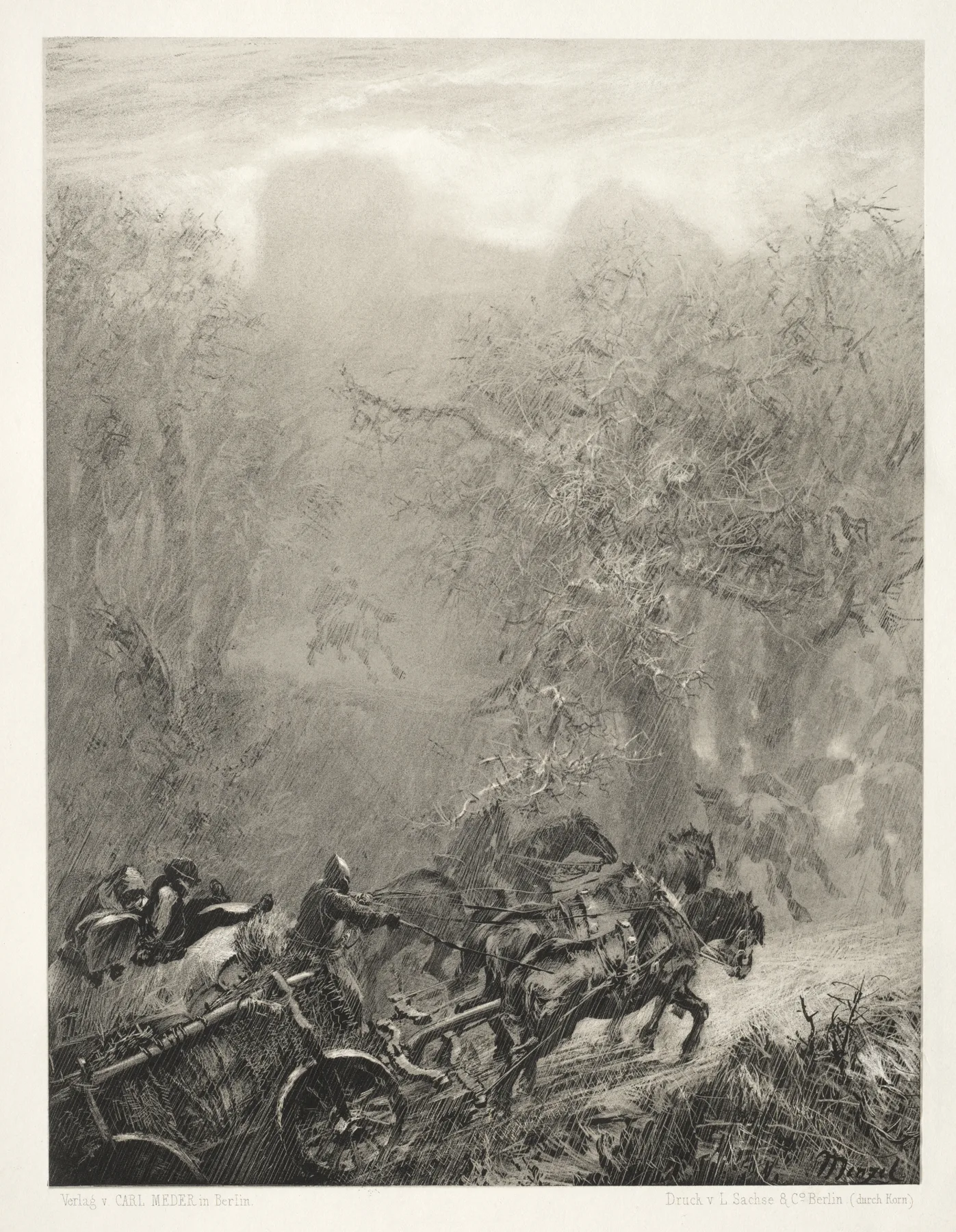
Menzel, Essay on Stone with Brush and Scraper: The Convoy of Prisoners through a Woods, 1851. lithograph.
The Cleveland Museum of Art · Mr. and Mrs. Lewis B. Williams Collection
The Convoy of Prisoners through a Woods
Menzel, 1851: a plate copy from crayon on stone
Essay on Stone with Brush and Scraper: The Convoy of Prisoners through a Woods, 1851: lithograph (The Cleveland Museum of Art). A plate copy: the standard protocol for crayon on stone applied to this one sheet at the size of your book, with Menzel's own habits as the checklist. Find the darkest passage and notice it is burnished, not hatched.
In pencilA lithograph is crayon on a grained stone: the grain breaks the stroke into dots, so the tone is soft and granular. Soft graphite on a medium-tooth paper does the same. Work with the side of the lead, layer rather than press, and keep the lights as paper.
- Master
- Adolph Menzel
- Difficulty
- Time
- about 2 h
- You draw with
- 2B, 4B, 6B graphite, charcoal pencil
Why this one
- Draw what is in front of you, not what you know is there.
- Pressure as a tool: lean on the soft grades until the paper shines, then put a hard grade over it for the edge.
- Everything is worth drawing. A railing is as serious as a cathedral.
From your kit
The whole kit →- 1Grafwood 2B, 4B, 6B 2B, 4B, 6B for the darks. Long points from the Blackwing on everything up to B.
- 2Willow charcoal, or until it arrives Pitt Matt 12B and 14B on their sides the matt grades are the closest graphite gets to willow. Slip sheet under the hand.
- 3Pitt Matt 14B, knife-sharpened stands in for the charcoal pencil: trunk, branch zig-zag, the one accent.
- 4Kneaded eraser (warm it) and the clean Mono Zero lift the lights out of the mass; the Mono Zero for sky holes and lit edges.
- 5Alpha sketchbook 9 x 6 draw at the book's size and keep the proportions; date the page.
In general, this study asks for
- Drawing pad, medium tooth
- 2B, 4B, 6B with long points
- Kneaded eraser
- Precision eraser
- Slip sheet
Watch first
All videos →A single late Corot looked at slowly; watch for the three divisions of light and the lost edges.
YouTube
The plan
5 stages · ~100 min- 1
Read the plate first
5 minBefore any mark, look at The Convoy of Prisoners through a Woods for five minutes with the pencil down. Find the eye level or the horizon. Find the lightest light and the darkest dark and notice whether they touch. Count the big shapes: it is rarely more than four. Say what the picture is about in one sentence.
Checklist0 / 3 - 2
Envelope and masses
15 minMeasure the sheet's proportion and draw the envelope lightly at the size you will work. Place the horizon as a fraction of the height. Block the three or four big shapes as pale outlines, checking each against the others with the pencil held at arm's length. No detail yet; if a line is inside a shape, it is too early.
TipBeginners rush this stage. Masters spend half the drawing here.
Checklist0 / 3 - 3
Masses on the side of the lead
35 minWith the 4B on its side, lay every mass as a flat tone at its approximate value, lightest first. Let the paper's tooth break the stroke the way the stone breaks the crayon. No edges yet, no lines.
Checklist0 / 3 - 4
Darks, edges, the crayon's accents
35 min6B for the darkest passages, layered not pressed. Sharpen the few edges the print sharpens (a trunk against sky, a roof line) and lose the ones it loses. Charcoal pencil or 6B point for the few drawn accents.
Checklist0 / 3 - 5
Compare and note
10 minSide by side with the original: where did you add what was not there? Where did you darken what was light? Write one sentence on the sheet about what to change next time. Date it. Box it.
Checklist0 / 2
What it should look like
- Soft, granular tone with no visible hatching.
- Masses that read from across the room.
- A few crisp accents in a sea of softness.
Where it goes wrong
- Shiny, pressed darks. Pressure instead of layers. Three light layers of 4B then 6B, each at a different angle.
- Outlines around the masses. Habit from line drawing. Lay the mass; let its edge be the edge.
Log this session
Start the clock when you pick up the pencil. Stop it when you put it down. Log it. Every session counts toward the box.
Status
How did it go?
Related studies
 Master study
Menzel
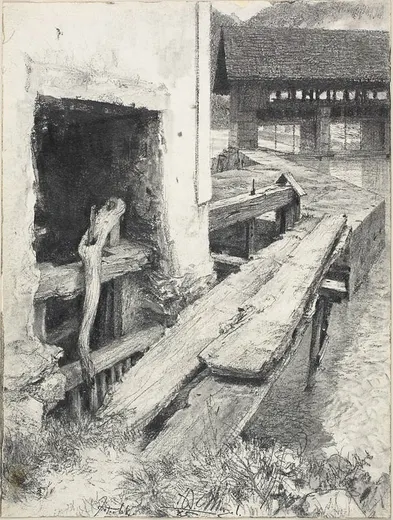
Sluice
Timber in perspective, drawn with pressure as a tool
3h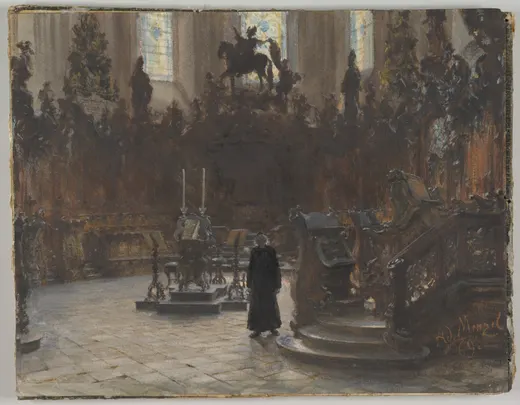 Master study
Menzel
The choirstalls in Mainz Cathedral
A dark interior with one window of light, translated to graphite
2.5h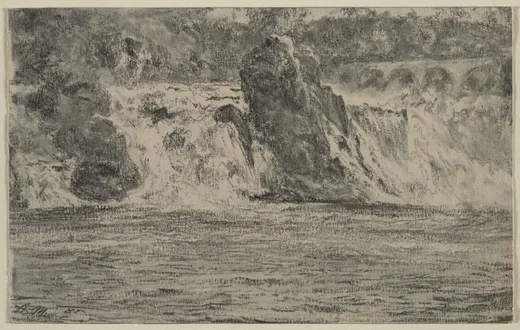 Master study
Menzel
Falls of the Rhine at Schaffhausen
Falling water as lifted light, with stumping as the second tool
2h