The Palace, Stirling Castle
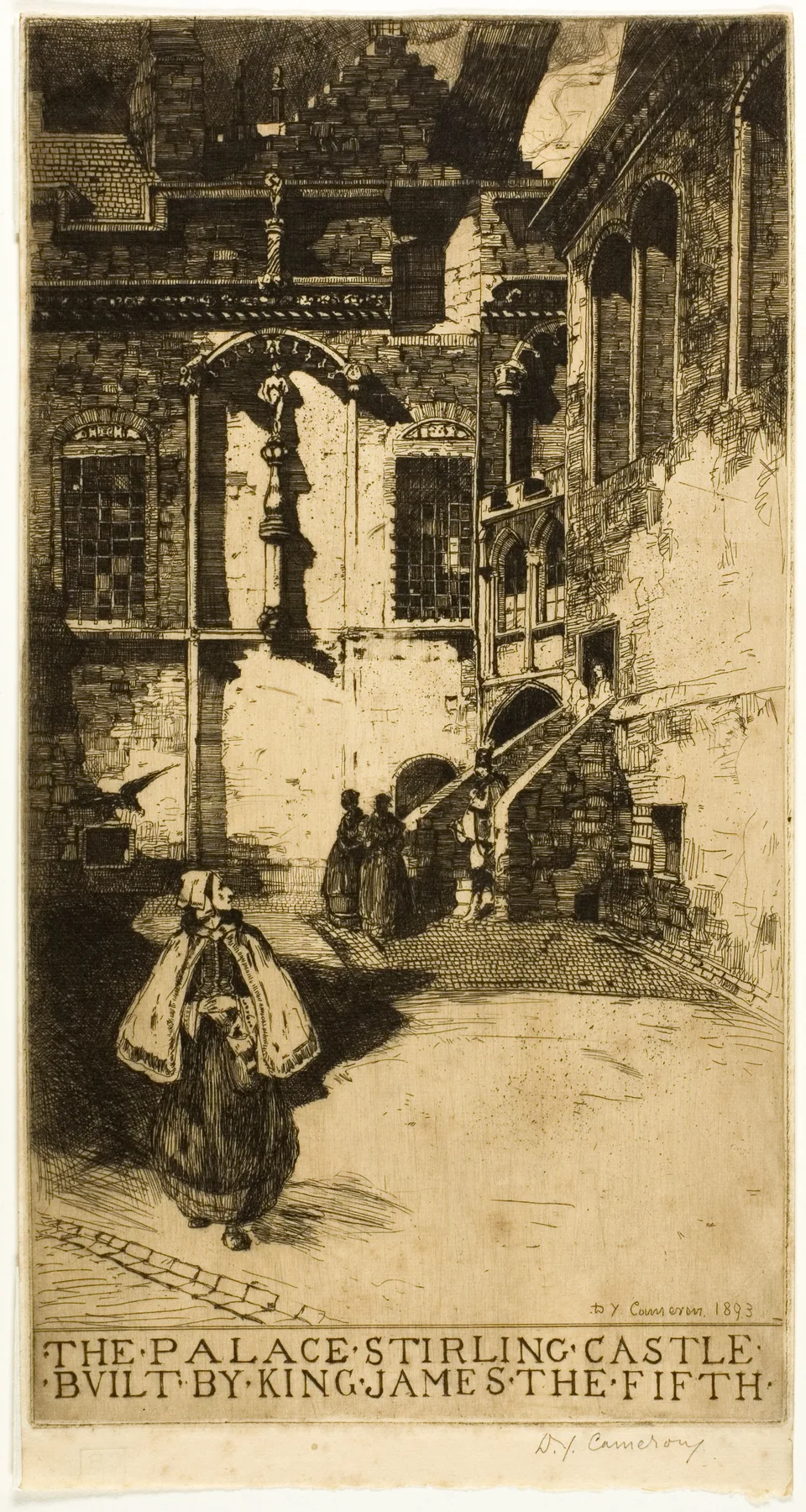
D. Y. Cameron, The Palace, Stirling Castle, 1893. Etching on cream laid paper.
Pins mark where to look before you draw.
The Art Institute of Chicago · Clarence Buckingham Collection
The Palace, Stirling Castle
Sculpture in a courtyard, with one figure to measure it by
The 1893 plate of James V's Renaissance palace inside Stirling Castle: the statued facade in raking light, a dark arch, and a single cloaked figure at the left that gives the whole courtyard its size. Cameron lettered the title on the plate; ignore it and draw the stone.
In pencilAn etched line is a drawn line. Copy it with hard grades and long points: tone from the spacing and direction of lines, cross-hatching only in the darkest third, no smudging anywhere.
- Master
- Sir David Young Cameron
- Difficulty
- Time
- about 2.5 h
- You draw with
- H, HB, 2B, 4B graphite
Why this one
- Sculpture on a building, drawn as masses of light and shadow rather than as figures.
- One figure doing all the work of scale.
- A dark arch used as the anchor of a composition.
From your kit
The whole kit →- 1Grafwood H, HB, 2B, 4B H, HB for layout and line; 2B, 4B for the darks. Long points from the Blackwing on everything up to B.
- 2Kneaded eraser and the Mono Zero press-and-lift corrections only; the Mono Zero for a single sharp light.
- 3Alpha sketchbook 9 x 6 draw at the book's size and keep the proportions; date the page.
In general, this study asks for
- Drawing pad or smooth cartridge
- 2H and H with long points
- HB for accents
- Kneaded eraser
- Sandpaper block
Watch first
All videos →Squinting, value scales and why beginners under-read darks.
YouTube
The plan
4 stages · ~105 min- 1
Light direction and masses
15 minFind where the light comes from (it rakes from one side). Thumbnail in three values: lit facade, shadow facade, black arch.
FigureOne light, one direction. Checklist0 / 2 - 2
The facade as architecture
35 minH: bays, string courses, the niches as rectangles, the arch. The statues are vertical rectangles in their niches, not people yet.
FigureBays by diagonals. Checklist0 / 3 - 3
Statues as light and shadow
45 minHB and 2B: each statue is a lit side and a shadow side; the shadow side joins the niche's shadow. No faces, no hands. 4B: the arch to black. The figure last, with the lightest touch.
Checklist0 / 3 - 4
Compare
10 minCover the figure with your thumb on both sheets: does the facade shrink? Note what the figure is doing. Date, box.
Checklist0 / 2
What it should look like
- A facade with sculpture that reads as light and shadow, not as little people.
- One black arch, one figure, balanced.
- Raking light you can name the direction of.
Where it goes wrong
- Statues drawn as figures. They look like people. They are stone in light. Two values each, no features.
Log this session
Start the clock when you pick up the pencil. Stop it when you put it down. Log it. Every session counts toward the box.
Status
How did it go?